

Note and recap of parts 1 to 4
Fictitious case. The organisation, nonconformities, safeguards, measurements and decisions are invented. The case file has not been reviewed by the BSI (Bundesamt für Sicherheit in der Informationstechnik, the German Federal Office for Information Security), is not certified and cannot be transferred to real municipalities or service providers. What is real are the identifiers and texts of the requirements from the Grundschutz++ user catalogue (Anwenderkatalog), build 2026-10-29; methodology according to BSI Standard 300-1, version 1.0.
The story so far: For the portal process GP-A, the IT Special-Purpose Association Sample Region (IZM) surveyed context, protection requirements and roles (part 1), compiled a package of 930 entries (part 2), surveyed the status, treated four risks and planned 60 safeguards (part 3). The internal audit in part 4 produced eight findings, among them a group account that was believed not to exist (FS-01), an incomplete backup with a recovery time of 31 hours (FS-02), a patch report missing five systems (FS-03) and two target object categories (Zielobjektkategorien) wrongly left empty (FS-05). In MB-01, executive management commissioned the corrective and improvement plan (EV-08) and decided to apply the practice (Praktik) DEV to the form logic (EV-09).
Nonconformities and their causes
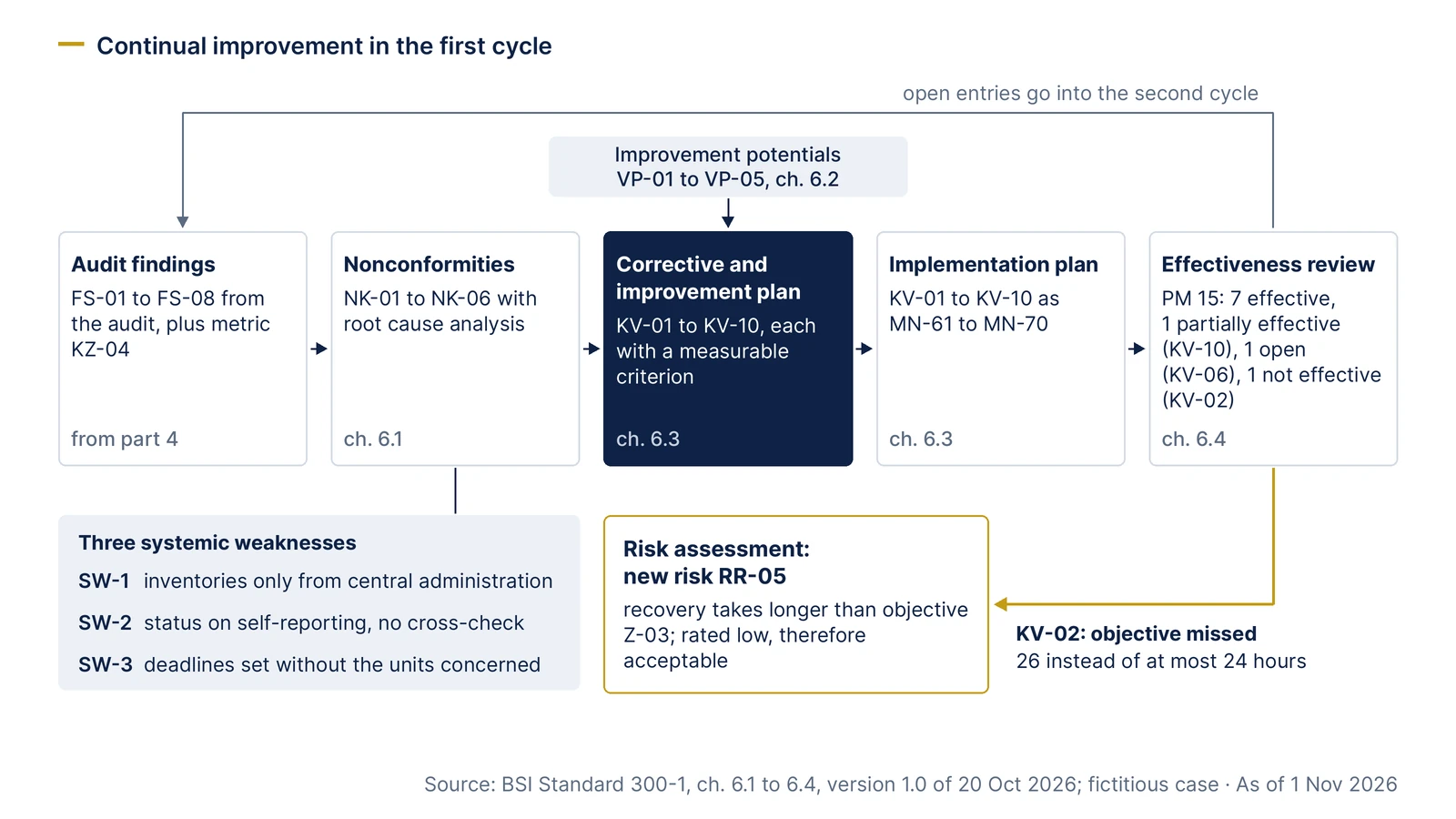
Under chapter 6.1, a deviation exists where requirements are not fulfilled to the intended extent. The standard requires deviations to be recorded and examined systematically: immediate and underlying causes, likelihood and consequences of recurrence, similar cases in other areas and indications of systemic weaknesses. In the catalogue, VRB.2.1 requires a method for this; its guidance explicitly names root cause analysis that goes beyond the immediate cause. From the audit findings and the missed metric KZ-04, the IZM formed six nonconformities.
| NK | immediate cause | underlying cause | recurrence | similar cases (cross-check) | systemic |
|---|---|---|---|---|---|
| NK-01 group account (FS-01) | local account created by the manufacturer at commissioning and kept in use | status for BER was based only on the export from the directory service; local accounts are not listed in the inventory of authorisations (BER.1.4) | likely for every device with its own account management | comparison of all 46 systems: two further local accounts on the firewall cluster | yes, SW-1 |
| NK-02 backup incomplete (FS-02) | a directory excluded after the backup job was changed over | change to the backup job without a change procedure and without comparison against the list of data to be backed up (NOT.4.1); test samples not selected by risk | possible with every change to the job | backup of the form builder checked: complete | yes, SW-2 |
| NK-03 patch report incomplete (FS-03) | five virtual machines without an agent | tool report accepted as evidence without reconciling the population against the CMDB | likely with every new VM | antivirus report: three systems were missing there as well | yes, SW-2 |
| NK-04 categories wrongly empty (FS-05) | information from IT operations adopted without checking | completeness check in part 2 only through interviews, without observation at the workplace | possible with every extension of the information domain | service desk AS-21 also uses browser and office software; the categories are already in the package with AS-25, and the status of the 14 requirements is surveyed for AS-21 as well | yes, SW-2 |
| NK-05 deadline for the information security officer (ISB) exceeded (FS-07) | recruitment procedure took longer than planned | deadline set without consulting the HR department; ch. 4.4 requires realistic deadlines and coordination with the units concerned | likely for safeguards that need staff | KZ-02 shows 72% deadline compliance overall | yes, SW-3 |
| NK-06 objective Z-03 missed (KZ-04, EV-12) | recovery in 31 hours | recovery never measured against Z-03; restart time not planned | certain as long as the technology does not change | - | no, technical |
Three systemic weaknesses. SW-1: inventories contain only centrally managed objects. SW-2: the statuses "fulfilled" and "not applicable" were adopted on the basis of the teams' self-reporting, without a cross-check by another role. This touches on PERS.2.3.3, which requires a separation of roles between implementing security requirements and reviewing them. SW-3: deadlines are set without the units that have to meet them. Under chapter 6.1 it must be examined whether such weaknesses require fundamental adjustments to the ISMS. For SW-2 the IZM answered yes and changed the procedure for the status survey (KV-05).
Improvement potentials and their assessment
Besides the deviations, the IZM evaluated the sources that chapter 6.2 names for improvement potentials: threat situation, effectiveness of the implementation plan, audit results, process optimisations, security incidents and suggestions from employees. The assessment followed the five criteria of the standard, on three levels.
| VP | Source | Proposal (fictitious) | Risk reduction | Effort | Strategic importance | Synergies | Sustainability |
|---|---|---|---|---|---|---|---|
| VP-01 | security event SV-01 | complete MFA for all 24 editorial accounts (BER.5.9) | high | low | high | RR-02 | high |
| VP-02 | effectiveness of the implementation plan, FS-06 | requirement identifier as a mandatory field in the ticketing system | low | low | medium | evidence, audit | high |
| VP-03 | audit result FS-08 | vulnerability findings on portal assets with a reference to the affected risk in the register | medium | low | medium | RR-01 | medium |
| VP-04 | process optimisation, KZ-05 | more automated evidence, each reconciled against the population from the CMDB | medium | medium | high | SW-2 | high |
| VP-05 | suggestion from the service desk | enquiries about fake emails in the portal's name: bring forward a strict sender policy for sending notifications (KONF.13.5.1, so far scheduled in the plan for PM 16) | medium | low | medium | AS-15 | high |
Corrective and improvement plan
Chapter 6.3 requires the proposals to be embedded in a corrective and improvement plan, prioritised by available resources, quick wins and greatest improvement potential, and the plan to be included in the implementation plan. In the catalogue, VRB.4.1 (corrective actions), VRB.4.2 (improvement actions) and VRB.5.1 (priorities) cover this. Every entry has a measurable effectiveness criterion, because chapter 6.4 provides for clear, measurable criteria for the evaluation. Entries KV-01 to KV-10 are in the implementation plan as MN-61 to MN-70.
| Entry | for | Safeguard (fictitious) | Priority | responsible | Deadline | Effectiveness criterion |
|---|---|---|---|---|---|---|
| KV-01 | NK-01 | dissolve all locally shared accounts; one emergency account per system as a documented exception with justification, protection and attribution of every use to a person, as described in the guidance on BER.3.16; add local accounts to the inventory under BER.1.4 | quick win | R-04 | PM 13 | comparison of all systems: no shared account in regular operation |
| KV-02 | NK-02, NK-06 | correct the backup job, reconcile the list of data to be backed up automatically with the job, recovery test with risk-based samples including the evidence directory | greatest potential | R-03 / R-04 | PM 14 | 100% of samples complete; acceptance of applications within one working day, defined under Z-03 as no more than 24 hours |
| KV-03 | NK-03 | agents on the five VMs; every tool report shows its coverage against the CMDB | quick win | R-04 | PM 13 | coverage 46 of 46 in three consecutive reports |
| KV-04 | NK-04 | add asset AS-25 "browser and office software on the admin notebooks" with the categories Web browsers and Office applications, survey the status of the 14 requirements; future completeness checks with observation at the workplace | quick win | ISB | PM 13 | 14 entries with status; no empty category without evidence at the next validation |
| KV-05 | SW-2 | cross-check by the ISB staff unit of every status "not applicable" and every status "fulfilled" that rests only on self-reporting (PERS.2.3.3) | greatest potential | ISB | PM 15 | all 39 former "not applicable" entries and all self-reports given a second review |
| KV-06 | NK-05, SW-3 | deadlines only after agreement with the unit responsible; plan safeguards that need staff together with the HR department | resources | controlling department | PM 13 | KZ-02 at least 90% in the next quarter |
| KV-07 | VP-01 | MFA for the remaining six editorial accounts | quick win | R-08 | PM 13 | 24 of 24 accounts with MFA |
| KV-08 | VP-02 | mandatory field for the requirement identifier in the ticketing system | quick win | R-04 | PM 13 | no safeguard without reference to a requirement |
| KV-09 | VP-03 | findings from vulnerability scans with a risk reference in the register | quick win | ISB | PM 14 | every high-criticality finding on portal assets with a reference to a risk |
| KV-10 | EV-09 | survey the status of the practice DEV for the form logic in AS-02 (PM 14) and establish the procedure for developing form logic (DEV.1.1 to DEV.1.2) | resources, after the ISB post is filled | R-08 / ISB | PM 14 and PM 17 | all DEV entries with status (PM 14); DEV.1.1 to DEV.1.2 fulfilled (PM 17) |
VP-04 and VP-05 did not get an entry of their own: VP-04 is absorbed into KV-03 and KV-05, and VP-05 was implemented as a change to the deadline of the existing safeguard for KONF.13.5.1.
Effectiveness review: what worked and what did not
Under chapter 6.4, the implemented safeguards are checked for effectiveness, with targeted tests and reviews once implementation is complete, and the results are documented. In the catalogue, VRB.6.1 requires effectiveness to be tested regularly. The review was carried out by the ISB staff unit, which has been staffed since PM 13. The entries it implemented itself or shares responsibility for (KV-04, KV-05, KV-09, KV-10) were re-checked on a sample basis by the internal audit department of municipality K03, so that nobody assesses their own work alone. The review in PM 15 showed:
| Entry | Test (fictitious) | Result | Assessment |
|---|---|---|---|
| KV-01 | comparison of the local account lists of all 46 systems | no shared account in regular operation; three emergency accounts documented as exceptions | effective |
| KV-02 | recovery test with six samples | all samples complete; applications accepted after 26 hours | not effective: completeness achieved, time objective missed |
| KV-03 | three consecutive patch reports | 46 of 46 systems | effective |
| KV-04 | status survey of the 14 requirements | 8 fulfilled, 3 SOLLTE (SHOULD) not fulfilled (KONF.12.4, KONF.12.5, KONF.12.1.11), 3 KANN (MAY) not fulfilled, each surveyed for AS-25 and AS-21; STM.2.1.2 and STM.2.1.3 therefore fulfilled again | effective |
| KV-05 | cross-check of the former "not applicable" entries and the self-reports | complete; found in the process: GC.9.1.1.1.1 (sufficient resources for the ISB) had been recorded as fulfilled since part 3, although the ISB worked only part-time; corrected and fulfilled with the appointment in PM 13 | effective |
| KV-06 | KZ-02 in the following quarter | not yet measurable | open |
| KV-07, KV-08, KV-09 | configuration and ticket exports, register | 24 of 24 accounts with MFA; no safeguard without a reference; all findings with a risk reference | effective |
| KV-10 | status survey of the 34 DEV entries for AS-02 | status of all 34 entries surveyed in PM 14: 7 fulfilled, 25 not fulfilled, 2 not applicable; procedure in draft, deadline PM 17 | partially effective, procedure open |
KV-02 shows why evaluation is a step of its own. The safeguard has been implemented and the gap in the backup closed, and yet the objective was missed. The new cause: restoring runs over a connection from the backup storage with too little bandwidth. Under chapter 6, findings like this trigger a cycle of the risk assessment.
What goes back into the risk assessment
Chapter 6 provides for vulnerabilities and changed threat situations identified during improvement to be taken into account in the risk assessment. In the case this affects three entries of the register from part 3 and one new risk.
| Risk | Reason for reassessment | Result (fictitious) |
|---|---|---|
| RR-01 | two vulnerability findings on the citizen portal (FS-08, KV-09) | both remedied; rating stays medium |
| RR-02 | event SV-01, MFA complete (KV-07) | rating stays medium; limited acceptance period extended until the next review and approved again |
| RR-03 | move postponed again (EV-11) | stays medium; the limited acceptance period ends in PM 20, a decision is needed then |
| RR-05 (new) | KV-02: recovery takes longer than objective Z-03 | occasional, limited: low, and therefore acceptable under the IZM's criteria |
Open decision OF-07: RR-05 is acceptable under the acceptance criteria, but objective Z-03 from the policy has been missed. The two do not fit together. Executive management must either invest in faster restoration or change Z-03. The question depends on OF-01, the classification of the availability of GP-A, and is therefore on the agenda of management review MB-02 at the start of the second cycle. The IZM reviews the risk assessment as a whole at least annually and when significant changes occur, as provided (Annex 3, criterion 35).
Result of part 5: final balance of the first cycle
The balance updates the status list from part 3: with the corrections from the audit, the practice DEV surveyed in PM 14 (KV-10), the 14 requirements reported later and the safeguards completed by PM 15. The package now comprises 944 entries: 942 from the catalogue and two of the IZM's own.
| Modal verb | Entries | fulfilled | not fulfilled | not applicable | Part 3 for comparison (fulfilled / not fulfilled / not applicable) |
|---|---|---|---|---|---|
| MUSS (MUST) | 149 | 141 | 8 | 0 | 117 / 27 / 5 |
| SOLLTE | 589 | 544 | 42 (40 temporary, 2 permanent) | 3 | 480 / 65 / 33 |
| KANN | 206 | 42 | 163 | 1 | 38 / 164 / 1 |
| Total | 944 | 727 | 213 | 4 | 635 / 256 / 39 |
What lies behind the figures. The open MUSS requirements are the five procedural requirements of the practice DEV for the form logic (KV-10), PERF.5.1, because the procedure for new threats is still missing, NOT.1.1 and GC.1.1 (see below). Of the 39 "not applicable" entries from part 3, four remain: KONF.3.3, NOT.4.5 and, for the form logic, DEV.3.4 (no password processing) and DEV.4.7 (no binary code, the scripts are interpreted). According to its guidance, DEV.4.6 applies analogously to the interpreter options for interpreted languages and is therefore applicable, in the case not fulfilled. The other 35 no longer apply, 3 as a result of the audit and 32 as a result of decision EV-09. Of the KANN requirements, the four chosen in risk treatment have been implemented (BER.4.1.2, DET.6.2.1, TEST.3.1.11, TEST.4.1.1); NOT.4.12 remains not fulfilled because the copy at K05 is not geo-redundant within the meaning of the guidance. The 40 temporarily unfulfilled SOLLTE requirements still include NOT.4.16.1 and NOT.4.1: the IZM will only count them as fulfilled after a second complete half-yearly test with the corrected backup job; the missed time objective from KV-02 is recorded separately as RR-05. Added to these are GC.3.1.3 (agreement with K11 missing), EIG-02 and 20 requirements of the practice DEV. The two permanent ones are, unchanged, GEB.1.4 and TEST.3.1.5.
Is the first cycle complete? The guidance on GC.1.1 states that the requirement „ist erst dann als erfüllt anzusehen, wenn die komplette Vorgehensweise mindestens einmal vollständig durchlaufen wurde“ (our translation: "is only to be regarded as fulfilled once the complete approach has been run through in full at least once"). The IZM has run through all five process steps for GP-A. The guidance also requires the requirements for the ISMS to be „standardkonform umgesetzt“ (our translation: "implemented in conformity with the standard"). As long as seven further MUSS requirements are open, this is not demonstrated. The IZM therefore follows the cautious reading, continues to record GC.1.1 as not fulfilled and will review the status as soon as KV-10, PERF.5.1 and NOT.1.1 are done. Whether "in full" also refers to the entire scope, that is GP-B to GP-D as well, is left open by the guidance. The IZM has noted this as interpretation question OF-08.
What goes into the second cycle
Chapter 6.3 includes the corrective and improvement plan in the implementation plan, and chapter 5.5 re-examines the package at every validation. For the IZM this means the second cycle starts with the open entries from the first.
| Topic | Origin | Next step (fictitious) |
|---|---|---|
| GP-B Pay fees online | EV-03 | model the payment service provider as a cloud service; according to the build of 29 Oct 2026, the categories Outsourcing and Cloud services add 38 requirements |
| K13 joining | validation part 4 | include the connection and interface in the boundary of the information domain |
| OF-01 and OF-07 availability and objective Z-03 | part 1, part 5 | decision in MB-02 |
| OF-05 server room | part 3, EV-11 | decision before the limited acceptance period of RR-03 ends in PM 20 |
| OF-03 login service | part 2 | check specifically in the second audit |
| OF-06 practice DEV for procured software | part 4, EV-09 | the IZM applies DEV only to its own form logic; whether the DEV requirements with the Applications category are not applicable to procured software or have to be evidenced through the manufacturer's obligations is open |
| OF-08 reach of GC.1.1 | part 5 | monitor the interpretation, adjust the status if necessary |
| L-01 agreement K11 | part 1 | escalation to the association assembly |
| BSI performance metrics | part 4 | compare with KZ-01 to KZ-06 once published |
Whether the IZM will seek ISO 27001 certification on the basis of Grundschutz++ has not been decided. This case file is not evidence of certification. What an audit in the certification procedure requires is described on the page Certification.
The full case file and the methodology behind it
The five parts can be read individually. Anyone who wants to read the file in one go starts with part 1; every identifier can be traced back to where it first appears.
- Survey and planning
- Requirements analysis
- Implementation
- Monitoring
- Improvement (this page)
Methodology: BSI Standard 300-1, Assessing requirements and documenting deviations, Risk analysis, Security concept.
Blackfort Technology supports updating the implementation plan, validating the requirements and preparing the next management review, see Consulting.
Rights notice: References from BSI Standard 300-1 "Methodik Grundschutz++" (Grundschutz++ methodology), version 1.0 of 20 October 2026, © Bundesamt für Sicherheit in der Informationstechnik 2026, source: BSI page on Grundschutz++. They are not licensed under CC BY-SA 4.0; the licence notice at the end of the page applies only to the extracts from the catalogue data.