

Where the requirements come from
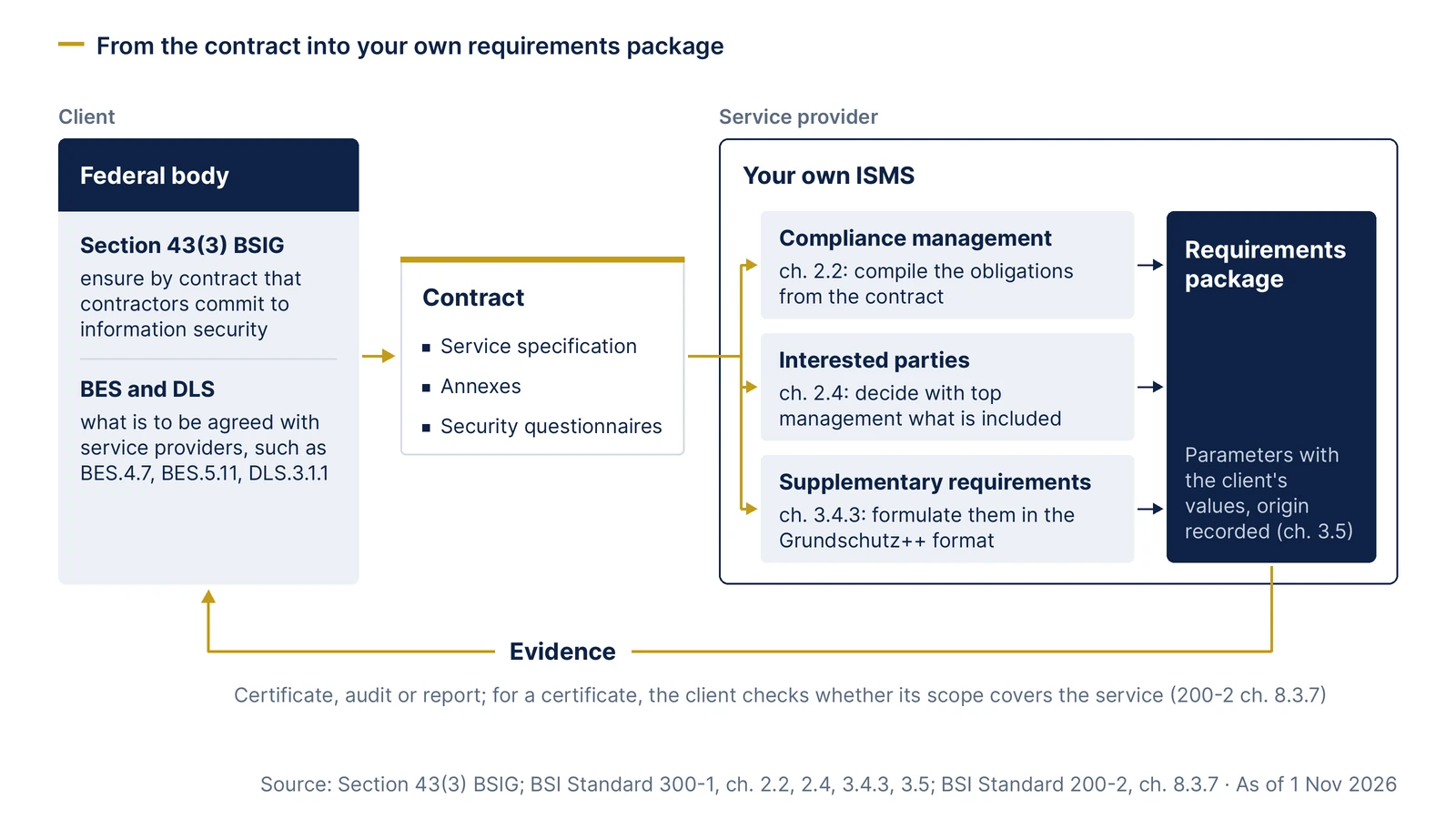
Section 43(3) BSIG provides: where organisations under public or private law are commissioned to provide services for federal information technology, „ist vertraglich sicherzustellen, dass sie sich zur Einhaltung der Voraussetzungen zur Gewährleistung der Informationssicherheit verpflichten“ (our translation: "it shall be ensured by contract that they commit to complying with the conditions for guaranteeing information security"). This also applies where interfaces to federal communications technology are set up. The duties of the top management of the commissioning body remain unaffected. The provision is addressed to the body of the federal administration; for the service provider, it takes effect through the contract.
What the contract actually says is determined by the commissioning body. Under Section 44(1) BSIG, that body is itself bound by minimum requirements from the BSI standards, the IT-Grundschutz Compendium and the minimum standards. For the minimum standard on the use of external cloud services, the Bundesamt für Sicherheit in der Informationstechnik (BSI), the German Federal Office for Information Security, describes explicitly how the cloud provider's audit evidence is to be used for the body's ISMS. Under Section 44(4), the BSI provides technical guidelines and reference architectures, which bodies take into account in suitability requirements for contractors in procurement procedures.
One special case concerns IT service providers to the federal administration organised under public law: Section 29(1) no. 2 BSIG names them as bodies of the federal administration in their own right. For them, Sections 43 and 44 can then apply directly, in addition to the requirements of their clients; Section 44(3) provides that the BSI supports the provision of solutions by the federal IT service providers. Whether your organisation is one of them is not decided on this page.
How Grundschutz++ takes in client requirements
BSI Standard 300-1 has three points at which obligations towards clients enter the ISMS. Chapter 2.2 names compiling contractual obligations as an aspect of compliance management, and the resulting requirements are to be taken into account in the requirements package. Chapter 2.4 names customers as external interested parties; in agreement with top management, it is decided which binding obligations are included in the ISMS as requirements. Chapter 3.4.3 describes how this is done: develop a requirement of your own, formulate it in the Grundschutz++ format, extend the requirements package with it.
The second lever is parameters. Many requirements contain placeholders such as „regelmäßig“ (our translation: "regularly"), which the institution specifies during or after the creation of the requirements package (chapter 3.5), unless fixed parameters exist (chapter 3.4). If the client prescribes an interval or a procedure, you adopt this value for the information domain in which the service is provided and record its origin. If several clients demand different values, it makes sense to apply the strictest value for shared assets or to separate the information domains. That is our suggestion; the standard does not expressly regulate this case.
The third is the scoping. For evidence to mean something to the client, the service must lie within your own scope and information domain (chapters 2.3 and 3.1). BSI Standard 200-2 sets out the check from the client's point of view in chapter 8.3.7: if a service provider presents a certificate, „muss immer berücksichtigt werden, ob der Geltungsbereich des ausgestellten Zertifikates die Dienstleistung auch tatsächlich umfasst“ (our translation: "it must always be considered whether the scope of the certificate issued actually covers the service").
For the client's view, the Grundschutz++ user catalogue (Anwenderkatalog) is worth a look. The practices (Praktiken) procurement management (BES) and service provider management (DLS) describe what an outsourcing institution should agree with its service providers and review. What it says there reaches you as a requirement. A dedicated module for the provider side, like OPS.3.2 „Anbieten von Outsourcing“ (Provision of Outsourcing) in the IT-Grundschutz Compendium 2023, is something we did not find in build 2026-10-29. In classic IT-Grundschutz, OPS.3.2 requires, among other things, uniform basic requirements for contracts with users (A2), passing contractual provisions on to subcontractors (A3), a client separation concept (A4) and a security concept for the outsourcing service (A5).
The duties of the commissioning body are described on the page Grundschutz in the federal administration. How you build the requirements package is explained on the page Modelling with target object categories.
Requirements adoption matrix
The matrix lists twelve fictitious requirements of the kind that might appear in a service specification or a contract with a federal body. The column "Possible origin at the client" names the requirement of the user catalogue from which such a requirement may be derived; whether it actually is in a given case is known only to you and your client. The other columns show how the requirement lands in your own ISMS. The matrix does not interpret any contract: it classifies what the contract says. What a clause means legally and whether it is effective is for your legal department to examine.
| No. | Client requirement (fictitious) | Possible origin at the client | Classification in your own ISMS | Evidence to the client | Question before signing |
|---|---|---|---|---|---|
| V-01 | For the service, the contractor operates an ISMS in accordance with IT-Grundschutz. | BES.4.7 „ISMS beim Dienstleister“ (ISMS at the service provider) (SOLLTE, i.e. SHOULD) | Include the service in scope and information domain (300-1 ch. 2.3, 3.1); record the requirement as an obligation under ch. 2.4 | Description of scope and information domain; security concept for the service | Is IT-Grundschutz 2023 or Grundschutz++ meant, and from when? |
| V-02 | Compliance is to be demonstrated annually by audit, certificate or comparable security evidence. | DLS.3.1.1 „Audit oder Zertifikat“ (audit or certificate) with the parameters type of evidence and „regelmäßig“ (regularly) | Adopt type of evidence and interval as parameter values (ch. 3.5); keep them in your own evidence plan | Certificate with a matching scope (200-2 ch. 8.3.7) or other agreed evidence | What counts as "comparable"? Is a certificate for a larger information domain that includes the service sufficient? |
| V-03 | The client may review security processes and safeguards. | BES.5.11 „Recht auf Audit“ (right to audit) (SOLLTE) | Establish auditability: contact person, documents, access; align with the internal audit programme (300-1 ch. 5.2) | Conduct of the review; the client's audit report | Lead time, scope, confidentiality of documents, who bears the costs |
| V-04 | The client's data is to be separated from other clients. | BES.4.5.2 „Mandantentrennung“ (client separation) (KANN, i.e. MAY) | Supplementary requirement in the requirements package (ch. 3.4.3); in classic Grundschutz OPS.3.2.A4 | Client separation concept and evidence of implementation | Which separation is sufficient: logical, network, hardware? |
| V-05 | Incidents affecting the client are to be reported without delay. | BES.5.10.2 „Melden von Vorfällen“ (reporting incidents) (SOLLTE) | Include the reporting channel in the procedure for external communication (300-1 ch. 2.9) and link it to your own incident handling | Reporting process; record of test reports | Reporting address, report content, what counts as "affecting" |
| V-06 | Subcontractors only with the client's consent. | BES.5.6.2 „Autorisierung von Unterauftragnehmern“ (authorisation of subcontractors) (KANN) | Your own procurement and service provider management towards subcontractors; pass on contractual obligations (classic OPS.3.2.A3) | List of subcontractors; consents | Does this also apply to data centre or cloud services you rely on? |
| V-07 | Regular report on the effectiveness of the security safeguards. | BES.5.12 „Informationspflichten“ (duties to inform) (SOLLTE) | Derive the report from your own performance evaluation (300-1 ch. 5.1); interval as a parameter | Report in the agreed structure | Which metrics and which interval? |
| V-08 | The client's data is to be backed up according to its specifications and backup copies are to be provided. | NOT.4.13 „Datensouveränität“ (data sovereignty) (SOLLTE); BES.5.13 „Bereitstellung von Datensicherungen“ (provision of backups) (SOLLTE) | Parameterise your own requirements of the practice NOT for the assets concerned with the client's values | Backup logs; results of restore tests | Procedure, interval, storage location and format of provision |
| V-09 | Compliance with the BSI minimum standard on TLS in its current version. | Minimum standard under Section 44(1) BSIG, passed on to the contractor via the contract | Supplementary requirements under ch. 3.4.3, as we suggest, one per requirement of the minimum standard and with version details | Configuration evidence, for example an automated check with documented tool, time and result (300-1 ch. 4.3) | Which version is agreed, and how are new versions adopted? |
| V-10 | The risk analysis for the service is to be disclosed. | BES.4.8.4 „Offenlegung der Risikoanalyse“ (disclosure of the risk analysis) (KANN) | Approval of disclosure by your own top management; define scope and confidentiality | Extract from the risk register for the service | Which part, in what form, under which confidentiality agreement? |
| V-11 | Shared responsibility is to be defined for the cloud service. | BES.1.6, BES.1.7 (SOLLTE) | Responsibility matrix per service; your own shares as assets in the information domain | Signed responsibility matrix | Who operates logging, backup, access rights? |
| V-12 | At the end of the contract, data is to be returned and deleted and access revoked. | BES.5.13.1 (KANN), DLS.4.1, DLS.4.1.2 (SOLLTE); for deletion periods during the term BES.5.14 (SOLLTE) | Exit procedure for the service; revocation of access rights in the leaver process | Exit plan; deletion log | Format of return, deadlines, evidence of deletion |
In the user catalogue, the modal verbs in brackets apply to the outsourcing institution. In the contract, the client may agree a SOLLTE or KANN requirement as a firm obligation; what counts for you is then the agreed wording. How to schedule the evidence and assign it to responsible persons is described on the page Evidence plan; automated check results as evidence are covered on the page automated evidence.
Protection requirements: who decides, who delivers
In Grundschutz++, each institution determines the protection requirements for its own business processes (300-1 chapter 2.6). For the client's business process, that is the client; for your own process of providing the service, it is you. For your classification to fit, you need to know the client's category. Ask for it actively and record it in your own information domain.
In chapter 8.2.3, BSI Standard 200-2 describes the reverse direction: an IT service provider cannot, „im Regelfall“ (our translation: "as a rule"), provide its services for every possible protection requirements category and therefore offers them with a protection suitability it has defined itself. The information owner decides whether this suitability is sufficient or whether additional safeguards are needed. Under Grundschutz++ too, it helps to state for each service which protection requirements category (normal or high) it is designed for. This makes coordination with several clients plannable.
Procedure in five steps
The steps build the matrix for a real contract. They assume that an ISMS exists or is being set up; if not, the work begins with defining the information domain.
- Collect requirements: go through the contract, service specification, annexes and security questionnaires for requirements and enter each one, with its reference, in a row of the matrix.
- Assign: for each requirement, record whether it concerns the scope, an existing requirement, a parameter or a new supplementary requirement (300-1 ch. 2.3, 3.4.3, 3.5).
- Have top management decide: which obligations are included as requirements is decided by the institution in agreement with its top management (ch. 2.4). Anything that cannot be fulfilled belongs in the question before the contract is signed.
- Plan evidence: for each requirement, define the type of evidence, responsible persons and date; for certificates, check the scope against the service (200-2 ch. 8.3.7).
- Maintain: update the matrix and adjust the requirements package when contracts change, new clients come in or new versions of minimum standards are issued.
If a client requires Grundschutz for the first time and you do not yet have an ISMS, the page Client requires IT-Grundschutz will help; operating boundaries and shared responsibility for data centre and cloud services are covered on the page Grundschutz in data centre and cloud operations. Blackfort Technology supports service providers in adopting client requirements into the requirements package and evidence plan; the services are described on the page Consulting. We classify the requirements that you name or that appear in your documents; whether they apply legally is for your legal department to examine.
Rights notice: Quotations from BSI Standard 200-2 © Bundesamt für Sicherheit in der Informationstechnik, source: BSI Standard 200-2. Information from the IT-Grundschutz Compendium, edition 2023 © 2023 Reguvis Fachmedien GmbH, © 2023 Bundesamt für Sicherheit in der Informationstechnik, Bonn (as stated in the imprint of the edition), source: BSI page IT-Grundschutz Compendium. Statutory text from https://www.gesetze-im-internet.de/bsig_2025/. They are not under CC BY-SA 4.0; the licence notice at the end of the page applies only to the extracts from the catalogue data.