

Where the requirement may come from
A Grundschutz requirement in a contract has a reason on the client's side. Three sources are documented in the material we evaluated. Under Section 43(3) BSI Act (BSIG), federal bodies must ensure by contract that the bodies they commission commit to complying with the conditions for information security. Organisations with an ISMS under Grundschutz++ have requirements for their service providers in the user catalogue (Anwenderkatalog), for example BES.4.7 „ISMS beim Dienstleister“ (our translation: "ISMS at the service provider"), BES.5.11 „Recht auf Audit“ (our translation: "right to audit"), BES.4.8.3 „IT-Grundschutz-Analyse der Infrastruktur“ (our translation: "IT-Grundschutz analysis of the infrastructure") or DLS.3.1.1 „Audit oder Zertifikat“ (our translation: "audit or certificate"). And BSI Standard 200-2 names, in chapter 11, as a motive for a certificate that service providers want to use it to provide trustworthy evidence that they have implemented the safeguards in accordance with IT-Grundschutz.
So ask which requirement in the client's own rules gave rise to the contract clause. DLS.3.1.1, for example, requires verification on the basis of an „Audits, Zertifikates oder vergleichbaren Sicherheitsnachweises“ (our translation: "audit, certificate or comparable security evidence"); which of these forms it accepts is set by the client as a parameter. With the answer, you know which evidence is meant.
This page does not interpret any contract. We classify the requirements you name or that appear in your documents; whether they apply legally and what a clause means is for your legal department to check.
Catalogue of clarifying questions for the conversation with the client
The questions are worded so that you can copy them unchanged into an e-mail or minutes of a meeting. The right-hand column shows what you need the answer for.
| No. | Question to the client | What you need the answer for | Reference |
|---|---|---|---|
| R-01 | Which requirement in your rules does the clause go back to? | Shows which evidence is meant and how strictly it is interpreted | Catalogue BES, DLS; Section 43(3) BSIG |
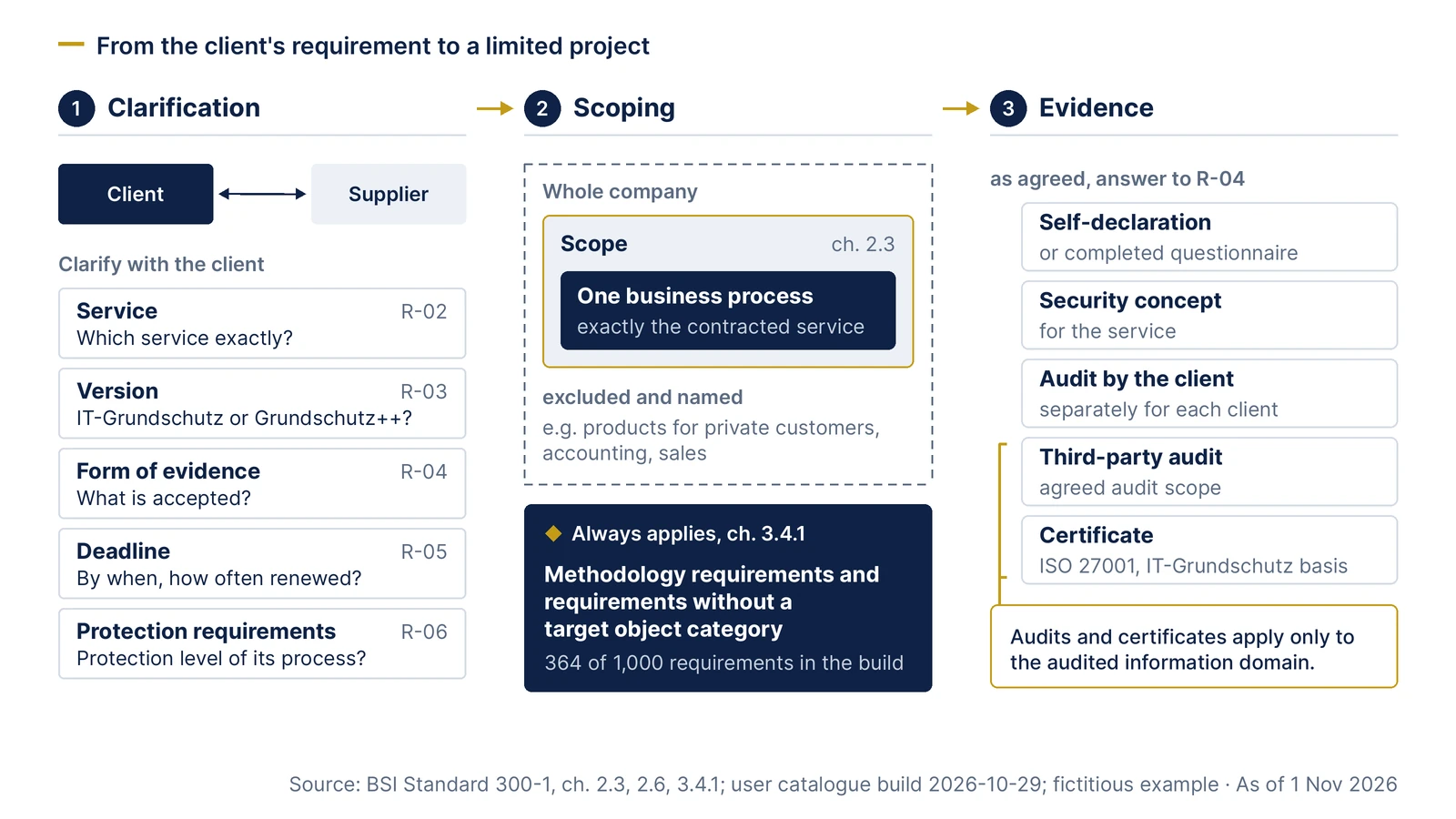
| R-02 | Which service exactly is to be covered: development, operation, support, data processing? | Narrows down the scope | 300-1 ch. 2.3 |
| R-03 | Is IT-Grundschutz under BSI Standard 200-2 with the 2023 Compendium meant, or Grundschutz++ under BSI Standard 300-1? | Determines the methodology and the requirements catalogue | BSI milestone plan |
| R-04 | Which form of evidence do you accept: self-declaration, security concept, your own audit, third-party audit, certificate? | Determines the type and extent of preparation | Catalogue DLS.3.1.1 |
| R-05 | By when must the evidence be available, and how often must it be renewed? | Sets the deadline and the cycle; the cycle becomes the parameter value | 300-1 ch. 3.5; DLS.3.1.1 |
| R-06 | What are the protection requirements of your business process for which we provide the service? | Determines whether requirements for "high" and a risk assessment become necessary | 300-1 ch. 2.6, 2.11 |
| R-07 | Are there additional individual specifications, for example BSI minimum standards, encryption or data location? | Become supplementary requirements in the requirements package | 300-1 ch. 3.4.3 |
| R-08 | Is an existing ISO 27001 certificate sufficient if its scope covers the service? | Can save or reduce a new project | 200-2 ch. 8.3.7 |
| R-09 | Do you want to audit us yourself, and if so, with what lead time and scope? | Planning of contact persons and documents | Catalogue BES.5.11 |
| R-10 | How and when should we report security incidents that affect you? | Anchor the reporting channel in your own communication procedure | Catalogue BES.5.10.2; 300-1 ch. 2.9 |
| R-11 | Does the requirement also apply to our subcontractors? | Determines whether you yourself must obtain evidence from third parties | Catalogue BES.5.6.2 |
| R-12 | Is there a transition period in which an implementation plan is sufficient as an interim status? | Allows a step-by-step build-up | Matter of agreement |
Record the answers in writing. Under BSI Standard 300-1 chapters 2.2 and 2.4, they are inputs for compliance management and the analysis of interested parties; in consultation with top management, it is decided which binding obligations are included in the ISMS as requirements.
Evidence options at a glance
Which option fits depends on the answer to R-04. The table sets out side by side the options that appear in the sources we evaluated. It makes no statement about which option your client has to accept.
| Option | What it shows | Limit | Reference |
|---|---|---|---|
| Self-declaration or completed questionnaire | The supplier's statements on its safeguards | No audit by third parties; whether it counts as "comparable security evidence" is decided by the client | Catalogue DLS.3.1.1 (parameter) |
| Security concept for the service | How the supplier secures the service, based on the client's requirements | Describes target state and implementation, without audit by third parties | Compendium 2023 OPS.3.2.A5 |
| Audit by the client | Result of an audit of the contract-related processes and safeguards | Ties up your own resources for each audit, separately for each client | Catalogue BES.5.11 |
| Third-party audit without certificate | Independent findings for an agreed audit scope | Audit criteria and auditor must be agreed with the client | Catalogue DLS.3.1.1 |
| Technical test results for individual requirements | Result of automated configuration checks or scans; tool, time and test result must be documented | Proves individual technical requirements, not management requirements | 300-1 ch. 4.1, 4.3 |
| ISO 27001 on the basis of IT-Grundschutz | Certificate from the certification body at the BSI for an information domain | Applies only to the certified scope; on the basis of Grundschutz++ it can be applied for from 1 Jan 2027 according to the milestone plan | 200-2 ch. 11; 200-2 ch. 8.3.7 |
| ISO/IEC 27001 without reference to Grundschutz | Certificate for an ISMS under the ISO/IEC 27001 standard | Whether the client accepts it is clarified by R-08 | Company website, see below |
| C5 attestation (Testat) for cloud services | Audit report by an auditor (Wirtschaftsprüfer) against the C5 criteria catalogue | Only for cloud services | Company website, see below |
Blackfort Technology provides information on the last two options on its company website: ISO 27001 consulting and BSI C5 consulting. How a certification procedure on the basis of IT-Grundschutz works is described on the page BSI Grundschutz certification; what technical test results achieve as evidence is described on the page automated evidence.
Limited scope: what can be reduced and what cannot
BSI Standard 300-1 permits a narrow scope. It can „die gesamte Institution oder einen Teilbereich umfassen“ (our translation: "cover the entire organisation or a part of it") (chapter 2.3), the information domain can represent a section (chapter 3.1), and for the initial introduction the standard recommends starting with the most important business process from the highest protection requirements category (chapter 2.6). For a company whose client requires evidence for a specific service, it makes sense to take exactly this service as the first business process. The business processes under consideration must lie entirely within the scope; excluded areas may be named.
The methodology cannot be reduced. Under chapter 3.4.1, the methodology requirements apply „für alle Institutionen und sind verpflichtend auf jeden Informationsverbund anzuwenden“ (our translation: "to all organisations and must be applied to every information domain"), and all other requirements without a target object category (Zielobjektkategorie) must be included in the requirements package. In the user catalogue (build 2026-10-29), by our count these are 364 of 1,000 requirements, of which 319 are at the normal-SdT security level (139 MUSS, i.e. MUST, and 180 SOLLTE, i.e. SHOULD) and 45 at elevated (erhöht). The information security policy, roles, document control, internal audit and management review therefore also belong to a small project. What can be reduced is the number of assets and thus the number of requirements with a target object category.
A limited scope is also a limited scope of the evidence. A certificate or audit applies to the information domain that was audited. If a second client later requires evidence for a different service, you extend the scope to the next business process; 300-1 provides for this anyway with its step-by-step examination of all processes.
Fictitious example: A software company develops and operates a web portal for appointment booking and preliminary application checks for a district administration. The contract requires evidence under IT-Grundschutz. Name, service and answers are invented.
| Element | In the scope | Reason |
|---|---|---|
| Scope | Business unit "portal operations for public administration clients" with development, operation and support of the portal | The contracted service in full; 300-1 ch. 2.3 |
| First business process | GP-01 Operate the portal for the client | Answer to R-02; protection requirements "high" for availability according to the answer to R-06 |
| Assets | Portal application, database, two virtual servers at an IaaS provider, development computers of the portal team, ticket system, the company's shared directory service, six employees of the team | Needed for GP-01; 300-1 ch. 3.1 |
| Excluded | Product development for private customers, accounting, sales | No relation to GP-01, separate systems; named under ch. 2.3 |
| Interfaces | IaaS provider (outsourcing/cloud service), connection to the district administration's network, the company's shared directory service | Ch. 3.1; the directory service is also an asset (see above) |
| Requirements package | Methodology and requirements without a target object category; requirements of the assigned categories; supplementary requirements from the answers to R-07 | Ch. 3.4, 3.4.1, 3.4.3 |
| Evidence | Security concept for GP-01 and annual third-party audit; certificate as a later option | Answer to R-04 and R-05 |
How to delimit the scope and information domain in detail is described on the page Delimiting the information domain; you assess the protection requirements with the protection requirements determination.
Sequence for a limited project
The sequence assumes the answers from the catalogue of clarifying questions. It follows the process steps of BSI Standard 300-1 and ends with the agreed evidence.
- Clarify the questions and record the answers as compliance input (300-1 ch. 2.2, 2.4).
- Top management decision: approve the scope, the first business process, resources and the policy (ch. 2.10).
- Survey: record the assets of the business process and assign target object categories. Help: structure analysis, modelling.
- Requirements package: mandatory requirements, requirements of the categories, supplementary requirements from the contract; fill parameters with the client's values (ch. 3.4, 3.5).
- Implementation status and plan: assess each requirement as "fulfilled", "not fulfilled" or "not applicable", plan the gaps. Help: assessing requirements.
- Evidence: prepare and schedule the agreed form. Help: evidence plan.
This page treats Grundschutz as the answer to a specific client requirement. Blackfort Technology covers general questions on information security in SMEs and on setting up an ISMS without reference to Grundschutz on its company website https://www.blackfort-tec.de/en. If a federal client is behind the requirement, the page IT-Grundschutz for IT service providers to the federal government adds an adoption matrix for contract requirements. Blackfort Technology supports you with clarifying questions, scoping and evidence planning; the services are listed on the page Consulting.
Rights notice: Quotations from BSI Standard 300-1 © Bundesamt für Sicherheit in der Informationstechnik 2026, source: BSI topic page Grundschutz++. Information from BSI Standard 200-2 and the IT-Grundschutz Compendium, 2023 edition © Bundesamt für Sicherheit in der Informationstechnik or © 2023 Reguvis Fachmedien GmbH (as stated in the imprint of the edition), sources: BSI Standard 200-2, BSI page IT-Grundschutz Compendium. They are not licensed under CC BY-SA 4.0; the licence notice at the end of the page applies only to the extracts from the catalogue data.