
Two perspectives on the same service
A data centre or cloud service appears in two ISMSs. In the operator's ISMS it is part of its own information domain, with buildings, rooms, host systems, networks and administrators. In the customer's ISMS it is an asset of the target object category (Zielobjektkategorie) Outsourcing or Cloud services. In Annex 1, BSI Standard 300-1 names „RZ-Housing“ (our translation: "data centre housing") as an example of Outsourcing and IaaS, PaaS and SaaS as examples of Cloud services. When defining the information domain, chapter 3.1 expressly asks which parts are outsourced to external parties and which cloud services are used.
The IT-Grundschutz Compendium 2023 separates the two views into modules of their own: OPS.2.2 Cloud Usage and OPS.2.3 Use of Outsourcing for the customer, OPS.3.2 Provision of Outsourcing for the provider. OPS.3.2 names the operation of a data centre, an application or a website as examples and states: „Allerdings verbleibt die Verantwortung aus Sicht der Informationssicherheit stets bei der auslagernden Institution.“ (our translation: "However, from the information security perspective, responsibility always remains with the outsourcing institution.") BSI Standard 200-2 says the same in chapter 8.3.7.
In the Grundschutz++ user catalogue (Anwenderkatalog), the requirements for outsourcing and cloud are written from the perspective of the outsourcing institution, in the practices (Praktiken) procurement management (BES) and service provider management (DLS). We did not find a separate module for the provider side like OPS.3.2 in build 2026-10-29. For the operator this means: it builds its ISMS with the target object categories of its own assets and aligns its evidence with what customers will require of it under BES and DLS.
Which target object categories represent operations
For data centre or platform operations, the main candidates are the categories for locations, rooms, IT systems and networks. The table shows how many requirements in the user catalogue (build 2026-10-29) are assigned directly to each category, counted recursively across all nesting levels. Through inheritance under chapter 3.4.2, the requirements of the parent categories are added for an asset. The figure is therefore a lower bound for what applies to an asset.
| Target object category | Directly assigned requirements | In operations, for example |
|---|---|---|
| Locations | 59 | Data centre location, alternate site |
| Buildings | 2 | Data centre building |
| Rooms | 6 | Control room, storeroom |
| Server rooms | 4 | Computer rooms, colocation space |
| Rooms for technical infrastructure | 3 | UPS, air-conditioning and network distribution rooms |
| IT systems | 93 | Servers, storage systems, management systems |
| Host systems | 9 | Virtualisation hosts |
| Virtualisation solutions | 4 | Hypervisor platform, cluster management |
| Networks | 34 | Data centre network, management network |
| Internal network segments | 3 | Tenant segments, administration segment |
| External network connections | 16 | Carrier connections, customer connections, cloud peering |
| Administrators | 9 | Operations team, on-call service |
| Outsourcing | 29 | at the operator: its own upstream services, such as maintenance of the air-conditioning |
| Cloud services | 9 | at the operator: cloud services it uses, such as for monitoring |
The assignment of the examples is ours. The definitions in Annex 1 of 300-1 govern the assignment. How to assign assets to the categories and take inheritance into account is described on the page Modelling with target object categories.
Scope fact sheet for an operating service
Under BSI Standard 200-2 chapter 8.3.7, customers check „ob der Geltungsbereich des ausgestellten Zertifikates die Dienstleistung auch tatsächlich umfasst“ (our translation: "whether the scope of the certificate issued actually covers the service"). A fact sheet that describes the service the way a customer obtains it answers this question in advance. The example is fictitious: an operator with a virtualisation platform at two locations, which it offers as IaaS to public sector clients.
| Field | Guiding question | Reference | Fictitious example |
|---|---|---|---|
| Service | What is the service called, as the customer obtains it? | 300-1 ch. 2.3 | "IaaS-Ö platform service": virtual servers with storage and network |
| Operator's business process | Which of its own processes delivers the service? | 300-1 ch. 2.5 | GP-B03 Operation of the virtualisation platform |
| Suitability for protection requirements | For which protection requirements category is the service designed? | 300-1 ch. 2.6; 200-2 ch. 8.2.3 | designed for "high" for availability and confidentiality |
| Locations and rooms | Which locations, buildings and rooms are included? | 300-1 ch. 3.1 question 3 | DC North and DC South, each with computer room and technical rooms |
| Technical boundary | Up to where does the operator run things, and from where does the customer? | 300-1 ch. 3.1 question 2 | up to and including the hypervisor and platform network; guest operating system and applications with the customer |
| Interfaces | Which transitions to customers, carriers and upstream suppliers exist? | 300-1 ch. 3.1; Annex 1 (External network connections) | Customer connection via VPN and public administration network; self-service portal; maintenance access for the air-conditioning service provider |
| Tenant separation | How are customers separated from each other? | Compendium OPS.3.2.A4; catalogue BES.4.5.2 (customer view) | separate network segments and storage areas per tenant |
| Upstream services | What does the operator itself obtain from third parties? | 300-1 ch. 3.1 question 4 | Power supply, air-conditioning maintenance, backup storage at a second provider |
| Excluded | What is expressly not part of the service? | 300-1 ch. 2.3 | Operation of guest systems, data backup within the guest systems |
| Evidence | Which evidence do customers receive, for which scope? | 200-2 ch. 8.3.7; catalogue DLS.3.1.1 (customer view) | Certificate with the scope "IaaS-Ö platform service at DC North and South"; annual report |
The fields follow the questions in 300-1 chapters 2.3 and 3.1. How to define an information domain in general is described on the page Delimiting the information domain.
Responsibility matrix: shared responsibility per operating model
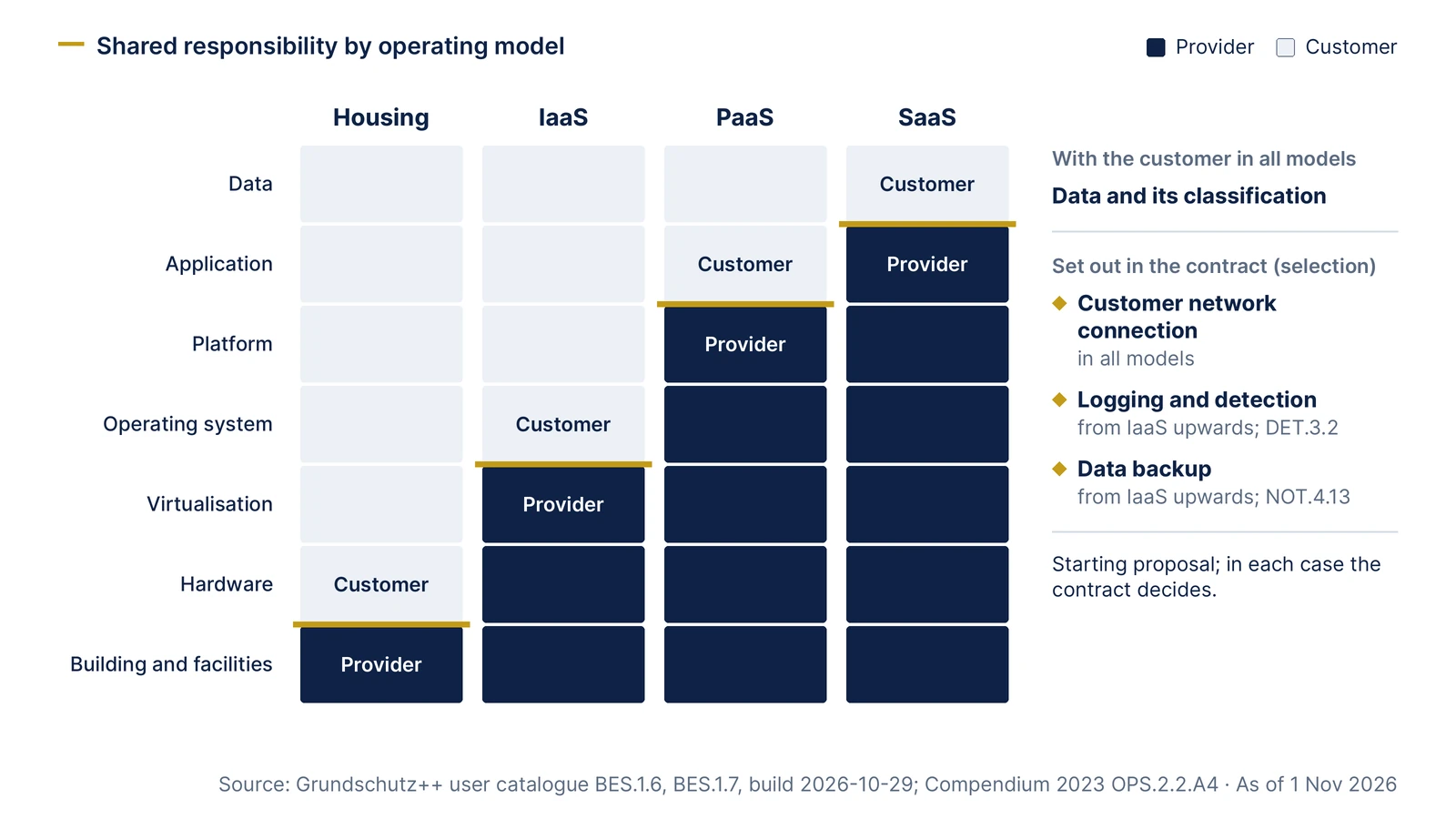
The user catalogue requires the outsourcing institution to document the deployment model for every cloud service „mit Ausführung der geteilten Verantwortlichkeiten“ (our translation: "with a description of the shared responsibilities") (BES.1.6) and to agree the shared responsibility with the provider (BES.1.7). In the Compendium 2023, OPS.2.2.A4 requires that it is clearly recognisable how the areas of responsibility are divided between the provider and the commissioning institution. An operator that describes this split in advance for each model gives the customer the basis for both requirements.
The matrix is a starting proposal. P stands for provider, C for customer, A for "agree in the contract". In each case, the contract decides.
| Layer or task | Housing / colocation | IaaS / hosting | PaaS | SaaS | Reference in catalogue or standard |
|---|---|---|---|---|---|
| Building, access, fire protection | P | P | P | P | Target object categories Buildings, Server rooms |
| Power, air-conditioning, technical infrastructure | P | P | P | P | Rooms for technical infrastructure |
| Hardware of customer systems | C | P | P | P | IT systems |
| Virtualisation, host systems | C | P | P | P | Host systems, Virtualisation solutions |
| Operating system of customer systems | C | C | P | P | IT systems |
| Platform, middleware, runtime environment | C | C | P | P | Applications |
| Business application | C | C | C | P | Applications |
| Data and its classification | C | C | C | C | Data; 300-1 ch. 2.6 |
| User permissions | C | C | A | A | Users, Administrators |
| Customer network connection | A | A | A | A | External network connections; BES.7.1.2, BES.7.2 |
| Logging and detection | C | A | A | A | DET.3.2 (KANN, i.e. MAY): cloud events in the institution's audit log |
| Data backup | C | A | A | A | NOT.4.13 (SOLLTE, i.e. SHOULD): backup of data at the service provider |
| Jurisdiction and data location | A | A | A | A | BES.2.2 (SOLLTE), BES.2.3 (KANN) |
| Evidence to the customer | P | P | P | P | BES.4.8.2 (SOLLTE): third-party evidence of conformity for cloud services; DLS.3.1.1 |
For logging and data backup, the technology lies with the provider, but the requirement in the catalogue lies with the customer. Without an agreement, the customer cannot fulfil it. With housing, the customer adds the operator's service to its information domain as an asset of the Outsourcing category, and its own systems in the third-party room as assets of its own. If the customer wants to record a server room requirement as "not applicable", it needs one of the two reasons in 300-1 chapter 4.1.1: the underlying component does not exist in the information domain, or the requirement cannot be fulfilled functionally. The justification must be documented.
How the C5 criteria catalogue differs
According to the BSI, the C5 criteria catalogue specifies „Mindestanforderungen an sicheres Cloud Computing“ (our translation: "minimum requirements for secure cloud computing") and is aimed primarily at professional cloud providers, their auditors and their customers. Fulfilment of the criteria can be attested by auditors (Wirtschaftsprüfer) commissioned by the cloud provider. According to the BSI, it is not involved in selecting the auditors or in the audit and does not evaluate the reports. C5 is therefore an audit framework for a cloud service, Grundschutz++ a methodology for an institution's ISMS.
C5 is still relevant for the responsibility matrix, because the BSI also stresses in relation to C5 that every customer needs its own risk management and bears remaining residual risks itself. A C5 audit report can serve the customer as evidence within the meaning of BES.4.8.2. Whether your service needs a C5 report and how to prepare it is not covered by this page.
Blackfort Technology provides information on the C5 audit on its company website: https://www.blackfort-tec.de/en.
IT-Grundschutz Profile for a large IT service provider: a 2018 thesis
On its list of IT-Grundschutz Profiles, the BSI also links to a master's thesis with a profile for large IT service providers. Being linked does not mean being recognised: the document itself gives its status as „Anerkennung durch BSI: in Diskussion“ (our translation: "Recognition by BSI: under discussion") (chapter A.1).
| Fact sheet | Details |
|---|---|
| Original title | IT-Grundschutz-Profil für einen großen IT-Dienstleister (IT-Grundschutz Profile for a large IT service provider) |
| Type | Thesis (master's thesis according to the BSI page); author and publisher: Christoph Möhring (ch. A.1) |
| Version and date | In the document „Working Draft, Version 0.1 vom 14. März 2018“ (our translation: "Working Draft, version 0.1 of 14 March 2018") (ch. A.1). The BSI list gives version 1.0, the BSI page on the thesis the date 17 May 2018. |
| Basis | Basic Protection under BSI Standard 200-2 (ch. A.3.3; the text says 200-1, the footnote refers to 200-2); modules from the „im Oktober 2017 freigegebenen BSI-Grundschutz-Kompendium“ (our translation: "BSI Grundschutz Compendium released in October 2017") (ch. A.9) |
| Length and rights | 13 pages; confidentiality „öffentlich“ (our translation: "public"), no licence statement |
| Location | BSI page on the thesis, retrieved on 2 Nov 2026 |
Scope: The target group is IT service providers in the public and private sectors with at least 50 million euros in annual turnover, 250 employees or five locations that serve several customers (chapter A.3.1). The profile covers only the service provider's own information domain, with normal protection requirements. The customer side, specific technology, applications and requirements beyond Basic Protection are excluded (chapters A.3, A.3.2, A.4.2). The selection of modules ranges from security management to business continuity management and includes the data centre, partly with standard requirements (chapter A.5). According to the profile itself, implementing it alone is not sufficient for ISO 27001 certification on the basis of IT-Grundschutz (chapter A.3.3).
- Suitable if you are a large IT service provider looking for a selection of organisational foundations for your own information domain, including the data centre, as a starting point, and you read the author's remarks as a contribution to discussion.
- Not suitable if you are defining the scope and responsibility of an individual data centre or cloud service, governing shared responsibility with customers, building evidence for customers or aiming for a certificate. The thesis does not deal with cloud services or the customer side.
Path to Grundschutz++: Several modules of the profile no longer exist under their identifier in the 2023 edition of the Compendium: CON.4, CON.5, INF.3 and INF.4 are not included, and according to the Compendium OPS.3.1 was replaced by OPS.3.2 Provision of Outsourcing. For OPS.3.2, the draft mapping to Grundschutz++ (as of 21 July 2026, status „draft“) contains a single assignment across 21 requirements: OPS.3.2.A14 on monitoring the systems used for customers intersects with DET.4.17 „Anwendungsbasiertes Kapazitätsmanagement“ (our translation: "Application-based capacity management") (KANN). Provider obligations such as a tenant separation concept (OPS.3.2.A4) or a security concept for the outsourcing service (OPS.3.2.A5) have no target there. This matches our finding above that the user catalogue does not contain a separate module for the provider side. BSI Standard 300-1 does not include Basic Protection as an approach, see Basic, Core and Standard Protection. Further profiles are put in context in the overview IT-Grundschutz Profiles.
Next steps for operators
If you want to set up an operating service under Grundschutz++, start with the fact sheet and the matrix for the models you offer and agree both with a pilot customer. Then follow the steps of the methodology for your own organisation: protection requirements of your own operating processes, structure analysis of the assets, modelling, requirements package.
- Record your own processes and assets: Structure analysis
- Justify suitability for protection requirements: Protection requirements determination
- Adopt customer requirements from contracts: IT-Grundschutz for IT service providers to the federal government
- Schedule evidence for customers: Evidence plan
- Prepare a certificate with a suitable scope: BSI Grundschutz certification
Blackfort Technology supports operators with scope definition, responsibility matrix and evidence planning. The services are described on the page Consulting.
Rights notice: Quotations from BSI Standard 300-1 © Bundesamt für Sicherheit in der Informationstechnik 2026, source: BSI topic page Grundschutz++. Quotations from BSI Standard 200-2 © Bundesamt für Sicherheit in der Informationstechnik, source: BSI Standard 200-2. Quotation from the IT-Grundschutz Compendium, 2023 edition © 2023 Reguvis Fachmedien GmbH, © 2023 Bundesamt für Sicherheit in der Informationstechnik, Bonn (as stated in the imprint of the edition), source: BSI page IT-Grundschutz Compendium. Quotations on C5 © Bundesamt für Sicherheit in der Informationstechnik, source: BSI page C5 criteria catalogue, retrieved on 1 November 2026. Short quotations from the master's thesis „IT-Grundschutz-Profil für einen großen IT-Dienstleister“ by Christoph Möhring with chapter reference, source: BSI page on the thesis, retrieved on 2 November 2026. The thesis contains no licence statement. These quotations are not licensed under CC BY-SA 4.0. The licence notice at the end of the page applies only to the excerpts from the catalogue data.