

What 300-1 and the catalogue specify about roles
Chapter 2.8 of 300-1 states that, for an ISMS, an information security organisation „mit festgelegten Rollen und Zuständigkeiten zwingend erforderlich“ (our translation: "with defined roles and responsibilities is absolutely necessary"). Three points apply: define roles and responsibilities with the necessary qualifications and competences, avoid conflicts of interest, with the examples „IT-Leitung vs. ISB, DSB vs. ISB“ (our translation: "head of IT vs. ISB, data protection officer vs. ISB"), and define interfaces within the scope. There is also a participation rule: the ISB or another role of the security organisation must be involved in security-relevant projects and informed of their essential content, and the points at which this happens are defined.
The user catalogue implements this mainly in the practice (Praktik) Governance and Compliance (GC) as MUSS requirements (MUST), and for the risk owner in the practice Risk Management (RISK):
| Requirement | Content (abridged) | Parameter |
|---|---|---|
| GC.9.1 Definition of a security organisation | define the security organisation, including roles, responsibilities and committees | - |
| GC.9.1.1 Definition of roles and responsibilities | assign the [parameter] within the ISMS, including their competences or powers | „Rollen und Zuständigkeiten“ (our translation: "roles and responsibilities") |
| GC.9.1.1.1 Information security officer | assign responsibility for information security to [parameter], reporting directly to top management | „einer unabhängigen Person“ (our translation: "an independent person") |
| GC.9.1.1.1.1 Resources for the ISB | assign sufficient resources to the ISB | - |
| GC.9.1.1.1.2 Right of direct access | establish the ISB's right of direct access to top management | - |
| GC.9.1.1.2 Deputy arrangements | assign deputies for all relevant roles and responsibilities | - |
| GC.9.1.1.3 Avoidance of conflicts of interest | define safeguards against conflicts of interest when defining roles | - |
| GC.9.1.1.4 Ensuring qualification | define the necessary requirements and skills for each holder of a role or responsibility | - |
| GC.10.1.2 Communication in project management | for security-relevant projects, establish the participation of [parameter] at defined points in time | „der relevanten Sicherheitsorgane“ (our translation: "the relevant security bodies") |
| RISK.1.3 Risk owner | establish the role of the risk owner with the necessary tasks and powers | - |
You set the parameters in GC.9.1.1, GC.9.1.1.1 and GC.10.1.2 yourself. How to record them is shown on Blueprints and parameters.
The roles at a glance
| Role | Tasks and powers according to the sources | Reference |
|---|---|---|
| Top management | responsibility for implementing the ISMS, which „kann nicht delegiert werden“ (our translation: "cannot be delegated"); takes and approves the relevant decisions, in particular on scope, protection requirements of the business processes, order of processing, resources and policy; authorises the framework of the risk assessment and the residual risks; carries out the management review | 300-1 ch. 2.10, 2.11, 4.2.3, 5.3; GC.1.2, GC.5.1.4, GC.6.1, RISK.1.5 |
| Information security officer (ISB) | responsibility for information security, reporting directly to top management, with sufficient resources and a right of direct access; is involved in security-relevant projects but does not take an active role in every one of them | 300-1 ch. 2.8; GC.9.1.1.1 et seq. |
| Business process owner | person, role or organisational unit responsible for the subject matter of a business process; also the risk owner unless otherwise specified | 300-1 Annex 2, ch. 4.2.1 |
| Risk owner | assigned to every risk; authorises the implementation planning for the agreed safeguards; for risks spanning several business processes, a lead risk owner | 300-1 ch. 4.2.1, 4.2.3; Annex 3, criteria 5, 16, 31; RISK.1.3, RISK.1.10 |
| Persons responsible for implementation (subject-matter and operational) | clearly assigned to implement requirements that are not fulfilled; for complex safeguards, split into subject-matter and operational responsibility | 300-1 ch. 4.4; UMS.3.1 |
| IT operations | named in 300-1 as an example of a role to be defined; implements technical safeguards and provides technical evidence | 300-1 ch. 2.8 |
| Audit team and audit team leader | selected objectively and impartially, professionally qualified; the audit team leader is assigned responsibility for the individual internal audit | 300-1 ch. 5.2.2; PERF.3.1.3 |
| Data protection officer (DPO, DSB) | named in 300-1 only as the ISB's counterpart in a conflict of interest; interface for questions on the processing of personal data | 300-1 ch. 2.8 |
| Compliance function | should be consulted in compliance management | 300-1 ch. 2.2; GC.3.1.2 |
| Staff | have the policy communicated to them; are an interested party of the ISMS | 300-1 ch. 2.7, 2.4 |
300-1 does not prescribe an IS management team or other committees. GC.9.1 requires committees to be included in the security organisation, and which ones you set up is your decision. How the classic method described roles is covered on BSI Standard 200-2.
RACI template for decisions and evidence
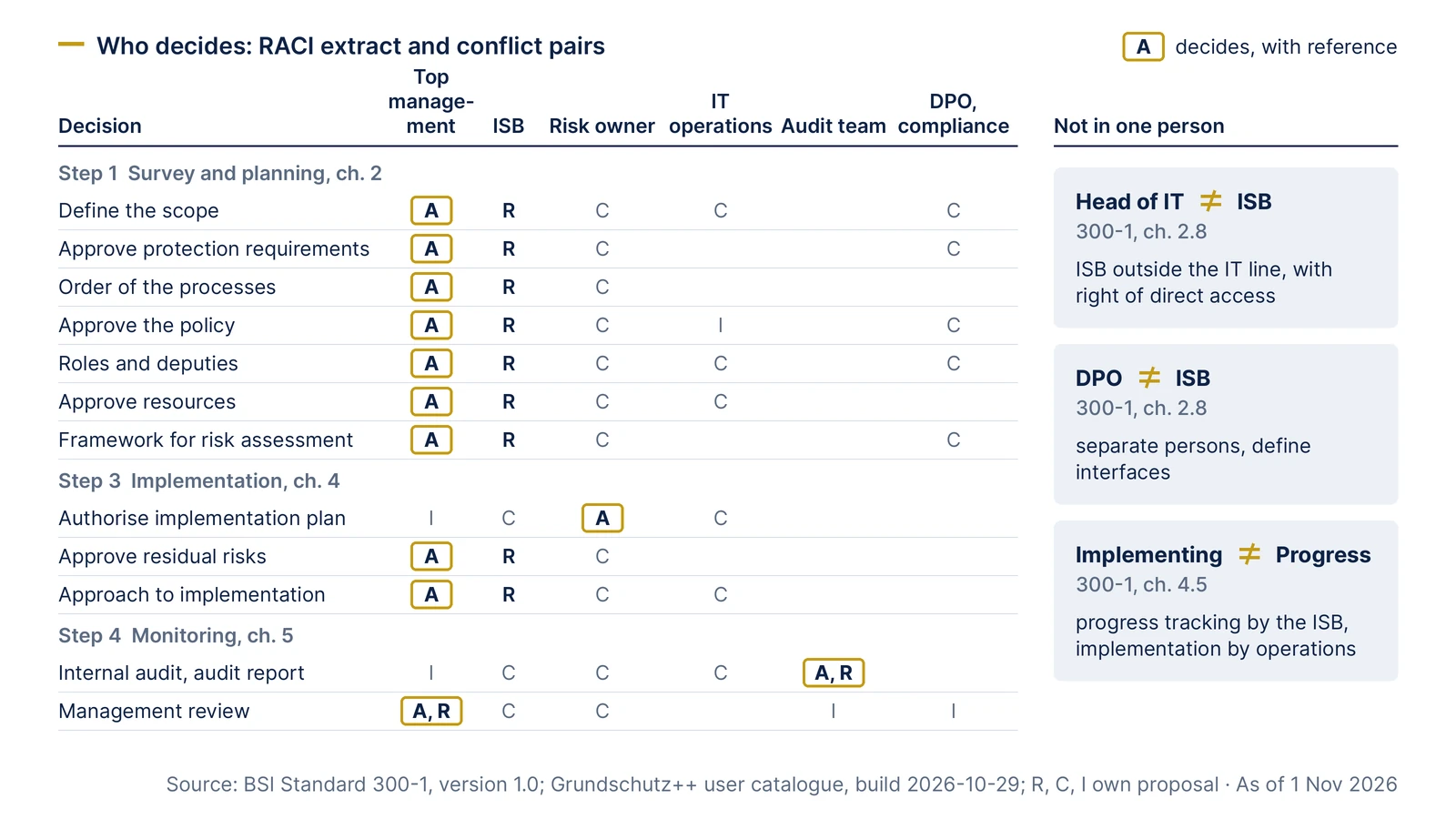
RACI stands for Responsible (carries out), Accountable (decides, exactly one role per row), Consulted (is heard beforehand) and Informed (is kept informed). Labelling: the A entries with a reference follow 300-1 or the catalogue. All other entries are our own proposal for a medium-sized organisation with its own IT operations and need to be adapted to your organisation.
| Decision or evidence | Top management | ISB | Business process or risk owner | IT operations | Audit team | DPO, compliance | Reference for A |
|---|---|---|---|---|---|---|---|
| Define the scope | A | R | C | C | - | C | ch. 2.3, 2.10; GC.6.1 |
| Document business processes | I | R | A | C | - | - | own proposal (subject-matter responsibility under Annex 2) |
| Approve protection requirements of the business processes | A | R | C | - | - | C | ch. 2.10; GC.7.1.2 |
| Define the order of the business processes | A | R | C | - | - | - | ch. 2.6, 2.10 |
| Approve the policy | A | R | C | I | - | C | ch. 2.7; GC.5.1.4 |
| Define roles, responsibilities, deputies | A | R | C | C | - | C | ch. 2.7 (security organisation in the policy, approval by top management); GC.5.1.4; for risk roles Annex 3, criterion 9, RISK.1.5 |
| Approve resources | A | R | C | C | - | - | ch. 2.10, 4.4 |
| Authorise the framework of the risk assessment (procedure, roles, criteria, risk appetite) | A | R | C | - | - | C | ch. 2.11; Annex 3, criterion 9; RISK.1.5 |
| Identify and evaluate risks | I | R | A | C | - | C | own proposal (risk owner under ch. 4.2.1) |
| Authorise implementation planning from risk treatment | I | C | A | C | - | - | ch. 4.2.3; criterion 31; RISK.1.10 |
| Approve residual risks | A | R | C | - | - | - | ch. 4.2.3; criterion 30 |
| Determine implementation status per requirement | I | A | C | R | - | - | own proposal |
| Implement safeguard and provide evidence | - | C | A (subject-matter responsibility) | R | - | - | own proposal; name the subject-matter responsibility per safeguard under ch. 4.4 and UMS.3.1 |
| Track progress of the implementation plan | I | A, R | I | C | - | - | own proposal; separation from implementation under ch. 4.5 |
| Approve the approach to implementation | A | R | C | C | - | - | ch. 4.4 |
| Carry out internal audit, audit report | I | C | C | C | A, R (audit team leader) | - | ch. 5.2.2 |
| Prepare management report | I | A, R | C | C | C | C | own proposal; informing top management under PERF.4.2 |
| Carry out management review | A, R | C | C | - | I | I | ch. 5.3 |
| Participation in security-relevant projects | - | C | A | R | - | C | own proposal (owner of the affected business process as the project sponsor); participation of the ISB under ch. 2.8 and GC.10.1.2 |
Check the completed template with two questions: does every row have exactly one A? Does the same person appear in a row as R for the implementation and as A for checking it? The second question leads directly to the conflicts of interest in the next section.
Conflicts of interest and how to resolve them
| Conflict | Why it is a problem | Reference | Resolution |
|---|---|---|---|
| The head of IT is also the ISB | Whoever is responsible for operations checks their own safeguards and priorities | 300-1 ch. 2.8 names „IT-Leitung vs. ISB“ (our translation: "head of IT vs. ISB"); GC.9.1.1.1 requires a responsibility that reports directly to top management (parameter „einer unabhängigen Person“, our translation: "an independent person") | Place the ISB outside the IT line, with a right of direct access to top management (GC.9.1.1.1.2) |
| The DPO is also the ISB | Different protection goals and reporting lines in one person | 300-1 ch. 2.8 names „DSB vs. ISB“ (our translation: "DPO vs. ISB") | Separate persons; define interfaces and coordination meetings (ch. 2.8) |
| Whoever implements also tracks progress | Delays become visible late or not at all | 300-1 ch. 4.5: prevent conflicts of interest through an appropriate distribution of roles | Progress tracking by the ISB, implementation by operations; another role checks the ISB's own safeguards |
| The ISB audits the ISMS they built | The audit is not objective and impartial | 300-1 ch. 5.2.2; PERF.3.1.3 requires professionally qualified and independent auditors | Internal audit by a function not involved in the set-up, if necessary by external parties |
| Top management wants to hand ISMS responsibility to the ISB | Decisions without authority, in particular on resources and residual risks | 300-1 ch. 2.10: responsibility „kann nicht delegiert werden“ (our translation: "cannot be delegated"); management responsibility already existed under 200-2, ch. 2.3 | The ISB prepares, top management decides; decision papers on the topics from ch. 2.10 |
| A risk affects several business processes | Unclear who authorises the treatment | 300-1 ch. 4.2.1: lead risk owner chosen from the owners of the affected business processes | Record the lead in the risk register; the other owners are consulted (C) |
| Who approves exceptions? | UMS.5.1 leaves the role open (parameter „eine zuständige Person oder Rolle“, our translation: "a responsible person or role"); for risks outside the acceptance criteria, criterion 27 requires top management; for MUSS requirements an exception is not possible | UMS.5.1; Annex 3, criterion 27; 300-1 ch. 4.1.2 | Set the parameter of UMS.5.1 to top management or clearly define what another role is responsible for; exclude MUSS requirements from every exception rule |
| Who approves the risk of a SOLLTE requirement (SHOULD) that is temporarily not fulfilled? | Ch. 2.11 requires a residual risk assessment and approval by top management for SOLLTE requirements that are in the implementation planning but not yet fulfilled; ch. 4.1.1 requires the risk to be identified, reported to top management and accepted by it; ch. 4.1.2 says a temporary non-fulfilment does not trigger a risk assessment | 300-1 ch. 2.11, 4.1.1, 4.1.2 | Open question of interpretation. To stay on the safe side, have top management approve the residual risk and document the deadline |
| Small organisation: one person holds several roles | The separations from ch. 2.8 and 4.5 cannot be fully achieved | GC.9.1.1.2 (deputies), GC.9.1.1.3 (safeguards against conflicts of interest) | Document the safeguard against the conflict, for example review of the evidence by another person or an external party; name a deputy for every role |
How to record risk decisions with responsibility and review is shown on Risk acceptance and residual risk, and how to enter the supplying and reviewing role per piece of evidence on Evidence plan.
Introducing and documenting roles
Define roles before people. For each role, describe the tasks, powers, required qualifications (GC.9.1.1.4) and the deputy (GC.9.1.1.2). Only then assign people. People change, the role description stays. In review entries, on the other hand, record the person who actually carried out the review, because ch. 4.3 requires „die dokumentierende beziehungsweise prüfende Person“ (our translation: "the person documenting or reviewing").
The security organisation belongs in the policy. Ch. 2.7 names the definition of the information security organisation as one of the aspects in developing the policy, with a reference to ch. 2.8 for the details. A separate roles document referenced by the policy is easier to change than the policy itself, which you need to have approved by top management again after every change.
The risk roles need their own definition. Under ch. 2.11, the organisation defines the necessary roles with responsibilities and powers at organisational level, in particular the risk owner, and top management authorises these role definitions (Annex 3, criteria 5 and 9). Check whether your business process owners can actually fill this role. If not, specify something else explicitly, as ch. 4.2.1 allows.
Top management is itself a target group. SENS.11.1 requires top management to be made aware of the importance of information security for protecting the business processes (SOLLTE, SHOULD). Whoever presents decision papers under ch. 2.10 should combine this with a short explanation of why this particular decision lies with top management.
Next: Information security policy · IT-Grundschutz in operation · Project planning and resources · Case study: survey and planning. Blackfort Technology supports you in setting up the security organisation and preparing decision papers for top management, see Consulting. Filling the ISB role externally is described under External information security officer on https://www.blackfort-tec.de/en.