

What 300-1 means by blueprint and parameter
Chapter 3.3 defines: „Eine Blaupause ist ein vorgefertigter Katalog von Anforderungen.“ (our translation: "A blueprint is a prefabricated catalogue of requirements.") Unlike the user catalogue (Anwenderkatalog), it is tailored to specific application scenarios and makes a preselection of requirements. In addition, it specifies the parameters. For working with blueprints, the standard sets four rules:
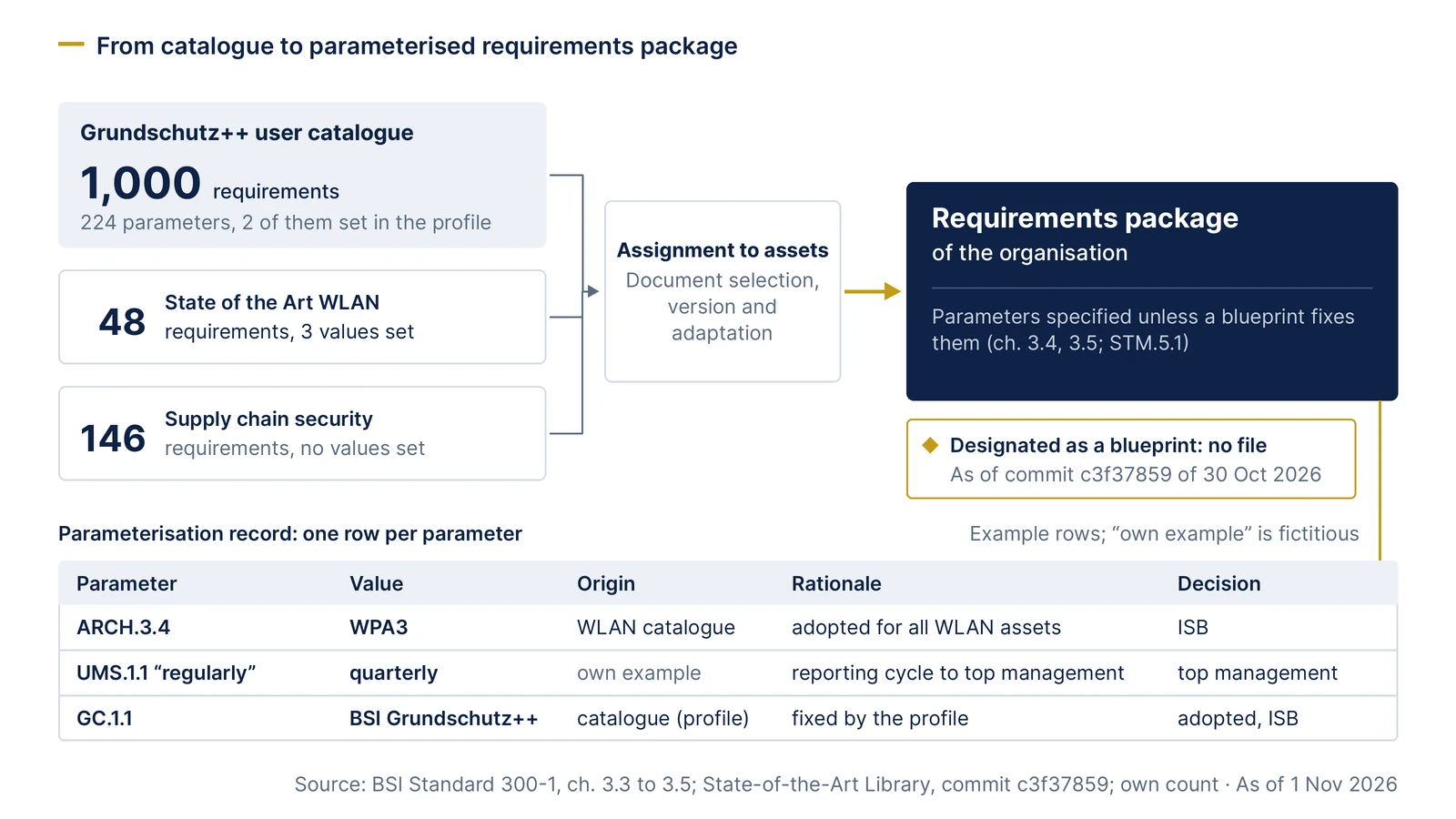
- Assignment to individual assets or asset groups is possible. According to ch. 3.3, what must be documented is „Die Auswahl (inkl. Version), Zuordnung und gegebenenfalls vorgenommene Anpassung der Blaupausen“ (our translation: "the selection (incl. version), assignment and any adaptation made to the blueprints").
- If a blueprint does not fully cover the subject matter, you supplement it with further blueprints or your own requirements.
- If the information domain or the range of blueprints changes, you review the selection again.
- Blueprints may be mandatory for certain organisations. Otherwise, an individual selection must be considered. From several blueprints, the organisation creates its own requirements package.
Chapter 3.5 explains parameters as „variabel gestaltbare Elemente innerhalb einer Anforderung“ (our translation: "variably configurable elements within a requirement"), which show auditors and users where there is room for manoeuvre and can be used for automated checks. They are specified during or after the creation of the requirements package. Chapter 3.4 governs precedence: the organisation sets the parameters „sofern keine festgeschriebenen Parameter (z. B. durch eine Blaupause) vorliegen“ (our translation: "provided no fixed parameters exist (e.g. through a blueprint)"). The user catalogue contains the methodology requirement STM.5.1 „Setzen von Parametern“ (our translation: "setting parameters") on this: structure modelling MUSS (MUST) assign concrete values to requirements with parameters.
Blueprints should not be confused with the IT-Grundschutz Profiles of classic IT-Grundschutz: a profile selects modules from one edition of the Compendium for a model scenario, it contains neither requirements of the user catalogue nor set parameters, and BSI Standard 300-1 does not mention profiles. How a profile can nevertheless be used as a template for the requirements package is shown in the overview IT-Grundschutz Profiles.
What is published as at 1 November 2026
We went through the BSI's State-of-the-Art Library (Stand-der-Technik-Bibliothek) as of commit c3f37859 (30 October 2026). The word „Blaupause“ (blueprint) appears there only in the description of the practice (Praktik) structure modelling (STM): „Blaupausen unterstützen die Filterung der Anforderungen.“ (our translation: "Blueprints support the filtering of requirements.") No file is designated as a blueprint, none as mandatory. The table shows the candidates and their status according to the information in the files themselves and our own count.
| Artefact in the repository | Publisher and state according to metadata | Content (own count) | Parameters | Status as a blueprint |
|---|---|---|---|---|
Grundschutz++ user catalogue (control_layer/Grundschutz++/) | BSI; version and build 29 Oct 2026 | 1,000 requirements in 20 practices | 224 parameters in 211 requirements; two values are fixed in the profile: GC.1.1 „BSI Grundschutz++“ and one parameter of NOT.1.1.4 „BSI-Standard 200-4“ | Not a blueprint: 300-1 expressly distinguishes blueprints from the user catalogue |
„Stand der Technik WLAN“ (State of the Art WLAN, control_layer/WLAN/) | BSI, State of the Art unit (Referat Stand der Technik); version 29 Oct 2026 | 48 requirements in six groups from „Planung und Bestand“ (planning and inventory) to „Betriebsumgebung und Sensibilisierung“ (operating environment and awareness); 37 with security level normal-SdT, 11 elevated (erhöht); all 48 identifiers are also in the user catalogue | Three values set: ARCH.2.6 „kontinuierlich“ (our translation: "continuously"), ARCH.3.4 „WPA3“, DET.4.19 „Wireless Intrusion Detection System (WIDS)“; implementation guidance (guidance) of all 48 requirements replaced | Meets the characteristics from ch. 3.3 (scenario, preselection, specified parameters); it is not designated as a blueprint |
„Supply Chain Security“ (control_layer/Lieferkettensicherheit/) | BSI, State of the Art unit; version 29 Oct 2026; description „Anforderungskatalog Lieferkettensicherheit“ (requirements catalogue supply chain security) | 146 requirements from ASST, BES, DLS, GEB, NOT, KONF and DEV; 105 normal-SdT, 41 elevated; all identifiers in the user catalogue | No values set; 24 requirements with open parameters | Thematic preselection without specified parameters; it therefore does not meet the characteristic "parameters specified" from ch. 3.3 |
„BSI Anforderungen zum Risikomanagement“ (BSI requirements for risk management, control_layer/Risikomanagement/) | BSI, State of the Art unit; version 22 Oct 2026 | 10 requirements of the practice RISK, all normal-SdT; six identifiers (RISK.1.2, RISK.1.4, RISK.1.6 to RISK.1.9) are not in the user catalogue of 29 Oct 2026 | one open parameter (RISK.1.1), no values set | Not a blueprint: thematic catalogue without an application scenario and without specified parameters; the profile of the user catalogue only takes RISK.1.1, RISK.1.3, RISK.1.5 and RISK.1.10 from it |
Draft minimum standard TLS (control_layer/Mindeststandard-TLS/) | draft according to the file name | not evaluated | not evaluated | Draft, not for the requirements package |
Component definitions (implementation_layer/, e.g. password policy, network architecture, Keycloak) | BSI | Descriptions of how an implementation can fulfil requirements | not evaluated | Not a blueprint: the README calls them references which, in its words, replace „nicht das Handeln der für die Informationssicherheit verantwortlichen Stelle“ (our translation: "not the actions of the body responsible for information security") |
The methodology catalogue (control_layer/Grundschutz++/sources/catalogs/), the kernel (control_layer/Kernel/) and the risk management catalogue (control_layer/Risikomanagement/) are the source catalogues from which the profile assembles the user catalogue.
The conclusion for your package: a blueprint within the meaning of 300-1 with binding effect does not exist in the evaluated state, and the sources evaluated here do not say which organisations will have to apply mandatory blueprints in future. You can use the WLAN catalogue as a template for WLAN assets. In that case, document it like a blueprint, with version, assignment and adaptations, and record that the BSI does not designate it as a blueprint. How the repository is structured as a whole is shown in Grundschutz++ user catalogue.
Checklist: origin and status of a catalogue before use
Before a catalogue goes into your package as a blueprint, answer these questions in writing. The answers belong in the documentation that chapter 3.3 requires.
| Check question | Where to look | Example WLAN (commit c3f37859) |
|---|---|---|
| Who publishes the catalogue? | Metadata parties and responsible-parties | BSI, State of the Art unit |
| Which version, which state? | Metadata version and last-modified, plus the commit | Version 2026-10-29T08:05:59, commit c3f37859 |
| Is it marked as a draft or as mandatory? | File name, metadata, accompanying texts | no marking |
| What does it apply to, and what not? | Metadata remarks | professionally operated WLAN infrastructures; private home networks and public mobile networks excluded |
| From which sources are requirements taken? | Profile: imports and back-matter | 48 requirements from the repository's kernel file; also named as references: a kernel version of 13 Aug 2026 and standards such as IEEE 802.11-2024 |
| Which parameters are fixed? | Profile: modify.set-parameters | three (ARCH.2.6, ARCH.3.4, DET.4.19) |
| What was changed in the requirement text? | Profile: modify.alters | requirement texts unchanged; implementation guidance of all 48 requirements replaced |
| Do the identifiers match the user catalogue you use? | Comparison of the identifiers against the build of your package | all 48 contained in the build of 29 Oct 2026 |
| Under which licence? | Repository | CC BY-SA 4.0 |
If an answer is unclear, use the catalogue only as a working aid and set the parameters yourself. They are then subject to the same as any other value of your own: give reasons and record them.
Which parameters the user catalogue contains
In the build of 29 October 2026, 211 of the 1,000 requirements have a total of 224 parameters (own count across all levels). Each parameter has a label that appears in its place in the requirement text. The catalogue contains values only for the two parameters mentioned above. You set all the others.
The most frequent is „regelmäßig“ (our translation: "regularly") with 68 occurrences. Seven further labels contain the word, once each, for example „regelmäßige“, „regelmäßig oder bei Änderungen“ and „regelmäßig oder prädiktiv“ (our translation: "regular", "regularly or in the event of changes" and "regularly or predictively"). They are followed by „zuständigen Personen oder Rollen“ (16), „eine zuständige Person oder Rolle“ (13), „einem anerkannten Standard“ (13), „Schwellwerten“ (13), „Kriterien“ (12) and „einen automatisierten Mechanismus“ (12) (our translation: "responsible persons or roles", "a responsible person or role", "a recognised standard", "thresholds", "criteria" and "an automated mechanism"). This results in four kinds of decision: interval, responsibility, reference standard, and threshold or criterion. Each kind needs a different rationale. An interval depends on the frequency of change and the protection requirements, a responsibility on your security organisation, a reference standard on a citable source with version.
Parameters are also an audit yardstick. 300-1 says they show auditors where there is room for manoeuvre (ch. 3.5). An auditor therefore checks whether you comply with the value you set, and can ask why you chose it. A value without a rationale is hard to defend in that situation.
Parameterisation record with example rows
The record is a table with one row per parameter in the package. Labelling: requirement, parameter identifier, label and the values from the user catalogue and the WLAN catalogue come from the State-of-the-Art Library (commit c3f37859). All values in the column "Set" without the origin "catalogue" or "WLAN catalogue" are our own, fictitious examples and not a recommendation of the BSI.
| Requirement (excerpt) | Parameter: label in the catalogue | Set | Origin | Rationale | Decided by, on | Next review |
|---|---|---|---|---|---|---|
| GC.1.1 Embed procedure for establishing an ISMS according to [parameter] (MUSS) | gc.1.1-prm1: „BSI Grundschutz++“ | BSI Grundschutz++ | catalogue (profile) | fixed by the profile | adopted, information security officer (ISB), 15 Dec 2026 | with a new build |
| NOT.1.1.4 Embed BCMS according to [parameter] (KANN (MAY), elevated) | not.1.1.4-prm2: „BSI-Standard 200-4“ | BSI Standard 200-4 | catalogue (profile) | fixed by the profile; requirement optional | adopted, ISB, 15 Dec 2026 | with a new build |
| UMS.1.1 Review implementation status completely [parameter] (MUSS) | ums.1.1-prm1: „regelmäßig“ (our translation: "regularly") | quarterly | own example | matches the reporting cycle to top management | top management, 15 Dec 2026 | management review |
| PERF.4.2 Inform top management [parameter] on the basis of the management report (MUSS) | perf.4.2-prm1: „regelmäßig“ (our translation: "regularly") | half-yearly, plus as occasion requires | own example | two meetings of top management per year | top management, 15 Dec 2026 | management review |
| GC.9.1.1.1 Assign responsibility for information security [parameter], reporting directly to top management (MUSS) | gc.9.1.1.1-prm1: „einer unabhängigen Person“ (our translation: "to an independent person") | ISB position in the staff unit of the management board, without line responsibility for IT operations | own example | avoiding the conflict between head of IT and ISB (300-1, ch. 2.8) | top management, 15 Dec 2026 | with organisational change |
| UMS.5.1 Authorise exceptions through [parameter] (MUSS) | ums.5.1-prm1: „eine zuständige Person oder Rolle“ (our translation: "a responsible person or role") | top management | own example | same body as for exceptions under Annex 3, criterion 27 | top management, 15 Dec 2026 | annually |
| GC.10.1.2 Embed involvement [parameter] in security-relevant projects (MUSS) | gc.10.1.2-prm1: „der relevanten Sicherheitsorgane“ (our translation: "of the relevant security bodies") | ISB at project start and before going live; DPO when personal data is processed | own example | 300-1, ch. 2.8: define when the ISB is involved | ISB, 15 Dec 2026 | annually |
| NOT.4.16.1 Review restoration on the basis of representative samples [parameter] (SOLLTE (SHOULD)) | not.4.16.1-prm1: „regelmäßig“ (our translation: "regularly") | half-yearly for each data set with high protection requirements, annually otherwise | own example | graded by protection requirements of the business processes | IT operations with ISB, 15 Dec 2026 | after each test |
| ARCH.3.4 Encrypt network connection [parameter] (SOLLTE, WLANs) | arch.3.4-prm1: „nach einem anerkannten Standard“ (our translation: "according to a recognised standard") | WPA3 | WLAN catalogue, version 2026-10-29 | WLAN catalogue adopted for all WLAN assets | ISB, 15 Dec 2026 | with a new version of the WLAN catalogue |
| ARCH.2.6 Review compliance with the network architecture [parameter] (SOLLTE, networks) | arch.2.6-prm1: „regelmäßig“ (our translation: "regularly") | continuously for WLAN networks; monthly for the other networks | WLAN catalogue for WLAN networks; own example for the others | two values for two asset groups, assignment noted in the package | ISB, 15 Dec 2026 | with a new version of the WLAN catalogue |
Three notes on filling it in. First: if a requirement applies to several asset groups with different values, as with ARCH.2.6, write one row per group or note the assignment explicitly. Second: "decided by" is no formality. Values that commit resources or define responsibilities belong before top management according to 300-1, ch. 2.10 and 4.4. Third: if a parameter refers to a standard, state the title and version so that a later review can trace the value.
Maintaining blueprints and parameters in operation
Both kinds of decision become outdated. 300-1 requires the selection of blueprints to be reviewed when the information domain or the available blueprints change (ch. 3.3), and names adaptations to the blueprints used and to the requirements of the State-of-the-Art Library as subjects of regular validation (ch. 5.5). The methodology requirement PERF.1.3 requires the currency of the requirements to be reviewed with the parameter „regelmäßig“ (our translation: "regularly"). You set this value yourself as well.
In practice, this means: note the commit in the record for every catalogue you adopt. When a new build appears, compare the set values and the identifiers and note the result, even if nothing changes. How validation and reassessment fit into the annual cycle is shown on the page Grundschutz in operation.
How a package comes about from assets and target object categories (Zielobjektkategorien) in the first place is described on the page Modelling and target object categories. The worked example there shows the inheritance, this page the specification that follows.
Next: Grundschutz in operation · Modelling and target object categories · Case study: requirements analysis. Selecting blueprints and setting parameters are part of the implementation, in which Blackfort Technology provides support, see Implementation and migration.