

What recurs: the obligations with references
300-1 sets a fixed minimum cycle for an operational task in one place only: the risk assessment is „mindestens jährlich sowie bei wesentlichen Änderungen überprüft“ (our translation: "reviewed at least annually and in the event of significant changes") (ch. 4.2.3; likewise Annex 3, criterion 35). Everything else is „regelmäßig“, „kontinuierlich“ or „anlassbezogen“ (our translation: "regularly", "continuously" or "as occasion requires"). The table summarises what recurs in operation.
| Task | Provision in 300-1 | Requirement in the catalogue (modal verb, parameter) | Cycle as prescribed |
|---|---|---|---|
| Check the implementation status of all requirements | Ch. 4.1.1: check completely for every requirement | UMS.1.1 (MUSS, i.e. MUST; „regelmäßig“) | to be set by you |
| Track progress of the implementation plan and update the plan | Ch. 4.5: follow up continuously, at regular intervals; plan as a living document | UMS.6.1, UMS.6.2 (MUSS); PERF.1.2 (MUSS, „regelmäßige“ review and updating) | continuous, review to be set by you |
| Review the risk assessment | Ch. 4.2.3; Annex 3, criterion 35 | Methodology in GC.12.1 and RISK.1.1 | at least annually and in the event of planned or actual significant changes |
| Follow up time-limited risk acceptances | Annex 3, criterion 28: set a time limit | - | at the end of the set period |
| Evaluate the performance of the ISMS | Ch. 5.1: design is free as long as uniform requirements are pending | PERF.1.1 (MUSS) | to be set by you |
| Plan the internal audit programme and carry out audits | Ch. 5.2: audit programme with objectives, risks, scope and frequency | PERF.3.1 (MUSS); PERF.3.1.2 risk-based planning (MUSS) | according to the audit programme |
| Prepare the management report, carry out the management review | Ch. 5.3: top management checks suitability, adequacy, effectiveness; „Regelmäßigkeit der Bewertung“ (our translation: "regularity of the review") as an aspect | PERF.4.1 (MUSS, „regelmäßig“ and as occasion requires), PERF.4.2 (MUSS, „regelmäßig“) | to be set by you, plus as occasion requires |
| Evaluate monitoring | Ch. 5.4: procedures for incident detection, vulnerabilities and new threats | PERF.5.1 (MUSS, „regelmäßigen“ monitoring) | ongoing, evaluation to be set by you |
| Validate requirements | Ch. 5.5: changes in the information domain, in the library, in blueprints, in the methodology | PERF.1.3 (MUSS, „regelmäßig“) | to be set by you |
| Check compliance with obligations | Ch. 2.2: compliance management | PERF.2.1 (SOLLTE, i.e. SHOULD; „regelmäßig“ and as occasion requires) | to be set by you, plus as occasion requires |
| Evaluate nonconformities, test the effectiveness of corrections | Ch. 6.1 and 6.4 | VRB.2.2 (MUSS, „regelmäßig“), VRB.6.1 (MUSS, „regelmäßig“) | to be set by you |
| Control documents | Ch. 2.9: procedure across the entire life cycle | GC.11.1 (MUSS) | according to the control procedure |
There are also subject-matter requirements with a cycle, for example NOT.4.16.1 (check restoration „regelmäßig“ using representative samples, SOLLTE) or SENS.1.2 (check the success of awareness raising „regelmäßig“ against objective criteria, SOLLTE). In the build of 29 October 2026, 68 parameters carry the label „regelmäßig“ (own count). All of them belong in the calendar with their set value. How to set and record the values is shown in Blueprints and parameters.
Annual calendar: an example to adapt
Fictitious example. The tasks and references come from 300-1 and the user catalogue. The months and cycles are our own choices for an assumed institution with two top management meetings on the ISMS per year and a financial year equal to the calendar year. Adopt the structure and set your own dates.
| Period | Task | Result | Responsible (example) | Reference |
|---|---|---|---|---|
| January | Set the audit programme for the year: objectives, risks of the programme, scope, audit team | Audit programme, noted by top management | Information security officer (ISB), head of internal audit | Ch. 5.2.1; PERF.3.1 |
| January | Check implementation status (quarter 1) | Status list with date and checking person | ISB with those responsible for implementation | Ch. 4.1.1; UMS.1.1 |
| February | Validation of requirements: new build of the library, blueprints, changes in the information domain | Validation note, changes to the package | ISB | Ch. 5.5; PERF.1.3 |
| March | Review of the risk assessment | Updated risk register, residual risks for approval | ISB, risk owners | Ch. 4.2.3; Annex 3, criterion 35 |
| April | Check implementation status (quarter 2); restoration test, first half-year | Status list; test record | ISB; IT operations | UMS.1.1; NOT.4.16.1 |
| May | Prepare the management report | Management report with audit results, performance evaluation, incidents, status of risk treatment | ISB | Ch. 5.3; PERF.4.1 |
| June | Management review 1 | Minutes, decisions, approved resources | Top management | Ch. 5.3; PERF.4.2 |
| July | Check implementation status (quarter 3); check compliance with obligations | Status list; compliance note | ISB; compliance function | UMS.1.1; PERF.2.1 |
| September | Complete internal audits according to the programme; restoration test, second half-year | Audit reports; test record | Audit team; IT operations | Ch. 5.2.2; NOT.4.16.1 |
| October | Check implementation status (quarter 4); evaluate nonconformities from the audits, transfer the correction and improvement plan into the implementation plan | Status list; correction and improvement plan | ISB | UMS.1.1; ch. 6.1 and 6.3; VRB.2.2 |
| November | Prepare the management report; evaluation of corrections implemented | Management report; evaluation result | ISB | Ch. 5.3 and 6.4; VRB.6.1 |
| December | Management review 2 with resources for the following year; evaluate the audit programme | Minutes, decisions; evaluation of the audit programme | Top management; ISB | Ch. 5.3 and 5.2.2; GC.8.1 |
| ongoing | Progress of the implementation plan, monitoring, document control | Maintained plan, monitoring evaluations, controlled documents | ISB, IT operations | Ch. 4.5, 5.4, 2.9; UMS.6.1, PERF.5.1, GC.11.1 |
You should also enter two BSI dates for 2027. According to the milestone plan (Meilensteinplan), the concept for performance measurement will be integrated into the methodology on 26 February 2027, and by 31 March 2027 all requirements of the methodology practices are to have performance indicators. After that, you should align your own performance evaluation with these requirements. Until then, institutions are free in the design under ch. 5.1. Which indicators you can present to top management is shown in Management review and indicators.
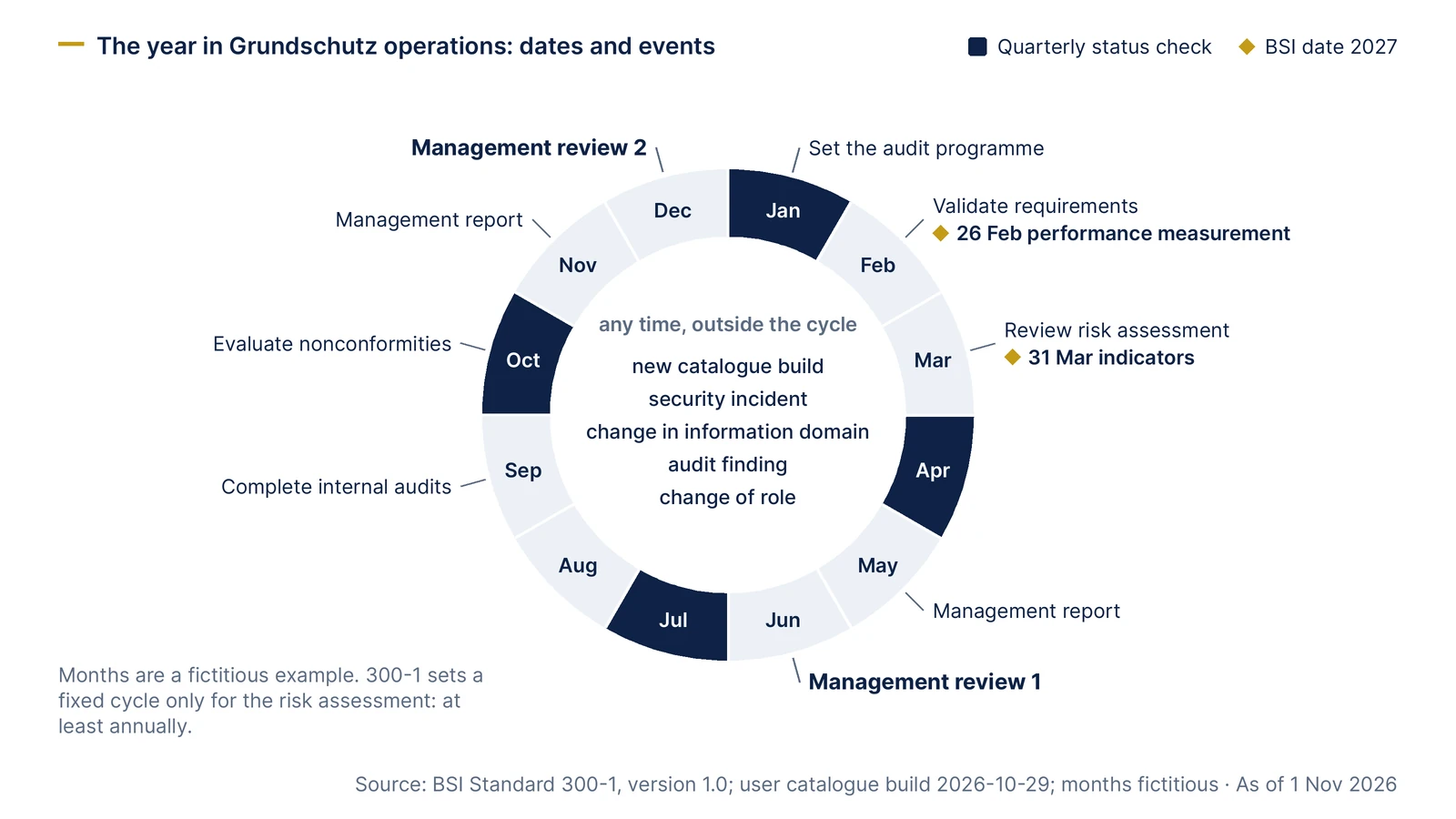
Event matrix: what triggers work outside the cycle
Many obligations are triggered by an event, independently of the calendar. The matrix assigns the follow-up tasks with their references to each event. For every event, decide who reports it and who initiates the follow-up tasks. Otherwise it falls between the dates.
| Event | Follow-up tasks | Reference |
|---|---|---|
| Significant change in the information domain (new site, new application, outsourcing) | Update scope and assets; check the selection of blueprints; validate requirements; review the risk assessment | Ch. 3.1, 3.3, 5.5; Annex 3, criterion 35 |
| New build of the State-of-the-Art Library (Stand-der-Technik-Bibliothek) or new version of the methodology | Compare identifiers and texts against the package; assess changed parameters and new requirements; document the result | Ch. 5.5; PERF.1.3 |
| New or changed business process | Document the process, determine protection requirements and have them approved by top management; for high protection requirements, a risk assessment | Ch. 2.5, 2.6, 2.10, 2.11 |
| Security-relevant project, such as introducing a new system | Involve and inform the ISB or another role of the security organisation at the defined points in time | Ch. 2.8; GC.10.1.2 |
| Security incident | Handling according to the incident procedure; evaluation as potential for improvement; inclusion in the management report | Ch. 5.4, 6.2, 5.3 |
| New vulnerability or new threat | Assess according to the monitoring procedures and take into account in the risk assessment | Ch. 5.4 |
| Finding from an internal or external audit | Plan and implement safeguards; root cause analysis; correction and improvement plan into the implementation plan | Ch. 5.2.2, 6.1, 6.3 |
| A requirement will foreseeably remain not fulfilled permanently | Change the classification from temporary to permanent; risk assessment; submit the residual risk to top management for approval | Ch. 4.1.2; Annex 3, criteria 30 and 34 |
| Time limit of a temporary risk acceptance expires | Reassess and have a new decision taken, or complete the safeguard | Annex 3, criterion 28 |
| New statutory or contractual obligation | Record the obligation, extend the requirements package, check compliance | Ch. 2.2, 3.4.3; STM.2.1.7; PERF.2.1 |
| Change in an ISMS role (such as ISB, risk owner) | Deputy takes over; appoint a qualified successor; reassign responsibilities in the implementation plan | GC.9.1.1.2, GC.9.1.1.4; ch. 4.4 |
| Safeguard is delayed against the implementation plan | Use the escalation path; adjust the plan; report status to those responsible and to top management | Ch. 4.5 |
One event can hit several rows. Outsourcing a system to a cloud service is at the same time a change in the information domain, possibly a security-relevant project and a new contractual obligation. Check every reported event against the whole matrix for this reason.
Organising operations
Calendar and matrix only work if they are maintained in one place. For responsibilities and deadlines, 300-1 recommends a project management or ticketing system (ch. 4.4). The same system suits the recurring tasks: one ticket per date with reference, result document and responsibility. For checks, ch. 4.3 requires the date and the checking person, and for automated checks also the tool, time and result. If the ticketing system produces this information when a ticket is closed, the evidence arises along the way.
Pay attention to separation of roles. Whoever implements a safeguard should not also track its progress, because ch. 4.5 requires a possible conflict of interest to be prevented through an appropriate allocation of roles. For internal audit, PERF.3.1.3 requires professionally qualified and independent auditors. Who takes on which task over the year is set out on the page Roles and responsibilities.
Plan the dependencies between the dates. The management review relies on audit results, the performance evaluation and the status of risk treatment (ch. 5.3). If audits and the risk review come after the report, the report lacks its basis. In the example calendar, the risk review in March and the audits up to September therefore each come before a management report.
Grundschutz++ is a new methodology, and the BSI announces additions. Keep a slot free in the calendar for checking new publications, for example as part of the validation. What changes in operation compared with classic IT-Grundschutz is shown in the comparison of IT-Grundschutz 2023 and Grundschutz++.
Next: Roles and responsibilities · Evidence plan · Risk acceptance and residual risk · Case study: monitoring · Comparison of 2023 and Grundschutz++.
Blackfort Technology prepares the implementation and evidence plan in the package Implementation and migration. Blackfort Technology describes ongoing ISMS operation, with the role of information security officer if required, on https://www.blackfort-tec.de/en under External information security officer.