

Why this plan works without person-days
Neither BSI Standard 300-1 nor the user catalogue states an effort for a Grundschutz project. The catalogue does assign an effort level to each requirement, and the namespace describes the levels with rough time frames per requirement, for example „innerhalb einer Woche“ (our translation: "within one week") for level 2. No figure for the whole project follows from this, because quantities, parallel work and existing safeguards are missing. How much work arises depends on quantities that only the survey delivers: business processes, protection requirements, assets, sites, service providers, quality of the existing documentation. A figure before this survey would be an estimate without a basis.
A great deal can still be planned. You can define which roles the project needs, in which work package each role leads, contributes or decides, and which quantities you have to survey first in order to assess the load per role. That is the content of the capacity plan below. It serves as the basis for the decision paper on releasing resources and can be updated as soon as the quantities are known.
What 300-1 and the catalogue require on resources
The requirements on resources are spread across the standard and the practices (Praktiken) GC and UMS. The table summarises them and shows what follows for planning.
| Reference | Requirement (summary or wording) | Consequence for the capacity plan |
|---|---|---|
| 300-1, ch. 2.10 | Responsibility for the ISMS lies with top management and cannot be delegated. The decision papers submitted to it „insbesondere“ (our translation: "in particular") include the release of resources | The plan ends in a decision paper to top management |
| 300-1, ch. 4.4 | Points to consider include providing the necessary resources, the competences of those responsible and realistic deadlines. Top management approves the approach „da diese die erforderlichen Ressourcen bereitstellen muss“ (our translation: "since it has to provide the necessary resources") | Plan a second approval for the implementation phase |
| 300-1, ch. 2.1.2 | Lack of resources is one of the internal factors of the context | Record known bottlenecks already in the context analysis |
| 300-1, ch. 2.6 | Recommendation to start a first implementation with the most important business process of the highest protection requirements category. All business processes are to be examined successively | Plan capacity per cycle, not for all business processes at once |
| 300-1, ch. 5.2.1 | For the internal audit programme, financial and time resources are to be determined, among others for audit activities, audit methods and the availability of audit staff | Audit team as a separate role with its own capacity |
| GC.8.1 (MUSS, i.e. MUST) | „Governance und Compliance MUSS ein Verfahren zur kontinuierlichen, wirtschaftlichen Planung von Ressourcen für das ISMS verankern.“ (our translation: "Governance and Compliance MUST establish a procedure for continuous, economical planning of resources for the ISMS.") According to the guidance, this covers personnel, financial and material or technical resources | The plan is updated continuously, not drawn up once |
| GC.9.1.1.1.1 (MUSS) | „Governance und Compliance MUSS dem Informationssicherheitsbeauftragten hinreichende Ressourcen zuweisen.“ (our translation: "Governance and Compliance MUST allocate sufficient resources to the information security officer.") According to the guidance, in small institutions the information security officer (ISB) can perform the task alongside others if there is enough time and no conflict of interest | Define the ISB's share of working time explicitly |
| GC.9.1.1.2, GC.9.1.1.4 (MUSS) | Deputy arrangements for all relevant roles. Requirements and skills for each role and responsibility holder | Deputy and qualification per role in the plan |
| UMS.2.2, UMS.3.1, UMS.4.1 (MUSS) | Prioritisation based on risk assessment, dependencies and availability of resources. Clearly assigned persons responsible. Realistic target date | Capacity is a prioritisation criterion, and deadlines follow from it |
The roles in a Grundschutz project
Planning is by role, not by person. One person can hold several roles, except where 300-1 rules out conflicts of interest: between head of IT and ISB and between data protection officer and ISB (ch. 2.8), between implementation and progress tracking (ch. 4.5), and for the internal audit team, whose selection is meant to ensure objectivity and impartiality (ch. 5.2.2). Which role is responsible for which decision and which evidence, and how you resolve conflicts, is set out on the page Roles and responsibilities. Here the only question is how heavily each role is tied up in the project.
Responsibilities per decision and evidence: Roles and responsibilities.
| Role | Tasks in the project | Reference | Note on staffing |
|---|---|---|---|
| R1 Top management | Decisions and approvals: scope, protection requirements, order, resources, policy, framework for risk assessment, residual risks | Ch. 2.10, 2.11, 4.2.3 | Reserve dates for decisions in the calendar early |
| R2 Information security officer | Steering the project, drafts, moderating the risk assessment, reports to top management | GC.9.1.1.1; guidance on GC.9.1.1.1 | reports directly to top management; not also head of IT |
| R3 Internal coordination | Dates, documents, filing, following up open points | own recommendation | can sit with the ISB in small projects |
| R4 Business process owners | Process description, protection requirements, risk ownership, approval of the implementation planning for their risks | Ch. 2.5, 2.6, 4.2.1; Annex 3, criteria 16 and 31 | one person per business process |
| R5 IT operations and administrators | Asset data, implementation status of technical requirements, operational implementation, technical evidence | Ch. 3.2, 4.1, 4.4 | heavily tied up in AP-05, AP-07 and AP-09 |
| R6 Business units and other functions | Facilities, HR, procurement, development: status of their requirements and implementation | Ch. 4.4 (coordination with affected areas) | name one responsible function per practice |
| R7 Data protection and compliance | Compliance obligations, coordination of the policy, interfaces | Ch. 2.2, 2.8 | data protection officer role kept separate from the ISB |
| R8 Progress tracking | Status of the implementation plan, deviations, status reports | Ch. 4.5 | not the same person who implements the safeguards |
| R9 Internal audit team | Audit programme, internal audits, report to top management | Ch. 5.2; PERF.3.1 | independent of those who built the ISMS |
| R10 Service providers | Information and evidence on outsourced parts | Ch. 3.1 (outsourcing boundaries) | clarify their contribution contractually before AP-05 starts |
Ten work packages along the five process steps
The work packages (AP, from the German Arbeitspaket) follow the chapters of 300-1 and apply when an ISMS is set up from scratch. For moving an existing ISMS, the Migration page has its own breakdown into ten packages, for example with the transfer of an IT-Grundschutz Check. The numbers there do not match those on this page. The column "Quantity drivers" names what determines the size of the package.
| AP | Content | Result | Quantity drivers | Chapter |
|---|---|---|---|---|
| AP-01 | Context, compliance obligations, scope, interested parties | Context note, register of obligations, decision paper on scope | Number of organisational units and sites, number of obligations | 2.1 to 2.4, 2.10 |
| AP-02 | Identify business processes, determine protection requirements, set the order | Process list with protection requirements, decision paper | Number of business processes; process map available or not | 2.5, 2.6, Annex 2 |
| AP-03 | Policy, roles, communication, document control | approved policy, organisation document, control procedure | existing documents, number of roles | 2.7 to 2.9 |
| AP-04 | Framework for risk assessment: procedure, criteria, risk appetite, roles | Risk analysis guideline, authorisation by top management | existing method, e.g. under 200-3 or ISO/IEC 27005 | 2.11, Annex 3 |
| AP-05 | Delimit the information domain, record assets and dependencies | Asset register with dependencies and interfaces | Number of assets, quality of CMDB and network plan, number of processes with high protection requirements, outsourcing | 3.1, 3.2 |
| AP-06 | Select blueprints (Blaupausen), assign target object categories (Zielobjektkategorien), specify parameters | Requirements package with catalogue version | Number of target object categories, number of parameters | 3.3 to 3.5 |
| AP-07 | Survey and assess the implementation status per requirement | Status with justification, classification of SOLLTE (SHOULD) requirements not fulfilled | Number of requirements in the package, number of responsible functions | 4.1 |
| AP-08 | Carry out the risk assessment | Risk register, treatment decisions, approvals | Processes with high protection requirements, assets not covered, SOLLTE requirements permanently not fulfilled | 4.2 |
| AP-09 | Implementation plan, responsibilities, deadlines, progress tracking | prioritised implementation plan with evidence | Number of open requirements and their effort levels | 4.3 to 4.5 |
| AP-10 | Performance evaluation, internal audit, management review, improvement | Audit report, management report, correction and improvement plan | Extent of the audit programme under ch. 5.2.1, e.g. information systems, sites, persons affected | 5, 6 |
The transition from an existing setup is described by the work packages on the Migration page. What AP-01 to AP-04 look like in a case followed from start to finish is shown in the case file, part 1.
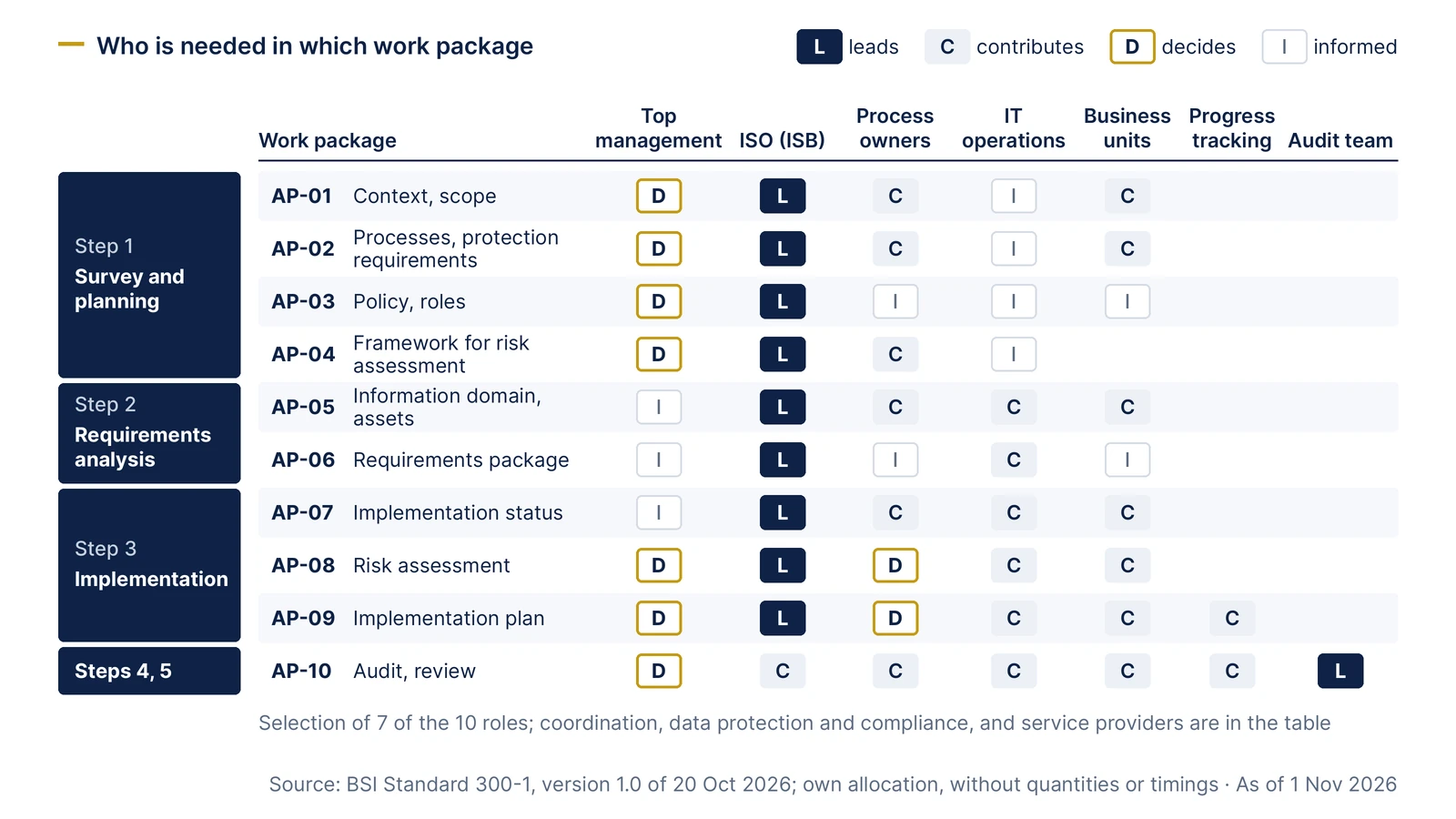
Capacity plan: who is needed in which work package
The matrix is the actual work result. L means leads, C contributes, D decides or approves, I is informed. An empty cell means the role is not needed. The allocation is our proposal and is tied to the references in 300-1 where the standard names a role.
| AP | R1 Top management | R2 ISB | R3 Coordination | R4 Process owners | R5 IT operations | R6 Business units | R7 Data protection, compliance | R8 Progress | R9 Audit team | R10 Service providers |
|---|---|---|---|---|---|---|---|---|---|---|
| AP-01 | D | L | C | C | I | C | C | |||
| AP-02 | D | L | C | C | I | C | I | |||
| AP-03 | D | L | C | I | I | I | C | |||
| AP-04 | D | L | C | C | I | C | ||||
| AP-05 | I | L | C | C | C | C | C | |||
| AP-06 | I | L | C | I | C | I | ||||
| AP-07 | I | L | C | C | C | C | C | C | ||
| AP-08 | D | L | C | D | C | C | C | |||
| AP-09 | D | L | C | D | C | C | C | C | ||
| AP-10 | D | C | C | C | C | C | C | C | L |
Two ways of reading it help with planning. The columns show which role is tied up across the whole project: ISB and coordination throughout, IT operations mainly in AP-05 to AP-09. The rows with a D for R1 show where the project waits for a top management meeting. The D for R4 in AP-08 and AP-09 stands for the authorisation of the implementation planning by the risk owners (Annex 3, criterion 31), while approval of residual risks stays with top management (criterion 30).
What determines the size: surveying the quantity drivers
Before you assess the load per role, survey the quantities. Most of them are available after AP-01 and AP-02, the number of requirements after AP-06. The table shows where each driver acts and where you get it from.
| Quantity driver | affects | Source | Why it counts |
|---|---|---|---|
| Business processes in scope | AP-02, AP-05, AP-07 | Process map or simplified analysis under Annex 2 | Protection requirements per business process (ch. 2.6); each cycle starts with one process |
| of which with high protection requirements | AP-05, AP-08 | Result of AP-02 | Document dependencies on the business process (ch. 3.2) and explicit risk assessment (ch. 2.11) |
| Assets and their data sources | AP-05, AP-06 | CMDB, asset register, network plan, operating manuals | 300-1 allows existing sources to be used (ch. 3.1); their quality decides how much has to be surveyed again |
| Target object categories and requirements in the package | AP-06, AP-07, AP-09 | Result of AP-06 | Every requirement needs a status (ch. 4.1.1) |
| Distribution of effort levels in the package | AP-09 | Field effort_level in the catalogue | shows how many requirements are quick wins (level 1) and how many are elaborate, complex safeguards (level 5) |
| Sites | AP-01, AP-05, AP-10 | Scope | Site inspections, facility requirements, extent of the audit programme (ch. 5.2.1) |
| key service providers and outsourcing | AP-05, AP-07 | Contracts, outsourcing register | Outsourcing boundaries (ch. 3.1); status depends on information from third parties |
| Existing setup | all | existing ISMS under the 2023 Compendium or ISO/IEC 27001 | shortens some packages but requires a comparison in return; see Migration |
For the distribution of effort levels, the catalogue itself gives a point of reference. In the build of 29 October 2026, of the 99 requirements of the methodology and risk management, 79 have level 0, which according to the namespace is not rated because implementation is mandatory in every case. For the 901 requirements from the kernel, the levels are distributed as follows: 0: 69, 1: 44, 2: 166, 3: 275, 4: 158, 5: 189 (own count). Your own package will have a different distribution; count again after AP-06.
Fully worked example (fictitious)
Muster Software GmbH (entirely made up) develops a specialist application for public-sector clients and runs it in its own data centre. Surveyed in AP-01 and AP-02: six business processes in scope, two of them with high protection requirements; two sites; three key service providers; a CMDB in which the mapping of applications to systems is missing for about half of the systems; no ISMS under the 2023 Compendium. Top management has decided to start with the business process "Operating the Musterakte", the operation of the specialist application.
The table shows the estimated load per role in the first cycle on three levels: high, medium, low. The levels are meant relative to each other and do not replace planning in hours. They show where bottlenecks are to be expected and for what top management has to release capacity.
| AP | Quantities in the example | ISB | Process owner | IT operations | Top management | Bottleneck and countermeasure |
|---|---|---|---|---|---|---|
| AP-01 | 1 institution, 2 sites, obligations from contracts with clients | high | low | low | medium | Contract documents are held by sales; name a contact person |
| AP-02 | 6 processes, no process map | high | medium | low | medium | simplified analysis under Annex 2 in one workshop per area |
| AP-03 | no policy in place | high | low | low | medium | schedule coordination with data protection and staff representatives early |
| AP-04 | no risk method in place | high | medium | low | medium | align the method with the 35 minimum criteria (Mindestkriterien) |
| AP-05 | first process with high protection requirements, CMDB incomplete | medium | medium | high | low | IT operations is also fully loaded with day-to-day operations; agree fixed time slots |
| AP-06 | Package for the first process | high | low | medium | low | - |
| AP-07 | Status per requirement, three service providers required to provide information | high | medium | high | low | request information from the service providers in advance |
| AP-08 | Risk assessment for the first process | high | high | medium | medium | Process owner is the risk owner and has to assess personally |
| AP-09 | Implementation plan for the open requirements | medium | medium | high | medium | progress tracking with the ISB, implementation with IT operations (ch. 4.5); because the ISB is under high load overall, controlling takes over the monthly status compilation |
| AP-10 | internal audit of the first cycle | medium | low | medium | medium | staff the audit team independently, internally or externally |
Result for the decision paper: The ISB is under high load in seven of ten packages. The guidance on GC.9.1.1.1.1 only allows the role to be performed alongside other duties if enough time remains for the tasks. The paper therefore proposes a fixed share of the ISB's working time for the project and names a deputy (GC.9.1.1.2). IT operations is the bottleneck in AP-05, AP-07 and AP-09. The paper proposes fixed time slots and points out that prioritisation under UMS.2.2 has to take the availability of resources into account. The remaining five business processes follow in later cycles with their own capacity planning.
Checklist: the release of resources as a decision paper
The paper to top management should be structured so that top management can decide on capacity without knowing the methodology in detail. These points belong in it:
- Size of the cycle: business process, scope, sites (ch. 2.3, 2.6)
- Roles with staffing, deputy and required qualification (GC.9.1.1.2, GC.9.1.1.4)
- Capacity plan: role matrix and load levels per work package
- quantity drivers surveyed and the assumptions still open
- Bottlenecks with countermeasure, explicitly the ISB's share of working time (GC.9.1.1.1.1)
- Conflicts of interest and how they are avoided (ch. 2.8, 4.5; GC.9.1.1.3)
- where external support is planned and for what
- material and technical resources, for example tools for asset recording or ISMS documentation (guidance on GC.8.1)
- When the plan is updated, for example with every status report under ch. 4.5 and in the management review under ch. 5.3
- Proposed resolution
Record the resolution in documented form like the other top management decisions under chapter 2.10. A separate paper follows for the implementation phase, because top management approves the approach separately under chapter 4.4.
Planning external support
External support relieves individual roles; responsibility stays where it is. For the ISMS it lies with top management (ch. 2.10), and process owners remain the risk owners of their risks. Tasks that can be given to external parties include preparing decision papers, moderation and methodology, checking an existing risk method against Annex 3, or an internal audit if the audit team is independent of the set-up work.
Blackfort Technology supports you with the decision and transition planning through a decision paper that includes the resource requirements, with the readiness analysis and migration concept, and with implementation. We set scope and price in a quote after an initial meeting; we do not state prices on this website. Blackfort Technology describes the role of the external information security officer on its company website.
Services: Consulting on IT-Grundschutz and Grundschutz++, Readiness and migration concept. External ISB: https://www.blackfort-tec.de/en.
Rights notice: Quotations from BSI Standard 300-1 (source: BSI page on Grundschutz++) are © Bundesamt für Sicherheit in der Informationstechnik and are not licensed under CC BY-SA 4.0. The licence notice at the end of the page applies only to the extracts from the catalogue data.