

What BSI Standard 300-1 and the user catalogue require
BSI Standard 300-1 deals with the policy in chapter 2.7, that is, in the first process step „Erhebung und Planung“ (survey and planning). There the standard names four aspects to be taken into account „z. B.“ (our translation: "for example"): the commitment of top management, concrete and measurable objectives (it gives SMART as an example), a strategy by which these objectives are to be achieved, and the information security organisation in its strategic orientation. The details of the organisation are covered in chapter 2.8. Top management must approve the policy, and it must be communicated to all staff, „da diese das ISMS in der Institution fest verankert und normiert“ (our translation: "as it firmly anchors and standardises the ISMS in the organisation") (chapter 2.7).
Chapter 2.10 lists approval of the policy among the decision papers that are submitted to top management „insbesondere“ (our translation: "in particular"). The list is not exhaustive. Top management's responsibility for information security already existed in classic IT-Grundschutz (200-2, chapter 2.3). What is new in 300-1 is the consolidated list of decision papers. Formal approval by top management of the written policy was already provided for in 200-2 (chapter 3.4.4), and fundamental management decisions had to be recorded (chapter 5.2.2). In the user catalogue (Anwenderkatalog), the guidance on GC.5.1.4 explicitly requires the authorisation to be documented.
In the user catalogue, the policy sits in the practice (Praktik) Governance and Compliance (GC). The five requirements in group GC.5 are all MUSS requirements (MUST) with the security level „normal-SdT“ (normal, state of the art). The table shows the wording in the build of 29 October 2026 and what follows from it for the document.
| Requirement (build 2026-10-29) | Requirement text in the catalogue | Consequence for the policy |
|---|---|---|
| GC.5.1 Festlegung von Zielen für die Informationssicherheit (setting information security objectives) | „Governance und Compliance MUSS konkrete und messbare Ziele für die Informationssicherheit auf Basis der identifizierten Rahmenbedingungen festlegen.“ (our translation: "Governance and Compliance MUST set concrete and measurable information security objectives on the basis of the identified framework conditions.") | Objectives with metric and target value. According to the guidance, the objectives must be measurable and concrete and should relate to the business objectives. As an example it gives the rate of up-to-date antivirus signatures |
| GC.5.1.1 Festlegung einer Sicherheitsstrategie (setting a security strategy) | „Governance und Compliance MUSS eine grundlegende Strategie zur Erreichung der Ziele für die Informationssicherheit gemeinsam mit der Institutionsleitung festlegen.“ (our translation: "Governance and Compliance MUST set a fundamental strategy for achieving the information security objectives together with top management.") | Strategy section: approach, principles, order |
| GC.5.1.2 Verpflichtung der Institutionsleitung (commitment of top management) | „Governance und Compliance MUSS die Verpflichtung der Institutionsleitung zuweisen.“ (our translation: "Governance and Compliance MUST assign the commitment of top management.") | Commitment section. The guidance lists overall responsibility, monitoring of the objectives, confirmation of the security organisation, provision of resources and support for improvement |
| GC.5.1.3 Erstellung einer Sicherheitsleitlinie (drawing up a security policy) | „Governance und Compliance MUSS eine für die Institution passende Sicherheitsleitlinie festlegen.“ (our translation: "Governance and Compliance MUST set a security policy suited to the organisation.") | As minimum content the guidance names „insbesondere“ (in particular) overall responsibility and commitment of top management, objectives, strategy, roles and responsibilities, and the commitment to continual improvement |
| GC.5.1.4 Freigabe der Sicherheitsleitlinie (approval of the security policy) | „Governance und Compliance MUSS die festgelegte Sicherheitsleitlinie durch die Institutionsleitung autorisieren.“ (our translation: "Governance and Compliance MUST have the defined security policy authorised by top management.") | The guidance reads: „Diese Autorisierung muss dokumentiert werden.“ (our translation: "This authorisation must be documented.") The evidence is the resolution with date and version |
The catalogue speaks of „Sicherheitsleitlinie“ (security policy), the standard of „Informationssicherheitsleitlinie“ (information security policy), BSI Standard 200-2 of the „Leitlinie zur Informationssicherheit“ (policy for information security). They all mean the same document. BSI Standard 200-1 gives "Information Security Policy" as the English term (chapter 7.1). Neither 300-1 nor the GC.5 requirements set a fixed review cycle. According to 200-2, the policy should be „spätestens alle zwei Jahre erneut zu überdenken“ (our translation: "reconsidered at least every two years") (chapter 3.4.5). For Grundschutz++ you set the cycle in the document control procedure (300-1, chapter 2.9; GC.11.1).
Policy, guideline, concept: what goes where
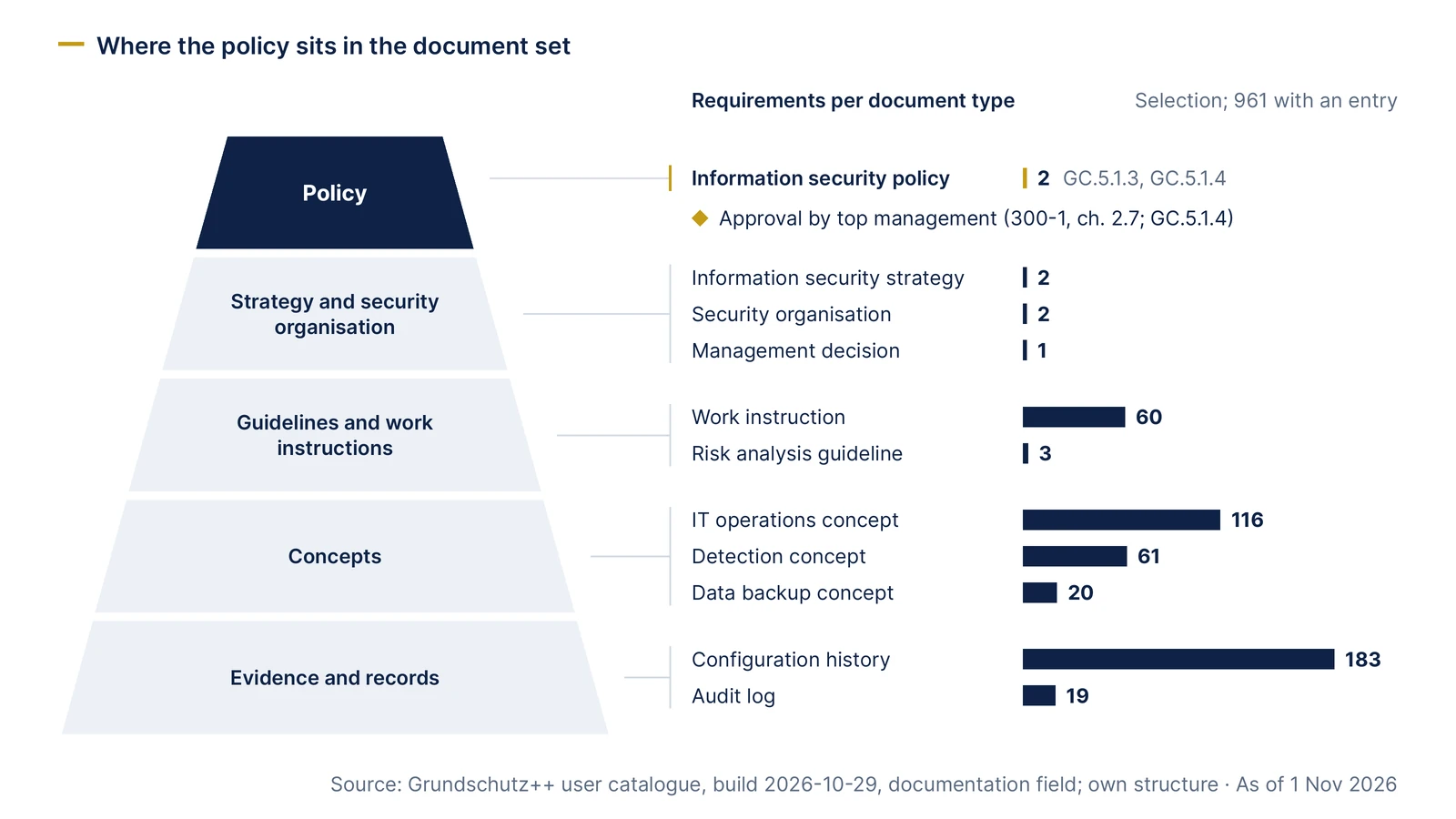
The policy stays short if it contains only what top management decides and what all employees need to know. Rules for individual activities and the technical design belong in subordinate documents. BSI Standard 200-2 already distinguishes the policy, with its fundamental statements, from the guidelines (Richtlinien), in which the safeguards to be implemented are set down in a way staff can understand (chapter 5.2.2). 300-1 does not prescribe a document hierarchy. The structure below is our own classification.
The catalogue itself offers a pointer: almost every requirement has a recommended document type in the documentation field. In the build of 29 October 2026 we counted 961 requirements with this field. Only two of them fall under the document type „Informationssicherheitsleitlinie“ (information security policy), namely GC.5.1.3 and GC.5.1.4. 116 fall under „IT-Betriebskonzept“ (IT operations concept), 60 under „Arbeitsanweisung“ (work instruction), 61 under „Detektions-Konzept“ (detection concept) and 20 under „Datensicherungskonzept“ (data backup concept). The policy is therefore a slim document to which many others refer.
| Document type | Purpose | Audience | Approval (own definition unless otherwise sourced) | Reason for change (examples) | Examples of values in the documentation field |
|---|---|---|---|---|---|
| Information security policy | Objectives, strategy, commitment of top management, organisation in outline | all employees | top management (300-1, ch. 2.7 and 2.10; GC.5.1.4) | new organisational objectives, changed scope, new organisation | Informationssicherheitsleitlinie (2) |
| Strategy and security organisation | Objectives with measurement methods, roles with authority, committees, deputies | top management, information security officer (ISB), role holders | top management | change of role holder, new objectives | Informationssicherheitsstrategie (2), Sicherheitsorganisation (2), Leitungsentscheidung (1) |
| Guidelines and work instructions | binding rules for activities, e.g. handling passwords, reporting events | affected employees, service providers | responsible manager after consultation with the ISB | new threat, audit finding, incident | Arbeitsanweisung (60), Richtlinie zur Risikoanalyse (3) |
| Concepts | functional and technical design of an area | responsible specialists, IT operations | responsible specialists | new systems, changes in the information domain | IT-Betriebskonzept (116), Detektions-Konzept (61), Datensicherungskonzept (20) |
| Evidence and records | show that a rule has been implemented | ISB, audit team | no approval, but document control | ongoing | Konfigurationshistorie (183), Audit Log (19) |
A rule of thumb for the draft: if a sentence would have to change as soon as you switch a product, a service provider or a deadline for updates, it belongs in a guideline or a concept. The policy refers to these documents without repeating them. For business continuity management, the catalogue has a separate document type „BC-Leitlinie“ (BC policy) (NOT.1.1 and NOT.1.1.4). It complements the information security policy. BSI Standard 200-4 on business continuity management has not been superseded by 300-1, and the catalogue sets the parameter „BSI-Standard 200-4“ for NOT.1.1.4. How the documents come together into a dossier is shown on the page Security concept.
Annotated template: ten sections
The template maps the requirements of chapter 2.7 and of GC.5.1 to GC.5.1.4 to ten sections. The order is our suggestion. The "Source" column shows where the obligation comes from. Where it says "own recommendation", neither the standard nor the catalogue explicitly requires the section.
| No. | Section | Content | Comment | Source |
|---|---|---|---|---|
| 1 | Applicability | The scope to which the policy applies, with a reference to the document that defines it | Do not describe the scope again. Top management defines it separately. Name excluded areas, if there are any | 300-1, ch. 2.3 and 2.10; GC.6.1 |
| 2 | Importance | Why information security matters for the organisation's tasks; which business processes and information are the focus | Two or three sentences relating to the organisation's objectives; no threat prose | GC.5.1 (guidance: objectives should relate to the business objectives) |
| 3 | Commitment of top management | Overall responsibility, provision of resources, monitoring of objectives, promotion of the ISMS | Under 300-1, responsibility for the ISMS cannot be delegated. The policy should say so | 300-1, ch. 2.7 and 2.10; GC.5.1.2 |
| 4 | Objectives | Three to five concrete, measurable objectives with metric, target value and responsibility for measurement | Choose objectives so that the performance evaluation can measure them later. According to the milestone plan, BSI performance indicators for the methodology requirements are announced for 31 Mar 2027 | 300-1, ch. 2.7 and 5.1; GC.5.1 |
| 5 | Strategy | Approach (Grundschutz++ under 300-1), protection requirements per business process, order of the business processes, principles of risk assessment | The strategy says how the objectives are to be achieved. The catalogue sets the parameter „BSI Grundschutz++“ for GC.1.1 | 300-1, ch. 2.6, 2.7 and 2.11; GC.1.1, GC.5.1.1 |
| 6 | Organisation | Roles in outline: top management, ISB with direct reporting right, business process owners, committee; reference to the organisation document | Only the strategic orientation. Authority, deputies and qualifications belong in the security organisation document | 300-1, ch. 2.7 and 2.8; GC.9.1, GC.9.1.1.1, GC.9.1.1.1.2 |
| 7 | Duties of all employees | Compliance with guidelines, duty to report events, involvement of service providers | Keep it short. The individual rules are in the guidelines | own recommendation; communication to all under 300-1, ch. 2.7 |
| 8 | Framework conditions | Reference to the register of legal and contractual obligations | Do not list laws individually, otherwise the policy goes out of date with every change | 300-1, ch. 2.2; GC.3.1 |
| 9 | Improvement | Commitment to continual improvement, management review, handling of deviations | Link to the management review so that the objectives reappear there | GC.5.1.3 (guidance); 300-1, ch. 5.3 and 6 |
| 10 | Entry into force | Approval note with date, version, start of validity, next review date, place of publication | Without documented authorisation, GC.5.1.4 remains unfulfilled | 300-1, ch. 2.7 and 2.9; GC.5.1.4, GC.11.1 |
What does not belong in it: password lengths, product names, network diagrams, deadlines for applying updates, names of individual employees (roles are enough) and confidential details. 200-2 advised moving confidential statements to a marked annex (chapter 3.4.4). 300-1 sets no requirement on length. 200-2 noted that „mehr als 20 Seiten in der Praxis nicht bewährt haben“ (our translation: "more than 20 pages have not proved their worth in practice") (chapter 3.4.3).
Completed sample for a fictitious organisation
The following sample is entirely invented. Muster Software GmbH stands for a software company with around 120 employees that develops a specialist application for public-sector clients and runs it in its own data centre. Do not adopt the text without checking it: objectives, roles and strategy must come from your own survey under chapters 2.1 to 2.6.
Muster Software GmbH (fictitious): Information security policy, version 1.0
1 Applicability
This policy applies to the scope of the ISMS as defined by the management board in resolution GF-03: development and operation of the specialist application "Musterakte", including the head office and data centre sites. The internal canteen administration is excluded.
2 Importance
Our clients entrust us with administrative data about citizens. An outage or a breach of confidentiality directly affects their administrative procedures and our survival as a provider. Information security is therefore one of our corporate objectives.
3 Commitment of the management board
The management board bears overall responsibility for information security and does not delegate it. It provides staff, budget and technology for the ISMS, receives a report on the objectives at least once a year in the management review and decides on resources, protection requirements, the order of the business processes and residual risks.
4 Objectives
| Objective | Metric and target value | Measured by |
|---|---|---|
| Z-1 Status known | For 100% of the requirements in the requirements package there is an implementation status no more than three months old | ISB, quarterly |
| Z-2 Close vulnerabilities quickly | At least 95% of vulnerabilities rated critical on systems of the specialist application are remediated within seven days | IT operations, monthly |
| Z-3 Resume operations | The specialist application is available again within eight hours after a disruption | Head of operations, per disruption and annual exercise |
| Z-4 Employees trained | All employees have completed the information security briefing in the calendar year | HR department, every six months |
5 Strategy
We run the ISMS under BSI Standard 300-1 „Methodik Grundschutz++“ (Grundschutz++ methodology) and build our requirements package from the Grundschutz++ user catalogue with a documented catalogue version. We determine protection requirements per business process in the categories "normal" and "high". We start with the business process "Operation of Musterakte" and add the remaining business processes in the order set by the management board. Where protection requirements are high, an asset is not adequately covered or a SOLLTE requirement (SHOULD) is permanently not fulfilled, we carry out a risk assessment in accordance with our risk analysis guideline. For SOLLTE requirements that are planned but not yet fulfilled, we assess the residual risk and submit it to the management board for approval.
6 Organisation
The management board has appointed an information security officer who reports directly to it, can present to it directly at any time and has no management role in IT operations. The security team, made up of the ISB, the head of operations, the head of development and the data protection officer, meets monthly. The business process owners are also the risk owners. Details are set out in the document "Security organisation".
7 Duties of all employees
All employees comply with the information security guidelines and report events that could impair security without delay through the known reporting channels. We bind service providers contractually to the rules that apply to them.
8 Framework conditions
We keep the legal and contractual obligations in the register of compliance obligations. The compliance office and the ISB keep it up to date together.
9 Improvement
We improve the ISMS continually. We evaluate deviations, audit findings and incidents and include corrections in the implementation plan. The management review checks annually whether the objectives have been achieved and whether this policy is still appropriate.
10 Entry into force
| Version | 1.0 |
| Approval | Management board resolution GF-07 with date and signature |
| Valid from | The day after publication on the intranet |
| Next review | at the next management review, at the latest after twelve months |
| Announcement | Intranet, circular email with acknowledgement, part of onboarding for new employees |
The target values in the sample are examples and not specified by the BSI. How to translate objectives into indicators for top management later is shown on the page Management review and indicators. What the same sections look like in a continuous case is shown in the case file, part 1: survey and planning.
Consulting, approving, announcing
300-1 does not specify who contributes to the policy. 200-2 recommended involving as many areas as possible, including IT operations, the data protection officer, the HR department and the staff council, internal audit and the legal department (chapter 3.4.1). For Grundschutz++, the analysis of interested parties under chapter 2.4 is a good starting point. Internally it explicitly covers top management, employees, managers and staff councils, and you add the other areas. The checklist shows the process with evidence.
| Step | Who | Result and evidence | Source |
|---|---|---|---|
| 1. Obtain a mandate | ISB from top management | Mandate to draw up the policy, date for the decision paper | own recommendation; 200-2, ch. 3.4 |
| 2. Derive the draft from the survey | ISB | Draft that refers to context, compliance obligations, scope and protection requirements | 300-1, ch. 2.1 to 2.6 |
| 3. Consult | Security committee, data protection, staff council, business units, IT operations | Comments and list of changes | 300-1, ch. 2.4; 200-2, ch. 3.4.1 |
| 4. Decision paper | ISB to top management | Paper with proposed resolution, objectives and open points | 300-1, ch. 2.10 |
| 5. Approval | Top management | Documented resolution with version and date | 300-1, ch. 2.7; GC.5.1.4 |
| 6. Announcement | ISB with communications and HR department | Publication, evidence of acknowledgement, inclusion in onboarding | 300-1, ch. 2.7; PERS.3.7 (onboarding of new starters, SOLLTE) |
| 7. Control and review | ISB | Entry in the document register with review date; review when objectives, scope or organisation change | 300-1, ch. 2.9; GC.11.1 |
Because the policy has to be communicated to all staff, people hired later are included. For step 6, therefore, record at which point in onboarding new employees receive the policy.
Reusing an existing policy under 200-2
If you already work under classic IT-Grundschutz, you have a policy. It does not have to be written from scratch when you move to Grundschutz++, but it needs sharpening in a few places. The review questions follow from comparing 200-2 with 300-1 and the catalogue:
| Review question | Background | Typical change |
|---|---|---|
| Does the policy still name 200-2 and the IT-Grundschutz Compendium as the approach? | GC.1.1 sets the parameter „BSI Grundschutz++“ | Switch the strategy to 300-1 and the user catalogue with catalogue version, name the transition period |
| Are the objectives measurable? | 300-1 requires concrete and measurable objectives (ch. 2.7), as does GC.5.1 | Replace general objectives such as "a high level of security" with metric and target value |
| Does it refer to three protection requirements categories? | 300-1 specifies two categories per business process (ch. 2.6) | Switch the strategy to "normal" and "high" per business process. Additional categories of your own are allowed but must be mapped to the two |
| Does the ISB report directly to top management? | GC.9.1.1.1 (MUSS) and GC.9.1.1.1.2 (direct reporting right, MUSS) | Add the reporting line and the right to present in section 6 |
| Does it contain the commitment to continual improvement? | Guidance on GC.5.1.3 | Add section 9 |
| Does the policy refer to a risk analysis under 200-3? | Grundschutz++ leaves the method open as long as it meets the minimum criteria (Mindestkriterien) in Annex 3 (ch. 2.11) | Reference to your own risk analysis guideline; check on the page Risk minimum criteria |
Which other documents change when you move is set out in the comparison of IT-Grundschutz 2023 and Grundschutz++, and the transition process is described on the page Migration.
Support
When setting up an ISMS or migrating to Grundschutz++, Blackfort Technology also supports the decision papers under chapter 2.10, including the paper for approving the policy. The scope of services is described on the page Consulting. General ISMS consulting without an IT-Grundschutz focus is available on the company website at https://www.blackfort-tec.de/en.
Rights notice: Quotations from BSI Standard 300-1 (source: BSI page on Grundschutz++) and from BSI Standards 200-1 and 200-2 (source: BSI page on the BSI Standards) are © Bundesamt für Sicherheit in der Informationstechnik and are not licensed under CC BY-SA 4.0. The licence notice at the end of the page applies only to the extracts from the catalogue data.