

Summary of the thesis
| Original title | „IT-Grundschutz-Profil für Versicherungsunternehmen der Privatwirtschaft“ (IT-Grundschutz Profile for private-sector insurance undertakings) |
|---|---|
| Type | Thesis. The title page notes: „Das vorliegende IT-Grundschutz-Profil wurde im Rahmen einer Masterarbeit erstellt.“ (our translation: "This IT-Grundschutz Profile was produced as part of a master's thesis.") Not an association profile published by the BSI, not a critical infrastructure (KRITIS) profile |
| Author | Madlin Marisa Rech; according to ch. 2.1 „in Zusammenarbeit mit VdPs erstellt“ (our translation: "produced in cooperation with VdPs", i.e. private-sector insurance undertakings), without naming the undertakings |
| University and supervision | named neither in the document nor on the two BSI pages |
| Version and date | Version 1.0 of 9 Dec 2021 according to the version history (first publication, no further version). The BSI list of profiles gives 9 Dec 2021, the BSI download page the date 15 Jan 2026; the version available there still states version 1.0. What lies behind the newer date cannot be determined. |
| Compendium edition | IT-Grundschutz Compendium, Edition 2021 (bibliography [7]); methodology according to BSI Standards 200-2 and 200-3 |
| Approach | Core Protection according to BSI Standard 200-2, limited to the core business processes for handling benefit cases and claims (ch. 2.3) |
| Scope of the document | 122 pages (PDF, about 2 MB), page numbering A-1 to A-109 including glossary, plus bibliography; 182 tables, 53 of them on the exemplary risk analysis in the annex |
| Availability | freely available via the BSI page on the document, without registration; confidentiality according to the title page „öffentlich“ (public) |
| Licence and rights | The document contains no licence information. We treat it as protected by copyright, quote only briefly with reference and otherwise reproduce the content in our own words; we do not reproduce tables and figures of the thesis. |
| Reference | BSI page „IT-Grundschutz-Profil für Versicherungsunternehmen der Privatwirtschaft“, retrieved on 2 Nov 2026 |
All profiles at a glance, with publisher, status and Compendium edition, are listed on the page Finding and reusing IT-Grundschutz Profiles.
Scope: the benefit case from recording to payment
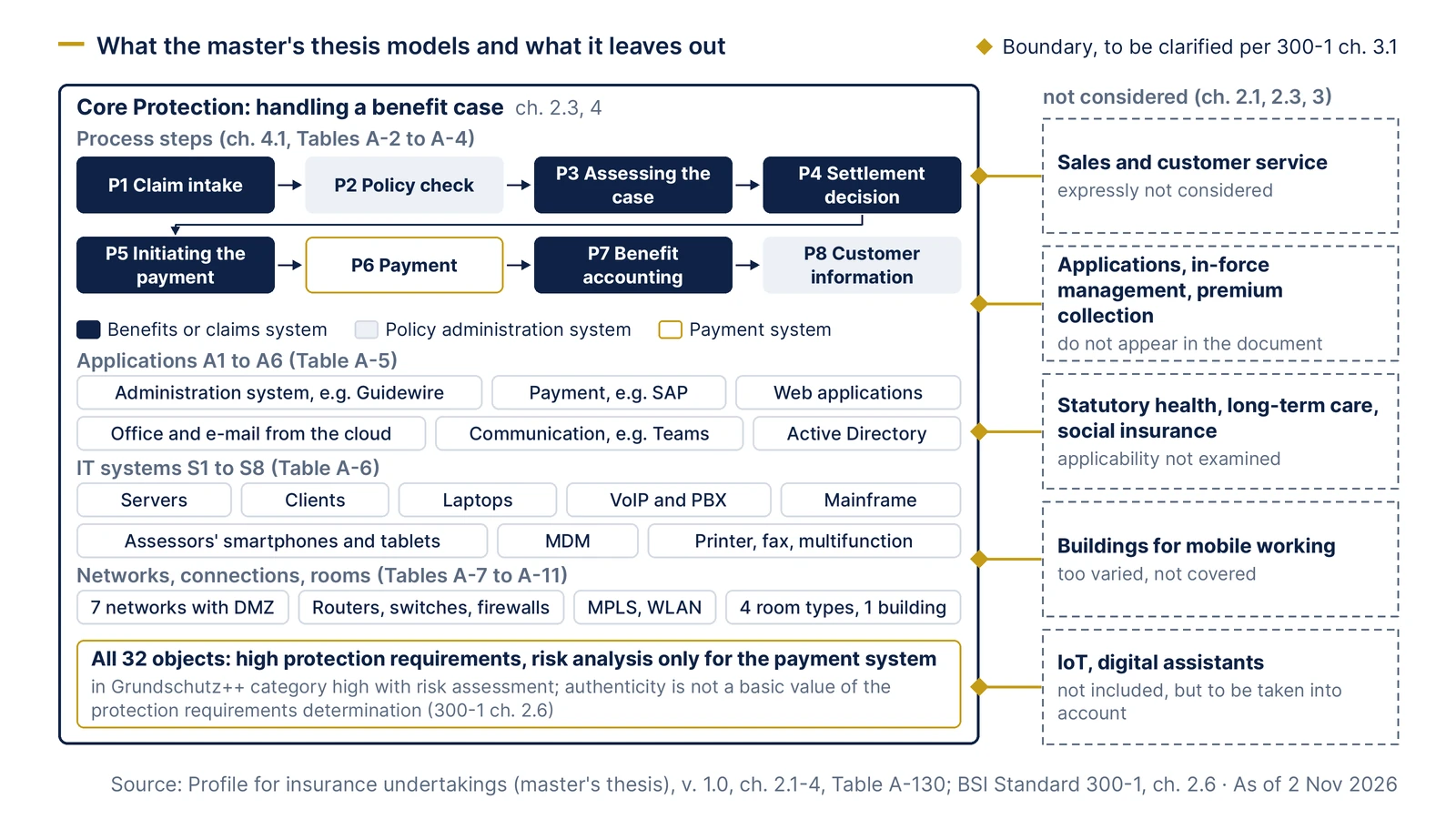
The thesis is aimed at those responsible for information security in private-sector insurance undertakings, abbreviated VdP (Versicherungsunternehmen der Privatwirtschaft) (chapter 1.2). This means undertakings that offer life insurance, property and casualty insurance or private health insurance. The lines of business are named using terms from the BSI Critical Infrastructure Ordinance (BSI-Kritisverordnung) (chapter 2.1). For statutory health and long-term care insurance and for the bodies of statutory pension, accident and unemployment insurance, applicability was expressly not examined, because other legal frameworks apply to them.
The scope is deliberately narrow. Only the processes that handle a benefit case or claim are considered, „da in diesen finanziellen Transaktionen erfolgen“ (our translation: "since financial transactions take place in them") (chapter 2.3). The thesis expressly does not consider processes for sales and customer service. Applications, in-force policy management, premium collection and intermediary support do not appear in the document. The policy administration system appears only where the benefit case needs it: in the policy check and in informing the customer.
The reference architecture (chapter 4) assigns eight process steps to the three systems that the Kritisverordnung names for insurance services. The benefits or claims system covers recording the benefit case (P1), assessing the benefit case (P3), settlement decision (P4), initiating the payment (P5) and benefit accounting (P7); the policy administration system covers the policy check (P2) and customer information (P8); the payment system covers the payment itself (P6). Six applications build on this: an administration system that combines the policy, claims and benefits systems (example Guidewire), a payment system based on ERP (example SAP), web applications, for instance for weather data queries during claims assessment, office applications and e-mail as a cloud solution (example Microsoft Office 365), a communication system (example Microsoft Teams) and Active Directory.
Two things stand out among the IT systems: mainframes („Mainframes“), on which, according to the thesis, many insurers still run core applications, and mobile devices with mobile device management, used above all by third parties such as assessors when examining benefit cases (Table A-6). In addition there are seven networks, from client, server and management network via ISP network and DMZ to telephone and printer network, routers, switches and firewalls, cabling, an MPLS leased line and WLAN, four types of room including the mobile workplace, and one building. In total there are 32 target objects (annex, Table A-130).
Excluded are the buildings in which people work remotely, because they are too varied (chapter 3.2), and IoT devices such as digital assistants, which some insurers already use; the thesis recommends taking them into account nonetheless (chapter 3.1). The network plan shows a generic topology; in practice the mainframe may sit in a network of its own (chapter 4.3.4). If your own information domain differs, missing or additional objects are to be documented and assigned to suitable modules (chapter 4.6). The checklist further down starts there.
Does the thesis fit your organisation?
The thesis fits if …
- you run life, property and casualty or private health insurance and want to start with benefits and claims handling as your first scope;
- your IT resembles the model: a central administration system for policy, claim and benefit, an ERP-based payment system, mainframes, office software from the cloud, assessors with mobile devices;
- you are looking for justifications for the protection requirements determination that already phrase health data, payment transactions and downtime of the payment in insurance terms;
- you need a ready-made module selection from the 2021 edition as a cross-check for your own modelling.
The thesis does not fit, or only to a limited extent, if …
- you protect statutory health or long-term care insurance or a social insurance body: applicability was not examined for these (chapter 2.1);
- your scope covers the whole undertaking: sales and customer service are excluded, applications, in-force policy management, premium collection and intermediary support do not appear;
- customer portals, apps or intermediary platforms are part of the core: mobile applications are considered not necessary (Table A-55), and web applications are modelled only for examining benefit cases;
- core systems run at an IT subsidiary, a group data centre or a service provider: the thesis names group membership and outsourced IT only as influencing factors (chapter 2.1) and does not model them;
- you expect a complete risk analysis: it exists only for the payment system;
- you have to cover requirements from DORA: the thesis was written before DORA started to apply and refers to the VAIT, which have since been repealed;
- you start directly with Grundschutz++: then you take over the eight process steps, the 32 target objects as a starting list of assets and the justifications for health and bank data; the assignment to target object categories (Zielobjektkategorien) takes the place of the module selection from the 2021 edition (see below).
What makes the thesis special
Authenticity as a fourth security objective: in addition to confidentiality, integrity and availability, the thesis consistently assesses authenticity and justifies this with the then requirements of the VAIT and the BSI Act (BSIG) (chapter 2.2 and section „3. Anwendungshinweise“ (application notes)). Specifically, this concerns the genuineness of the beneficiary at payment (P5, P6) and of the persons involved and policyholders in all other steps (Table A-20).
Protection requirements with an insurance focus: the categories are applied to insurer and policyholder (Tables A-12 to A-16). Health data under Article 9 GDPR lead to high protection requirements, and so do bank details for the payment. For availability, the thesis distinguishes: initiating and executing the payment are high, with a tolerable downtime between one and 24 hours; all other steps are normal, with 24 to 72 hours (Table A-19). Confidentiality is high for all eight steps: for P5 and P6 because of the bank details, for all others because medical information may be included (Table A-17). In the end, all 32 target objects have high protection requirements, none very high (Table A-130).
Assessors and other third parties: for 26 modules, the thesis adds a note in the requirement tables that „ebenfalls externe Mitarbeiter und Dritte (wie zum Beispiel Gutachter)“ (our translation: "external staff and third parties (such as assessors) as well") are to be taken into account (27 tables, because DER.3.1 appears twice), for example for awareness, authorisations, backup, deletion, VPN and mobile working (Tables A-60 to A-128). Outsourcing becomes relevant as soon as IT administration or the examination of benefit cases is outsourced (Table A-81).
Cloud instead of office software modules: because Office 365 is said to be used as a cloud solution in most organisations, the thesis excludes the modules for office products and for e-mail servers and clients and instead assigns cloud usage to applications A2 to A4 (Tables A-55, A-82). In addition, it names the BSI's C5 criteria catalogue and further cloud guidelines (section „4. Unterstützende Informationen“ (supporting information)).
Module selection and one additional requirement: 97 modules of the 2021 edition are examined, 69 are considered relevant and 28 are excluded with a justification, among them industrial IT, Android, macOS, removable media and the IS audit according to the guideline. For the firewall, the thesis additionally recommends NET.3.2.A27, so that attackers „nicht dieselbe Sicherheitslücke mehr als einmal ausnutzen können“ (our translation: "cannot exploit the same vulnerability more than once") (Table A-118). For implementation, the order R1, R2, R3 applies (section „3. Anwendungshinweise“).
Exemplary risk analysis: because all target objects have high protection requirements, a risk analysis according to BSI Standard 200-3 would be required for each of them. The thesis carries it out only for the payment system and leaves the remaining 31 target objects to the users. Of 47 elementary threats, 25 are considered relevant; threats that affect only the hardware, such as fire or power failure, are assessed as not relevant for the payment system as software (annex 1.1). They apply again to server, mainframe and data centre. Without additional safeguards, violation of laws, misuse of personal information and malware are rated „sehr hoch“ (very high); with the safeguards named, for example encryption, multi-factor authentication, least privilege and redundancy, all risks fall to „gering“ (low) (Tables A-181, A-182). The thesis itself stresses that this assessment is theoretical and must be based on the actual state of the undertaking (section 2.1.4 of the residual risk assessment).
In nine places, the structure, text and tables of the thesis do not match; check them before you take over tables: the table of contents counts chapter 4.1 twice, and after 5.2 the numbering jumps to „1.1. Relevanz der Anforderungen“ (relevance of the requirements) and „2. Restrisikobetrachtung“ (residual risk assessment), while the text cites these parts as chapters 5.3 and 6. Chapter 4.1 once speaks of P1 to P7, the tables list P1 to P8. Chapter 5.2 names the module „SYS.1.2 Windows Server 2012“, the requirement table SYS.1.2.2. Table A-26 lacks the mainframe S8. The printer network has normal availability in Table A-31 and high availability in Table A-130. Section 2.1.4 of the residual risk assessment counts 13 medium, eleven high and three very high risks, i.e. 27, while assessment Table A-181 contains 25 threats with 12, 10 and 3. Table A-128 is headed INF.8 but contains INF.9; DER.3.1 appears twice (Tables A-87, A-88).
Working aid: checklist for deviations from the model insurer
The eleven questions go through the places where an insurer can deviate from the model in the thesis: scope, group IT, office software from the cloud, assessors, mainframe and input channels. Every yes results in a process, an object or an interface that you document according to chapter 4.6 of the thesis. The right-hand column shows what follows from it for the insurer's requirements package: an additional business process (BSI Standard 300-1 chapter 2.5), an asset with a target object category (annex 1), an interface that chapter 3.1 wants documented „organisatorisch, technisch sowie infrastrukturell“ (our translation: "organisationally, technically and in terms of infrastructure"), or a supplementary requirement (chapter 3.4.3).
| No. | Question | What the thesis says | If yes: how to handle it in Grundschutz++ |
|---|---|---|---|
| 1 | Should your scope cover more than benefits and claims handling, for example applications, in-force policy management, premium collection, distribution or customer service? | only P1 to P8; sales and customer service expressly not considered (ch. 2.3) | identify every additional process and determine its protection requirements separately (300-1 ch. 2.5, 2.6); the scope of the thesis is suitable as the first process, because 300-1 recommends starting with the most important process of the highest category |
| 2 | Do the administration or payment systems run wholly or partly at an IT subsidiary, within the group or at a service provider? | outsourcing relevant for P1 to P8 if outsourced (Table A-81); in-house or outsourced IT only as an influencing factor (ch. 2.1) | answer the outsourcing delimitation according to 300-1 ch. 3.1; record the service as an asset of the category outsourcing or cloud services (annex 1) |
| 3 | Do you use office software, e-mail or communication from the cloud? | assumed as the norm; office and e-mail modules excluded, cloud usage for A2 to A4 (Tables A-55, A-82) | record each service as an asset of the category cloud services; the category applications covers in-house use |
| 4 | Do external assessors, adjusters or service providers examine benefit cases with their own or provided devices? | smartphones and tablets with MDM for assessors (Table A-6); notes on 26 modules to include third parties | document assessors as personnel assets, their devices as mobile devices and their access as an interface; if the examination is outsourced, also question 2 |
| 5 | Is the mainframe in a network of its own, or is it operated by a service provider? | in the model in the server network, a network of its own expressly possible (ch. 4.3.4) | manage the mainframe as an asset of its own with its own network boundaries; platform-specific requirements as supplementary requirements (see example 3 below) |
| 6 | Are web applications that touch benefit cases reachable from outside, for example online claims reporting, customer portal or intermediary portal? | web applications only for queries during the examination, in the DMZ; risks of externally reachable instances may differ (section 2.1.4 of the residual risk assessment) | each application as an asset, each access from outside as an interface; risk assessment per instance, not per type of application |
| 7 | Do benefit cases come in via further channels, for example post with scanning, app, telephony in customer service or data exchange with benefit providers (Leistungserbringer)? | communication via Office, Teams, telephony and fax; apps excluded as not necessary (Tables A-5, A-55) | document each input channel as a data path and interface; record the applications and service providers behind it as assets |
| 8 | Do you want to continue assessing the authenticity of the payee separately? | authenticity as a fourth security objective, high for the payment (ch. 2.2, Table A-20) | Grundschutz++ determines protection requirements for confidentiality, integrity and availability (300-1 ch. 2.6). Our proposal: formulate the verification of the payee as a supplementary requirement or manage it in the risk assessment for the payment |
| 9 | Do you use clients or mobile devices with operating systems other than those in the model, or IoT devices and digital assistants? | Windows clients and iOS devices assumed; other operating systems and IoT only as a note (ch. 3.1, Table A-56) | assign devices to the matching target object category (300-1 annex 1); IoT devices as assets of their own with an interface to the network |
| 10 | Do subsidiaries, foreign units or several sites belong to the project? | named as influencing factors, one building in the model (ch. 2.1, Table A-11) | define the scope of application; it „kann einen oder mehrere Informationsverbünde enthalten“ (our translation: "can contain one or more information domains") (300-1 ch. 3.1) |
| 11 | Has a risk analysis already been carried out for the remaining target objects? | only for the payment system, the remaining 31 target objects remain open (section „2. Restrisikobetrachtung/Risikobehandlung“ (residual risk assessment/risk treatment)) | risk assessment for all business processes with high protection requirements (300-1 ch. 2.6, 4.2); the threat selection of the thesis as a starting point, add hardware threats for systems and rooms |
Which target object category fits assessor devices, mainframe or group IT is our proposal; check it against the category definitions in annex 1 of 300-1. How to define group IT and service providers as boundaries of the information domain is described on the page Defining the information domain; how to extend the risk assessment beyond the payment system, on the page Carrying out a risk analysis.
Route to Grundschutz++: what remains of the thesis
For an insurer, three things change in the transfer: the eight process steps all end up in the category high, the inheritance of protection requirements to 32 target objects becomes an assignment of assets, and of the valid requirements of the 69 modules only just over one in four has an entry in the draft mapping. On 2 November 2026 we did not find a Grundschutz++ version of the thesis, which is based on BSI Standard 200-2 and the 2021 Compendium.
First, protection requirements. Grundschutz++ determines them for business processes, for the basic values confidentiality, integrity and availability, and has two categories (300-1 chapter 2.6). 300-1 describes the category high as „die Auswirkungen können beträchtlich sein“ (our translation: "the impact can be considerable"), almost word for word the description the thesis uses for its „hoch“ (high) (Table A-12). Since each of the eight process steps is high in at least one basic value, all of them end up in the category high, and for business processes with high protection requirements a risk assessment is required (chapters 2.6, 2.11). The scope of the thesis matches a recommendation of the standard: „Der GS++ empfiehlt, bei erstmaliger Implementierung eines ISMS mit dem wichtigsten Geschäftsprozess aus der höchsten Schutzbedarfskategorie zu beginnen“ (our translation: "GS++ recommends starting with the most important business process from the highest protection requirements category when implementing an ISMS for the first time") (chapter 2.6). Authenticity is not a basic value of this determination; how to carry it forward is covered by question 8 of the checklist.
Second, inheritance. Tables A-21 to A-49 pass the protection requirements on from processes to applications, systems, networks, rooms and buildings. In Grundschutz++ you instead assign assets to the processes and to target object categories; the protection requirements of the process determine which security level you choose for the requirements (300-1 chapter 3.4.2). You can use the 32 target objects of the thesis as a starting list of assets.
Third, the modules. For the 69 modules that the thesis marks as relevant, we have counted the draft mapping IT-Grundschutz 2023 to Grundschutz++. First we had to bring the identifiers to the 2023 edition: OPS.2.1 „Outsourcing für Kunden“ (outsourcing for customers) no longer exists in 2023, so we count OPS.2.3 „Nutzung von Outsourcing“ (use of outsourcing) instead (our proposal); instead of „SYS.1.2“ we count SYS.1.2.2 „Windows Server 2012“, as the requirement table of the thesis names it; SYS.2.2.3 is called „Clients unter Windows“ (clients under Windows) in 2023. We counted in the mapping file with status „draft“ of 21 July 2026 and looked up the targets in the user catalogue (Anwenderkatalog) build 2026-10-29. The result is a draft and not an official mapping.
How to record the classification high for health and bank data with a justification is described on the page Assessing protection requirements on a justified basis.
| Metric (69 modules of the thesis, 2023 identifiers) | Value |
|---|---|
| Requirement identifiers in the 2023 Compendium | 1,408, of which 227 are marked as dropped, i.e. 1,181 valid |
| Requirements with at least one entry in the draft mapping | 338 (around 29 % of the valid ones), none of them dropped |
| Distinct Grundschutz++ requirements as targets | 278 from 18 practices; most in DET (72), ARCH (61), TEST (30) and KONF (26) |
| Modules without a single entry | 12: ORP.4 Identity and Access Management, CON.2 Data Protection, CON.3 Backup Concept, CON.6 Deleting and Destroying Data, OPS.1.2.4 Teleworking, SYS.1.2.2 Windows Server 2012, SYS.1.3 Linux and Unix Servers, SYS.3.2.3 iOS (for Enterprise), NET.4.3 Fax Machines and Fax Servers, INF.5 Room or Cabinet for Technical Infrastructure, INF.7 Office Workplace, INF.9 Mobile Workplace |
| Modules typical for insurers | SYS.1.7 IBM Z: 38 identifiers, 4 dropped, 3 with an entry; APP.4.2 SAP ERP System: 32, 2 dropped, 6 with an entry; OPS.2.3 Use of Outsourcing: 24, 2 with an entry; OPS.2.2 Cloud Usage: 19, 1 with an entry |
| Target references that cannot be resolved in the catalogue | 10 references, all to the same identifier VRB.1.2 (not included in the 278 targets) |
For an insurer this means: precisely the systems that the thesis highlights as typical for the sector, mainframe, ERP payment and outsourced services, are hardly linked in the draft. An entry in the mapping also does not mean that the requirement is fully covered; the relationships range from equivalent to partial overlap. We have traced three places in the thesis individually:
| Place in the thesis | Requirement Compendium 2023 | Target in Grundschutz++ (catalogue build 2026-10-29) | Gap |
|---|---|---|---|
| Table A-118 on NET.3.2: additionally fulfil NET.3.2.A27 so that a vulnerability cannot be exploited twice | NET.3.2.A27 „Einsatz verschiedener Firewall-Betriebssysteme und -Produkte in einer mehrstufigen Firewall-Architektur“ (our translation: "Use of different firewall operating systems and products in a multi-tier firewall architecture") (elevated protection needs, SOLLTE, i.e. SHOULD) | Mapping: equivalent (equivalent-to) to ARCH.5.1.13 „Produktdiversität“ (our translation: "Product diversity"), security level elevated (erhöht), KANN, i.e. MAY: use filter products from different manufacturers for external network connections | Optional in Grundschutz++. The recommendation of the thesis is only retained if you justify it in the risk assessment or manage it as a supplementary requirement (300-1 ch. 3.4.2, 3.4.3) |
| Annex 1.5 on the payment system: „Es wird eine Mehr-Faktor-Authentisierung verwendet.“ (our translation: "Multi-factor authentication is used.") as a safeguard against espionage, identity theft, misuse of authorisations and further threats | ORP.4.A21 „Mehr-Faktor-Authentisierung“ (our translation: "Multi-factor authentication") (elevated protection needs, SOLLTE; likewise in the 2021 edition). On ORP.4 the thesis lists requirements A1 to A19 (Table A-64) and adds multi-factor authentication only as a safeguard of the risk analysis | Mapping: ORP.4 has no entry at all in the draft, so neither has A21. Our own search in the catalogue: BER.5.9 „Mehr-Faktor-Authentisierung für weitreichende Berechtigungen“ (our translation: "Multi-factor authentication for far-reaching authorisations") (normal-SdT, SOLLTE; the guidance also names access to particularly sensitive data) and BER.5.8 „Mehr-Faktor-Authentisierung am Perimeter“ (our translation: "Multi-factor authentication at the perimeter") (normal-SdT, SOLLTE, phishing-resistant for all interfaces reachable from outside) | The assignment is ours, not that of the draft. Grundschutz++ raises multi-factor authentication to the normal security level; whether every access to the payment system falls under it is for you to decide |
| Table A-103: SYS.1.7 for the mainframe S8, requirements A1 to A31 | SYS.1.7.A8 „Einsatz des z/OS-Sicherheitssystems RACF“ (our translation: "Use of the z/OS security system RACF") (basic, MUSS, i.e. MUST): among other things, lockout after failed attempts and on inactivity, changing default passwords, role-based access via RACF profiles | Mapping: no entry; of SYS.1.7 only A6, A16 and A33 are linked. Our own search in the catalogue: BER.3.10 „Anmeldeversuchsgrenze am System“ (our translation: "Login attempt limit on the system"), BER.3.12 „Systemsperre bei Inaktivität“ (our translation: "System lock on inactivity"), BER.4.1 „Prinzip der geringsten Berechtigungen“ (our translation: "Principle of least privilege"), BER.5.6 „Vorkonfigurierte Authentisierungsmittel von IT-Systemen“ (our translation: "Preconfigured authentication credentials of IT systems") (all normal-SdT, SOLLTE) | The assignment is ours. The catalogue contains no requirement that names z/OS, RACF or mainframes; platform-specific requirements such as the choice of encryption method for RACF passwords or the PassTicket algorithm are missing and belong in your requirements package as supplementary requirements. The modal verb drops from MUSS to SOLLTE |
The notes in the thesis are profile-specific requirements. The draft mapping only links requirements of the Compendium and therefore does not know them. This concerns the notes on assessors and other third parties in 26 modules, the selection of cloud usage instead of the office and e-mail modules, the assessment of authenticity and the safeguards of the exemplary risk treatment. If you want to keep the assessor notes and the verification of the payee, write them into the requirements package as supplementary requirements. How to look up, for example, the assignment of NET.3.2.A27 in the draft yourself is shown on the page Checking the IT-Grundschutz 2023 mapping.
Rights notices: Requirement titles from the IT-Grundschutz-Kompendium, Edition 2023, © 2023 Reguvis Fachmedien GmbH and © 2023 Bundesamt für Sicherheit in der Informationstechnik, source: BSI page on the IT-Grundschutz Compendium. These titles are not licensed under CC BY-SA 4.0; the licence notice at the end of the page applies to the excerpts from catalogue and mapping data. Quotations from the master's thesis „IT-Grundschutz-Profil für Versicherungsunternehmen der Privatwirtschaft“ by Madlin Marisa Rech, version 1.0 of 9 December 2021. Its author within the meaning of copyright law (Urheberin) is the writer of the thesis; the document contains no rights or licence notice. Quotations from BSI Standard 300-1: © Bundesamt für Sicherheit in der Informationstechnik. Both are reproduced verbatim, marked and with reference, source: BSI page on the master's thesis and BSI page on Grundschutz++.
What this page does not decide
In several places, the thesis relies on the Versicherungsaufsichtliche Anforderungen an die IT (VAIT, supervisory requirements for IT in insurance undertakings), circular 10/2018 of the Bundesanstalt für Finanzdienstleistungsaufsicht (BaFin), the German Federal Financial Supervisory Authority; among other things, it uses them to justify authenticity as a security objective. These references are historical. According to its announcement of 10 January 2025, BaFin repealed the VAIT „mit Ablauf des 16. Januar 2025“ (our translation: "with effect from the end of 16 January 2025"); the page of the circular contains a corresponding note. Since 17 January 2025, Regulation (EU) 2022/2554, DORA for short, has applied (Article 64); its scope and the exemptions, among others for certain insurance undertakings, are governed by Article 2. Whether DORA applies to your organisation, what it requires of your undertaking and how Grundschutz++ relates to it is not interpreted on this page.
The same applies to the other legal references in the thesis: the BSI Act and the BSI-Kritisverordnung, the GDPR, the Federal Data Protection Act (BDSG), the Money Laundering Act (GwG) and the Telemedia Act (TMG) are cited as they stood in 2021; the Telemedia Act ceased to have effect on 14 May 2024, and the Digitale-Dienste-Gesetz (DDG, German Digital Services Act) of 6 May 2024 entered into force on the same day (Federal Law Gazette, BGBl. 2024 I No. 149, Article 37). Whether and with which obligations the other provisions apply to your organisation today is not decided on this page. Nor do we assess the statement of the thesis that compatibility with ISO/IEC 27001 exists for its scope (chapter 2.4).
Implementing the thesis is neither evidence towards a supervisory authority nor a certification. The thesis regards its requirements as an implementation recommendation (chapter 2.3); according to the application notes, they are to be integrated into an institution's overall security concept. The fact that the BSI links the thesis in its list of profiles makes it neither a reviewed template nor a requirement for your undertaking.
Support with the transfer
If you want to set up benefits and claims handling on the model of the thesis as your first scope under Grundschutz++, or convert an existing security concept, the team at Blackfort Technology supports you with deviation analysis, protection requirements and requirements package. How such a conversion works with us is described on the page Consulting on IT-Grundschutz and Grundschutz++. Questions on DORA itself are answered on the company website at https://www.blackfort-tec.de/en. The second thesis with a profile linked by the BSI, the one for a large IT service provider, and all other profiles are listed in the overview of IT-Grundschutz Profiles.