
Profile at a glance
| Original title | „IT-Grundschutz-Profil für den Betrieb von Uncrewed Aircraft Systems in Behörden und Organisationen mit Sicherheitsaufgaben“ (IT-Grundschutz Profile for the operation of uncrewed aircraft systems in authorities and organisations with security tasks) |
|---|---|
| Publisher and authors | UAV DACH e. V.; twelve named authors, some with their university, consultancy or law firm stated; the document thanks a member of staff of the Bundesamt für Sicherheit in der Informationstechnik (BSI), the German Federal Office for Information Security, for technical comments (ch. 1.2) |
| Version and date | Version 1.2 of 1 Feb 2026 (change: chapter 5, „2-Schicht-Modell des Informationsverbunds“ (our translation: "two-layer model of the information domain")); version 1.1 of 12 Dec 2025 (change: table 8); version 1.0 of 20 Oct 2025 with the note „Prüfung und Freigabe BSI“ (our translation: "review and approval BSI") (all according to the version history, ch. 1.2). The BSI page for the profile gives the date 29 Oct 2025; the file retrieved there on 2 Nov 2026 contains version 1.2. |
| Revision cycle | „zweijährliche Überprüfung“ (our translation: "biennial review") intended (ch. 1.2). The disclaimer, on the other hand, states: „Dieses Dokument und die zugehörigen Anlagen werden nicht fortgeschrieben oder aktualisiert.“ (our translation: "This document and the associated annexes will not be revised or updated.") (ch. 1.1). Versions 1.1 and 1.2 show that it has been revised so far. |
| Compendium edition | IT-Grundschutz Compendium 2023 (list of sources annex 6, module lists ch. 7) |
| Methodology | Standard Protection according to BSI Standard 200-2, risk analysis according to BSI Standard 200-3, structure according to the BSI structural description for IT-Grundschutz Profiles (ch. 3); three protection requirements categories normal, high, very high (ch. 6) |
| References | according to ch. 3 conformant „in wesentlichen Punkten“ (our translation: "in essential points") with volume 1 (Open operating category) of the same association and aligned „in weiten Teilen“ (our translation: "to a large extent") with the EGRED 2 recommendations of the Bundesamt für Bevölkerungsschutz und Katastrophenhilfe, the German Federal Office of Civil Protection and Disaster Assistance |
| Scope | 59 pages (PDF, about 2 MB), 9 chapters, 7 annexes, 28 tables, 11 figures |
| Access | as a PDF via the BSI page for the profile, without registration and free of charge |
| Licence and rights | „Dieses Dokument darf in unveränderter Version weitergegeben werden.“ (our translation: "This document may be passed on in unaltered form.") (ch. 1.2). There is no open licence for text and tables. Third parties may use the pictograms to visualise network plans and information domains in the context of information security if they name the publisher; according to annex 7, the holder of the rights of use is one of the authors. The copyright in figure 8 (quadcopter) lies with a manufacturer (annex 7). We therefore quote briefly with references and do not reproduce tables and figures. |
| Type | Association profile, published on the BSI's list of profiles (not a critical infrastructure (KRITIS) profile, not a thesis); according to ch. 3 „ausschließlich als unverbindliche Empfehlungen zu verstehen“ (our translation: "to be understood exclusively as non-binding recommendations") |
| Where to find it | BSI page „IT-Grundschutz-Profil für den Betrieb von Uncrewed Aircraft Systems in Behörden und Organisationen mit Sicherheitsaufgaben“, retrieved on 2 Nov 2026 |
The association's two other UAS profiles, volume 1 (Open) and volume 2 (Specific), are addressed to organisations, authorities and companies in general and are structured by operating category; they are covered on the page IT-Grundschutz Profiles for UAS: Open and Specific. The overview Finding and reusing IT-Grundschutz Profiles places the BOS profile alongside the other profiles.
Scope: four processes, twelve applications, two airspaces
The profile looks at a UAS from three angles: as a participant in air traffic, as a highly mobile end device that captures, stores and transmits data, and as a command and operational resource of a BOS (chapter 1). From this it derives two guiding questions: how information security prevents an impairment of operational safety, and how it protects the data captured, stored and transmitted. Here, information security therefore also serves to prevent injury to persons and damage to property.
The profile describes operations with four processes and twenty sub-processes (chapters 2.2, 5.1): flight operations from mission preparation through take-off, flight and landing to post-mission follow-up; maintenance and repair, including updates to the flight operations software and to the software of payload, control units, antennas and charging systems; data management of the primary sensor data with read-out, storage in the analysis environment and deletion of the local storage; analysis of the secondary flight operations data in technical, qualitative, tactical and regulatory terms.
The reference architecture has twelve applications, among them flight planning, remote control, UAS operating system, battery management, BOS communication, control centre and airspace monitoring (table 1), eight devices from the workstation computer via the BOS digital radio to the on-board control unit (table 2), seven networks, divided into connections between UAS and ground control station, other connections and the UAS-internal networks for flight safety and other functions (table 3), the mobile infrastructure with multicopter, fixed-wing aircraft, mobile command post and vehicles (table 4) and the stationary infrastructure with workshop, data centre and two airspaces for training and deployment (table 5). Since version 1.2, chapter 5 distinguishes two layers: tables 1 to 6 represent an elementary information domain, tables 7 and 8 a more complex one.
According to chapter 4.2, the following are excluded: flight safety management, AI-supported flight safety procedures, swarms, autonomous operation without supervision by a remote pilot, the outsourcing of flight safety risks to third parties such as insurers, and electronic drone defence. The profile contains no recommendations for action on data protection (chapter 3), nor an analysis of the Cyber Resilience Act, which it recommends observing. It describes the system architecture of a specific UAS type (chapter 5.7) and the actors (chapter 5.8) only for the sake of completeness. The profile is expressly not intended for use in a commercial or private context (chapter 3).
If your information domain deviates from the reference architecture, the profile requires you to document the adjustment in the structure analysis and to assign suitable modules to additional processes and components; parts that do not exist can be omitted (chapter 5.9). For adapting sub-processes, annex 5 provides a tick-box template with all object identifiers.
Suitability for your drone unit
The profile is a good fit if …
- your authority or organisation with security tasks operates its own UAS with its own staff and needs a framework security concept for UAS operations or a type-specific concept for a UAS variant (chapter 2.3);
- you are yourself responsible for the workshop, data centre or a BOS cloud for sensor data and want to secure the data chain from on-board storage to analysis (chapters 5.6, 9.2);
- you are compiling requirements for a contract with an external provider of UAS services; the profile names this purpose explicitly (chapter 2.3);
- you want to coordinate rules with other BOS or agree on a mutual assessment (chapters 2.3, 3).
It is of limited use or none at all if …
- you use UAS as a company or outside a BOS: volumes 1 and 2 are intended for that (chapter 3; page Open and Specific);
- you deploy swarms, autonomously flying systems without supervision by a remote pilot or AI-supported flight safety functions, or defend against drones: these are excluded (chapter 4.2);
- you expect a ready-made protection requirements determination or a risk analysis for your own deployment: the profile provides scenarios and categories, the determination remains with you (chapter 6);
- you need a security concept for a specific UAS type down to component level: the profile describes the system architecture only in general terms (chapter 5.7);
- sensor data are held in a commercial cloud service: the profile relates cloud use mainly to a BOS cloud and outsourcing to other BOS (table 16); external providers appear only in contract design (chapter 2.3) and in the security level of the cloud provider (chapter 6);
- you are looking for answers on data protection or on manufacturers' obligations under the Cyber Resilience Act: the profile mentions both but does not cover them (chapters 3, 9).
What makes the profile distinctive
The UAS as part of operational technology: the profile includes the industrial IT modules with the note „Ausschließlich als Komponente eines UAS.“ (our translation: "Exclusively as a component of a UAS.") (table 19). Process control and automation technology, ICS component, sensors and actuators, machine and safety instrumented systems thus apply to the aircraft itself; for the safety instrumented systems the profile names anti-collision systems and automatic return to the take-off position on loss of link. Added to these are embedded systems, IoT device and removable media (table 18), the network modules from network architecture to the telecommunications system, each with the note „z.B. als Komponente eines UAS-Betriebsnetz“ (our translation: "e.g. as a component of a UAS operating network") (table 20), and cabling for tethered drones (table 21). The airspace appears as a separate object of the stationary infrastructure, separately for training and deployment (table 5).
Restrictions for BOS: the profile relates cloud use mainly to dedicated data rooms of a BOS cloud, and the use and provision of outsourcing to cooperation with other BOS (table 16). It highlights software tests and custom software for open-source software such as UAS operating systems (tables 16, 17). For audits according to the IS audit guideline (Leitfaden IS-Revision), the profile notes: „Ggf. gemäß Vorgabe der BOS-Fachaufsicht.“ (our translation: "Where applicable, as specified by the BOS specialist supervisory authority.") (table 15). A BOS can assess conformity itself or have it checked in a mutual audit with other BOS (chapter 3).
Protection requirements without a set value: unlike many profiles, this one does not determine protection requirements for individual objects. It gives examples for the six damage scenarios, such as a crash caused by a jammer with personal injury (SZ 03, table 9), and its own category definitions, which are based, among other things, on reach: normal remains limited to one sub-process, high affects several sub-processes, very high affects the entire process or reaches an extent that threatens existence or life (table 10). It leaves the determination itself to the BOS, adapted for each level of its hierarchy where necessary (chapter 6).
Risk analysis as the rule: a risk analysis according to BSI Standard 200-3 is required for high protection requirements, if no suitable module exists or for a special deployment scenario; the profile concludes: „Betroffen sind hiervon also alle beschriebenen Teilprozesse beim Betrieb von UAS.“ (our translation: "This therefore affects all described sub-processes in the operation of UAS.") (chapter 6.1). As the limit for residual risk it names at most low probability of occurrence with medium impact; exceptions are possible, and top management of the BOS is accountable for the residual risk and documents it in an audit-proof manner (chapter 8).
Specific guidance on data security (chapter 9.2): communication protocols encrypted according to the state of the art, with reference to Technical Guideline TR-02102-1; security mechanisms such as secure boot according to the state of the art (chapter 6); if the link is disrupted, change of frequency band, redundant links or autonomous return; store sensor data encrypted; unauthorised persons gaining access should be able to infer neither the purpose of the mission nor the operator; securely delete unintentionally captured image data that unlawfully interferes with the personal rights of uninvolved third parties; hash values as a conceivable means of proving alterations; control levels, for example according to the four-eyes principle.
Roles rather than accounts: chapter 7.3 describes remote pilot, co-remote pilot, airspace observer, payload specialist, maintenance technician, analyst and internal and external management staff as the basis for role-based access control. One person may hold several roles if the times do not overlap and no conflicting objectives arise.
Contradictions you should know about before adopting it: chapter 1 attributes „einem hohen Schutzbedarf“ (our translation: "high protection requirements") to UAS, chapter 6 assumes „allgemein von einem normalen Schutzbedarf“ (our translation: "generally normal protection requirements"). Chapter 1 announces UAS-specific, user-defined modules; chapter 7 contains only modules from the Compendium. Annex 1 lists D 01 and D 02 as multicopter and fixed-wing aircraft, while tables 2 to 4 list the control units under D 01 and D 02 and the aircraft under U 01 and U 02. In table 5 the data centre R 05 serves „Datenspeicherung und -aufbereitung“ (our translation: "data storage and processing"), in table 8 „Administration und Management“ (our translation: "administration and management"). The control centre A 11 is assigned in table 1 to mission preparation, follow-up, data management and analysis, in table 7 to mission preparation, take-off, flight and landing. The mobile phone is part of the domain as device C 03, yet the module SYS.3.3 Mobile Telephone is excluded. Of the 111 modules of the 2023 Compendium, chapter 7 lists all except INF.6 Data Media Archive; some titles differ from the 2023 edition, for example „Notebooks“ for SYS.3.1, but the identifiers match.
Interface with the control centre
The BOS profile lists the control centre as application A 11 in its own information domain (chapter 5.2, table 1), links it to workstation and mobile computers, mobile phone and digital radio and even to the on-board control unit (tables 2, 8) and assigns communication with the control centre to the co-remote pilot (chapter 7.3). It does not describe which data flow, by which route and who operates the remote end. The IT-Grundschutz Profile for control centres does not mention drones and does not fully cover BOS digital radio, while the BOS profile includes digital radios and telecommunications systems „als technische Anlagen für BOS-Digitalfunk“ (our translation: "as technical installations for BOS digital radio") (tables 2, 20).
If the drone unit and the control centre run separate security concepts, both should describe the same interface: data types (live video, position, situation report), transmission route, responsibility for devices and keys, retention on the control centre side. The page on the IT-Grundschutz Profile for control centres lists this point as a separate question in its checklist.
Working aid: responsibility matrix for the sensor data
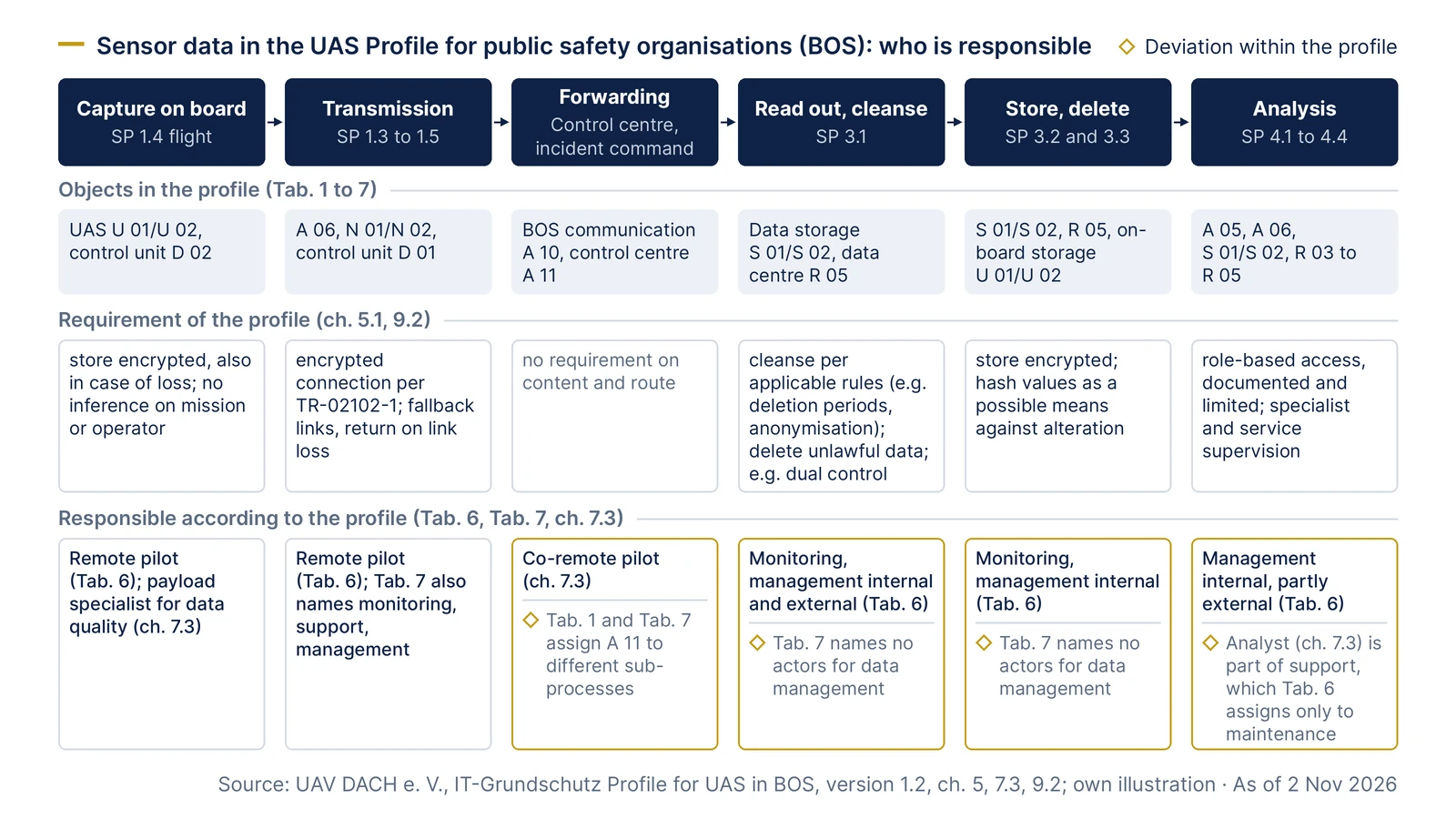
The profile's second guiding question concerns the protection of the captured data. It spreads the responsibilities for this across three places that do not agree: table 6 assigns actors to the sub-processes, table 7 assigns them differently and leaves data management without an actor, and chapter 7.3 describes the analyst as the role that prepares and analyses data, although the analyst belongs to operations support, which table 6 assigns only to maintenance. The matrix brings the information together step by step. You fill in the right-hand column for your unit; every empty cell is an open responsibility.
| Step (sub-process, SP) | Objects in the profile | Requirement of the profile | Responsible according to the profile | Your decision |
|---|---|---|---|---|
| 1 Capture on board (SP 1.4 flight) | UAS U 01/U 02, control unit D 02, internal networks N 06/N 07 | recordings are usually also held on an internal data medium; keep them encrypted, also in case the UAS is lost; no inference on mission purpose or operator (ch. 9.2) | Remote pilot (tab. 6); payload specialist for data quality (ch. 7.3) | Is the on-board storage encrypted? Who manages the keys? |
| 2 Transmission (SP 1.3 to 1.5) | Data transmission A 06, networks N 01/N 02, ground control station D 01, F 01 or R 03 | secured, encrypted connection per TR-02102-1; on disruption frequency change, redundant link or return (ch. 9.2) | Remote pilot; tab. 7 also names operations monitoring, operations support and management staff | Which links are encrypted, which fallback routes are approved? |
| 3 Forwarding to control centre and incident command | BOS communication A 10, control centre A 11, network N 03 | no requirement on content and route | Co-remote pilot for communication with the control centre (ch. 7.3); tab. 1 and tab. 7 assign A 11 to different sub-processes | Which data go to whom, by which route, and who operates the remote end? |
| 4 Read-out and cleansing (SP 3.1) | Data storage S 01/S 02, data centre R 05 | cleanse where applicable in line with statutory or other regulatory requirements; as examples the profile names deletion periods, the anonymisation of persons captured and the deletion of recordings not needed (ch. 5.1); securely delete image data that unlawfully interferes with the personal rights of uninvolved third parties; four-eyes principle as an example of a control level (ch. 9.2) | Operations monitoring, internal and external management staff (tab. 6); tab. 7 names nobody | Who reads out, who cleanses, who approves? |
| 5 Storage in the analysis environment (SP 3.2) | S 01 (data room) or S 02, R 05 | store encrypted; hash values (Streuwertfunktion) as a conceivable means of proving alterations (ch. 9.2) | Operations monitoring, internal management staff (tab. 6) | Storage location, hash method, who checks the hash values? |
| 6 Deletion of the local storage (SP 3.3) | A 06, U 01/U 02, R 05 | delete local data storage and, where applicable, the central data room (ch. 5.1); the profile does not name a method | as step 5 | Deletion method per storage medium, proof of deletion |
| 7 Analysis (SP 4.1 to 4.4) | Remote monitoring A 05, A 06, S 01/S 02, R 03 to R 05 | access via the roles from ch. 7.3, documented and limited; oversight by specialist and service supervision (ch. 9.2) | Internal management staff, for SP 4.1 and 4.4 also external (tab. 6); the analyst from ch. 7.3 is missing there | Who analyses, with which rights, and how long are results kept? |
We add two points as our own suggestion, because the profile does not cover them: check whether sensor data must be deleted from the device before maintenance or repair at the manufacturer (SP 2.1 to 2.6), and decide who reports the incident if the UAS is lost. The matrix does not replace a protection requirements determination; reasons for a classification are covered on the page Assessing protection requirements with reasons.
Path to Grundschutz++
The profile is based on BSI Standard 200-2 and the 2023 Compendium. Version 1.2 of February 2026 also stays with this methodology; we had not found a version by the association for Grundschutz++ by 2 November 2026. When transferring, three points need to be clarified for the drone unit.
First, protection requirements. The profile's three categories, with their definition by the reach of a damage (table 10), have to be „zu mappen“ (our translation: "mapped") to the two of Grundschutz++, normal and high (300-1 chapter 2.6); „sehr hoch“ (our translation: "very high"), in the profile the entire process or a life-threatening extent, ends up as high in our reading. As an aid for identifying high protection requirements, 300-1 names, among other things, the „Beeinträchtigung der persönlichen Unversehrtheit“ (our translation: "impairment of personal physical integrity"), without restriction. The profile itself lists a crash with personal injury as a scenario (SZ 03). If you consider this scenario possible for your own unit's flight operations, you will find it hard to justify the starting value normal from chapter 6 of the profile. In Grundschutz++, high protection requirements call for a risk assessment (Risikobetrachtung) (300-1 chapters 2.6, 2.11); the profile requires one for all sub-processes anyway.
Second, the aircraft as an asset. Grundschutz++ derives requirements from target object categories (Zielobjektkategorien) (300-1 chapter 3.4.2). We found no separate category for aircraft, vehicles or embedded systems either in annex 1 of 300-1 or in the target object categories of the user catalogue (Anwenderkatalog). Our suggestion: assign UAS and control units to IT systems (IT-Systeme), mobile computers at the deployment site to mobile devices (Mobile Endgeräte) and the radio links to networks (Netze). Whatever these categories do not adequately cover for an aircraft triggers an explicit risk assessment under 300-1 chapter 2.11; you enter the results as supplementary requirements in the requirements package (chapter 3.4.3). This mainly concerns the topics the profile covers through the industrial modules, such as collision avoidance and return on loss of link.
Third, the modules. For the 77 modules the profile takes into account, we looked up and counted every requirement in the draft mapping IT-Grundschutz 2023 → Grundschutz++. The mapping file has the status „draft“ (as of 21 July 2026); we resolved the targets in the user catalogue build 2026-10-29. The figures therefore reflect a draft status and not an official mapping.
| Count across the 77 modules | Result |
|---|---|
| Identifiers of these modules in the 2023 Compendium | 1,514, of which 197 marked as withdrawn (entfallen), leaving 1,317 valid ones |
| of which mapped in the draft | 403 (about 31% of the valid ones); none of them withdrawn |
| Grundschutz++ requirements the draft points to | 300 from 18 practices; most frequently DET (74), ARCH (61), KONF (40) and TEST (32) |
| of which from the five industrial modules that the profile applies only to the UAS itself | 61 identifiers, 8 withdrawn, 21 of the 53 valid ones with an entry |
| Modules with no requirement in the draft | 9: ORP.4 Identity and Access Management, CON.2 Data Protection, CON.3 Data Backup Concept, CON.6 Deletion and Destruction, APP.2.3 OpenLDAP, IND.2.3 Sensors and Actuators, INF.5 Room or Cabinet for Technical Infrastructure, INF.7 Office Workplace, INF.9 Mobile Workplace |
| Target references without a match in the catalogue | 14 references from 14 sub-requirements, all to the same identifier VRB.1.2, which is missing from the catalogue build 2026-10-29; with it there would be 301 distinct targets |
Among the modules without an entry are those to which chapter 9.2 refers for deletion and backup, CON.6 and CON.3, and ORP.4 for the role-based access control from chapter 7.3. Also without an entry are IND.2.3 Sensors and Actuators, which the profile applies to the aircraft, and INF.9 for the mobile workplace at the deployment site. Conversely, an entry does not mean that the requirement is covered: for CON.1.A1 in the table below, all three mappings are entered only as an intersection, and the modal verb drops from MUSS (MUST) to SOLLTE (SHOULD). We trace three points from chapter 9.2 down to the level of the individual requirement:
| Point in the profile | Requirement in the 2023 Compendium | Target in the user catalogue (build 2026-10-29) | What remains open |
|---|---|---|---|
| Ch. 9.2: data exchange between UAS and control unit via an „abgesicherte und verschlüsselte Datenverbindung“ (our translation: "secured and encrypted data connection"), reference to TR-02102-1 | CON.1.A1 „Auswahl geeigneter kryptografischer Verfahren“ (our translation: "selection of suitable cryptographic methods") (basic, MUSS) | Mapping: sub-requirement 1 intersecting (intersects-with, set as the default value in the draft) with BER.7.1 „Etablierte Algorithmen bei der Schlüsselerzeugung“ (our translation: "established algorithms for key generation") and KONF.2.2 „Kryptographische Verfahren in IT-Systemen“ (our translation: "cryptographic methods in IT systems"), sub-requirement 2 with BER.7.8 „Etablierte Algorithmen bei der Schlüsselnutzung“ (our translation: "established algorithms for key use"); all normal-SdT, SOLLTE | MUSS becomes SOLLTE. The catalogue does not name the radio link between UAS and ground control station. Our suggestion: name TR-02102-1 in the open parameter of KONF.2.2 and explicitly assign the control and video links as assets |
| Ch. 6 and 9.2: security mechanisms according to the state of the art „(z.B. secure boot)“ (our translation: "(e.g. secure boot)") as an aspect of the protection requirements determination | SYS.4.3.A14 „Abgesicherter und authentisierter Bootprozess bei eingebetteten Systemen“ (our translation: "secured and authenticated boot process for embedded systems") (elevated protection needs, SOLLTE) | Mapping: no entry. The draft links KONF.2.9 „Abgesicherter und authentisierter Bootprozess“ (our translation: "secured and authenticated boot process") (elevated (erhöht), KANN) only to SYS.2.1.A36 for clients; the mapping to SYS.4.3.A14 is ours, based on the fact that the guidance on KONF.2.9 expressly recommends the boot process for embedded systems | Optional in Grundschutz++, because requirements at the level „erhöht“ have the modal verb KANN (MAY) (300-1 ch. 3.4.2). If secure boot is to apply to your UAS, record it as a result of the risk assessment or as a supplementary requirement, ideally as early as procurement |
| Ch. 9.2: unintentionally captured image data that unlawfully interfere with personal rights „sind sicher zu löschen“ (our translation: "are to be deleted securely") | CON.6.A2 „Ordnungsgemäßes Löschen und Vernichten von schützenswerten Betriebsmitteln und Informationen“ (our translation: "proper deletion and destruction of resources and information requiring protection") (basic, MUSS) | Mapping: no entry, the entire module CON.6 is missing from the draft. Own search in the catalogue: ASST.7.3 „Geregeltes Löschen oder Vernichten“ (our translation: "regulated deletion or destruction") and ASST.7.3.2 „Löschverfahren“ (our translation: "deletion procedures"), both normal-SdT, SOLLTE | The mapping is ours. ASST.7.3 ties deletion to reaching a retention and deletion period; you define the profile's trigger, an unlawful recording found at read-out, yourself as a supplementary requirement for sub-process 3.1 |
The points from chapter 9.2 (some phrased as recommendations, some as examples) and the restrictions in the module tables are requirements specific to the profile. These points from the association do not appear in the draft mapping, which links only Compendium requirements: encryption of on-board storage, no inference on mission purpose or operator, hash values for sensor data, control levels such as the four-eyes principle, fallback routes if the link is disrupted, the residual risk limit from chapter 8. For a drone unit, at least the encryption of on-board storage and the residual risk limit belong in the requirements package as supplementary requirements; under chapter 8, top management of the BOS is accountable for the residual risk limit. How to set up the explicit risk assessment is described on the page Carrying out a risk analysis; you can cross-check individual mappings in the draft with the page Checking the IT-Grundschutz 2023 mapping.
Rights notice: Quotations and information from the IT-Grundschutz-Profil für den Betrieb von Uncrewed Aircraft Systems in Behörden und Organisationen mit Sicherheitsaufgaben (IT-Grundschutz Profile for the operation of uncrewed aircraft systems in authorities and organisations with security tasks), version 1.2, publisher UAV DACH e. V. The document contains no copyright or licence notice, only the note „Dieses Dokument darf in unveränderter Version weitergegeben werden.“ (our translation: "This document may be passed on in unaltered form.") (chapter 1.2). We do not distribute the document. We quote briefly with references; summaries, responsibility matrix and graphic are our own. Source: BSI page for the profile, retrieved on 2 November 2026. Quotations from BSI Standard 300-1 © Bundesamt für Sicherheit in der Informationstechnik 2026. Module and requirement titles from the IT-Grundschutz Compendium (IT-Grundschutz-Kompendium), 2023 edition, © 2023 Reguvis Fachmedien GmbH and © 2023 Bundesamt für Sicherheit in der Informationstechnik, source: BSI page on the IT-Grundschutz Compendium. These quotations and titles are not licensed under CC BY-SA 4.0; the licence notice at the bottom of the page applies to the excerpts from catalogue and mapping data.
Limits of this page: aviation law, data protection, proof
For flight operations, the profile refers to the „einschlägigen nationalen und internationalen Vorschriften“ (our translation: "relevant national and international regulations") (chapter 3) and names flight permits, no-fly zones, flight altitudes and the marking obligation only as examples. We do not interpret aviation law, nor police, fire service or civil protection law. Which requirements apply to your deployments follows from your task, your responsible body and the competent supervisory authority.
According to its own statement, the profile considers data protection only in part and without recommendations for action (chapter 3). This page does not decide which data protection rules apply to your unit's recordings. The same applies to the Cyber Resilience Act, which the profile recommends observing for the design, distribution and procurement of UAS, and to the EGRED 2 recommendations and the other papers from annex 6, whose content we have not examined.
A concept built according to this profile is neither a certification nor proof towards supervisory authorities. Self-assessment and mutual audit, which the profile proposes (chapter 3), are review routes between BOS. The document does not say what the note „Prüfung und Freigabe BSI“ (our translation: "review and approval BSI") on version 1.0 covers; the fact that the BSI publishes the profile does not create an obligation for your unit to apply it.
Support with the transfer
If you want to build a security concept for a drone unit according to this profile or move an existing one to Grundschutz++, the team at Blackfort Technology helps with protection requirements, risk assessment and requirements package. You can find how such support works under Consulting on IT-Grundschutz and Grundschutz++.