
Profile at a glance
| Original title | „IT-Grundschutz-Profil für Leitstellen“ (IT-Grundschutz Profile for control centres) |
|---|---|
| Publisher | Fachverband Leitstellen e. V.; according to the foreword developed jointly with the Bundesamt für Sicherheit in der Informationstechnik (BSI), the German Federal Office for Information Security, with the association's "Informationssicherheit" (information security) working group, the Bundesverband Professioneller Mobilfunk e. V. (PMeV) and participants from control centres and specialist companies |
| Version and date | Version 2.0 of 12 Feb 2024 according to the version history (modules adapted to the 2023 Compendium, notes on business continuity management updated to BSI Standard 200-4); first published as version 1.0 on 1 Feb 2021. The BSI page on the profile gives the date 18 Mar 2024. |
| Revision cycle | „jährlich“ (our translation: "annually") according to the cover page; on 2 Nov 2026 we found no version newer than 2.0 on the BSI page |
| Compendium edition | IT-Grundschutz Compendium 2023 |
| Methodology | BSI Standard 200-2, at least Standard Protection, individual requirements for elevated protection needs recommended (ch. 2); three protection requirements categories normal, high, very high |
| Scope | 38 pages (PDF, about 540 KB), 9 chapters, 39 tables |
| Accessibility | freely available via the BSI page on the profile, without registration |
| Licence and rights | The document contains no licence statement. We therefore quote only briefly and with a reference, and otherwise render the content in our own words; we do not reproduce the profile's tables and figures. |
| Type | IT-Grundschutz Profile of a professional association, published by the BSI (not a critical infrastructure (KRITIS) profile, not a thesis) |
| Reference | BSI page „IT-Grundschutz-Profil für Leitstellen“, retrieved on 2 Nov 2026 |
All profiles at a glance, with publisher, status and Compendium edition, are on the page Finding and reusing IT-Grundschutz Profiles.
Scope and model control centre
The profile addresses „die für Informationstechnik verantwortlichen Entscheidungsträger“ (our translation: "the decision-makers responsible for information technology") in the control centre sector and is also meant to serve as a basis for manufacturers and suppliers of control centre technology and for specialist planners (profile chapter 2). It regards itself as a template for introducing IT-Grundschutz in a control centre and adapting it to the centre's needs (chapter 1). For specialist planning this means: the profile is suitable as a starting point for security requirements in planning and procurement, because it names the systems of a control centre end to end.
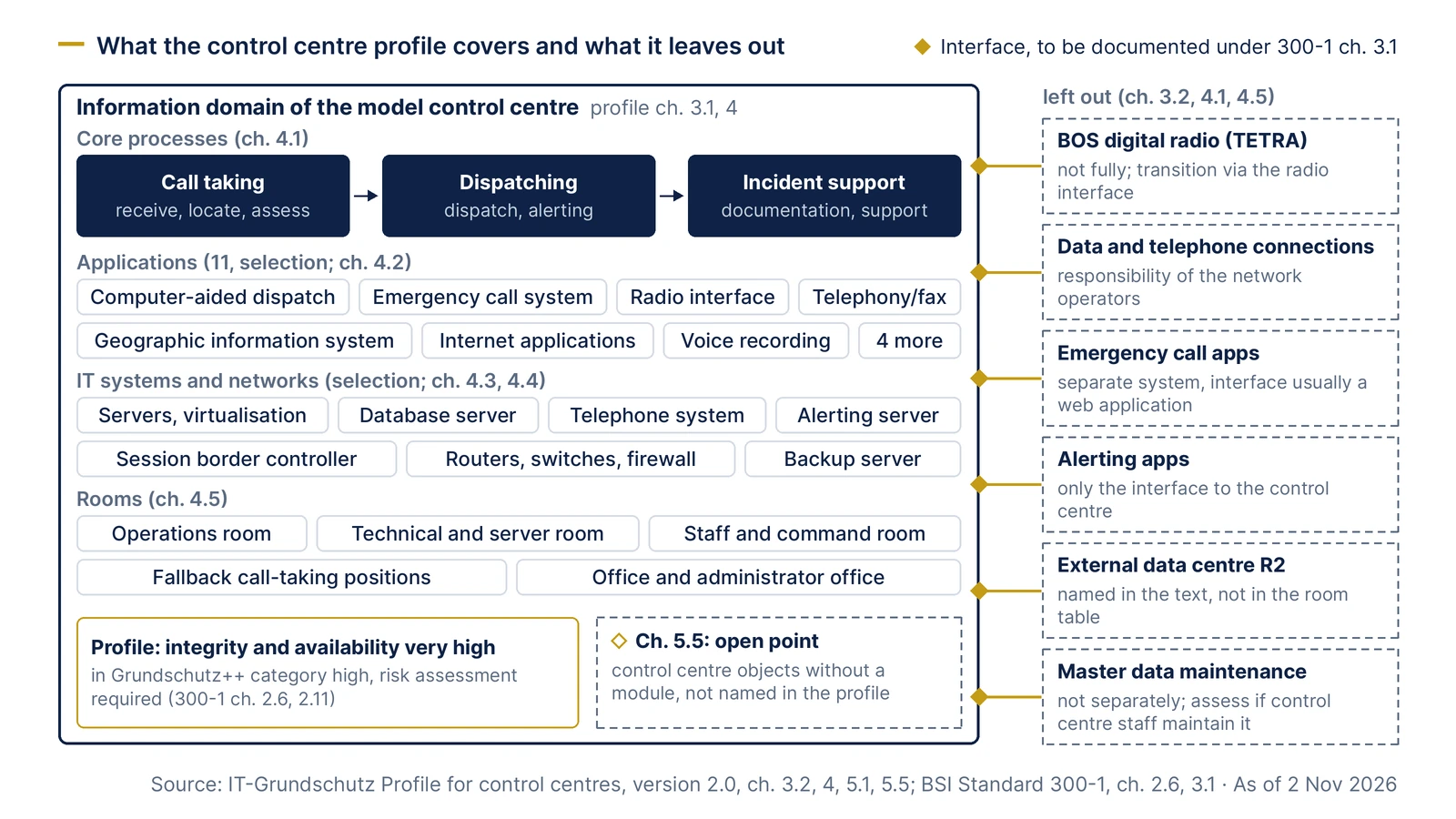
The reference architecture describes three core processes: call taking (Einsatzannahme), dispatching (Einsatzverteilung) and incident support (Einsatzbegleitung), divided into ten sub-processes from prioritising a report through dispatch and alerting to follow-up (chapter 4.1). Added to these are eleven applications, including the computer-aided dispatch system (Einsatzleitsystem), emergency call answering system, radio interface (Funkanschaltung), geographic information system, standardised call interrogation system, voice recording and the Modular Warning System (Modulares Warnsystem) (chapter 4.2), fourteen types of IT systems from clients and servers through the telephone system and interface server to the alerting server and alarm printer (chapter 4.3), the networks including session border controllers (chapter 4.4), and the rooms from the operations room through the technical and server room to the command staff room (Stabsraum) and fallback call-taking positions (Not-Abfrageplätze) (chapter 4.5). The network plan explicitly shows a „gedachte Musterleitstelle“ (our translation: "notional model control centre"); for the sake of clarity, redundancies are omitted from it (chapter 4.4.1).
Four areas are excluded (chapter 3.2): the digital radio of the Behörden und Organisationen mit Sicherheitsaufgaben (BOS), the German public safety authorities and organisations, to the TETRA standard is not fully considered, „weil dieser ein eigenständiges System darstellt, das lediglich Schnittstellen zu den Leitstellen bereitstellt“ (our translation: "because it is a separate system that merely provides interfaces to the control centres"); the data and telephone connections are the responsibility of the network operators; emergency call apps count as a separate system whose interface to the control centre is usually a web application in the browser; for alerting apps of fire brigades and aid organisations, only the interface between the control centre's applications and the app is to be considered. In addition, the profile does not deal with master data maintenance separately (chapter 4.1), does not list the Industrial IT modules in the first place (chapter 5.2) and mentions an external data centre „R2“ only in the text, not in the room table (chapter 4.5).
If your control centre deviates from the model control centre, the profile requires you to document additional or missing objects and to adapt the requirements to the protection requirements; the objects are to be assigned to suitable components of the Compendium (chapter 4.6). The checklist further down starts exactly there.
Does the profile fit your control centre?
The profile fits if …
- your control centre mainly operates its computer-aided dispatch system, emergency call answering, telephone system and servers itself and at its own site, with its own technical or server room;
- you are building or continuing a security concept under BSI Standard 200-2 with the 2023 Compendium and are looking for a ready-made module selection as a starting point;
- manufacturers or service providers look after your control centre systems via remote maintenance: the profile considers remote maintenance and the use of outsourcing relevant (tables 32, 38);
- as specialist planners or a manufacturer, you are compiling security requirements for a new control centre or a new computer-aided dispatch system; the profile explicitly names this role as a target group.
The profile does not fit, or only to a limited extent, if …
- your computer-aided dispatch system runs wholly or partly in a service provider's data centre or as a procured service: the profile assumes local operation and excludes cloud usage (table 32);
- several responsible bodies operate one control centre or shared technology: the profile does not deal with dividing responsibilities between several operators;
- you are yourself responsible for securing digital radio, alerting apps or emergency call apps: these systems are excluded (chapter 3.2);
- you operate mobile workstations, for instance in the command vehicle, or tablets for building and media technology: the modules for these are marked as not relevant, with the note that they may then become relevant (tables 35, 37);
- classified information is processed in your control centre: the profile excludes module CON.11.1 on the grounds that control centres are not subject to the Verschlusssachenanweisung (the German instruction on classified information) (table 31); whether this applies to you is for you to clarify;
- you start directly with Grundschutz++: then use the profile as a specialist source for processes, applications and notes; you set up protection requirements categories and module selection afresh (see below).
What makes the profile special
Protection requirements with downtimes: the profile translates the six damage scenarios of the methodology into control centre terms, down to tolerable downtimes. With normal protection requirements the tolerable downtime is more than 24 and less than 72 hours, with high a failure must be remedied within 24 hours, with very high within 4 hours (tables 11 to 13). The profile rates integrity and availability as very high for call taking, dispatching and the support of the emergency services, and as normal for documentation and follow-up; confidentiality is high almost everywhere because of medical information (tables 14 to 16). Through the maximum principle, all applications except the incident post-processing system, all IT systems, both network objects and the control centre's group of rooms therefore become very high for integrity and availability (tables 17 to 28).
Module selection by minimum principle: the profile goes through all modules of the 2023 Compendium except Industrial IT and models only those that „für eine Mehrheit der Leitstellen bedeutend sind“ (our translation: "are significant for a majority of control centres") (chapter 5.2). We compared the list against the 2023 Compendium: 104 modules are listed, none is missing, 75 are marked as relevant and 29 are excluded with reasons, including cloud usage, smartphones and tablets, mobile device management and network access control.
Control centre operations in the notes: tables 38 and 39 comment on individual requirements from the perspective of control centre operations. Examples are maintenance and repair work at times with few incidents, for instance at night (on ORP.1 and OPS.1.1.2.A25), patches not before weekends, public holidays or dates with a high volume of incidents, and with support available (on OPS.1.1.3.A7), separation of roles when dispatchers also administer systems: „Der Disponent sollte nicht mit Administrationsrechten eingeloggt sein“ (our translation: "The dispatcher should not be logged in with administration rights") (on OPS.1.1.2.A22), virus protection in coordination with the manufacturers of the control centre systems (on OPS.1.1.4.A5), test systems without patient data (on OPS.1.1.6.A13), a backup emergency call answering point (Ersatznotrufabfragestelle) as a remote storage location for backups (on CON.3.A12), and access to incident data of the old system after a system change (on OPS.1.2.2.A9).
Own, stricter specifications: in several places the profile goes beyond the wording of the Compendium. High-availability structures with at least 99.99 % availability are „zwingend vorzusehen“ (our translation: "mandatory"), with reference to the association's Handreichung Leitstellenplanung (guidance on control centre planning) (on NET.1.1.A28); the same applies to redundant connections „insbesondere für Notruf-Leitungen“ (our translation: "in particular for emergency call lines") (on NET.4.1.A19); multi-factor authentication is mandatory for VPN access (on NET.3.3); the firewall is to be built as packet filter, application-level gateway and packet filter (on NET.1.1.A18); backups are to run at least daily following the generation principle (on CON.3.A4). In addition, requirements for elevated protection needs are explicitly recommended for implementation, including APP.1.2.A12, APP.4.3.A21 to A23 and A25 (A24 only with non-local data storage), APP.5.3.A10 to A12, CON.6.A14, CON.9.A9, NET.1.2.A31 to A38 (A34 was dropped in the 2023 edition), NET.3.2.A27, INF.2.A26 and INF.8.A6.
An open point: chapter 5.5 states that there are objects specific to control centres that „nicht hinreichend modelliert werden“ (our translation: "are not adequately modelled") with the existing modules and therefore require a risk analysis, but it does not name a single one. In our assessment, the candidates are the specialist applications of the reference architecture for which the 2023 Compendium has no module of its own, such as the computer-aided dispatch system, emergency call answering system, radio interface and alerting server. You have to draw up this list yourself.
When adopting the profile, watch out for three inconsistencies: table 39 comments on modules that chapter 5.2 excludes (Unified Communications, Network Access Control, mobile workstation); the note on removable media refers to „SYS.3.4.A4“, table 35 to SYS.4.5.A12; the reference architecture names operating system versions such as „Win10, 7“ (table 6), which you check against your own inventory.
Working tool: checklist for deviations from the model control centre
The checklist covers the points at which a real control centre typically deviates from the model control centre. Answer each question with yes or no. Each yes is an object or an interface that you document under profile chapter 4.6. The right-hand column shows where the result ends up in Grundschutz++: as an asset of a target object category (Zielobjektkategorie) under BSI Standard 300-1 Annex 1, as an interface that under chapter 3.1 is to be documented „organisatorisch, technisch sowie infrastrukturell“ (our translation: "organisationally, technically and infrastructurally"), or as a supplementary requirement under chapter 3.4.3.
| No. | Check question | What the profile says | If yes: how to handle it in Grundschutz++ |
|---|---|---|---|
| 1 | Does the computer-aided dispatch system or part of the control centre technology run in a third-party data centre or as a procured service? | Cloud usage not relevant (tab. 32); external data centre R2 only in the text (ch. 4.5) | Record the service as an asset of the category outsourcing or cloud services; answer the outsourcing delimitation under ch. 3.1; the protection requirements of the supported processes apply here too |
| 2 | Do manufacturers or service providers maintain systems via remote maintenance? | relevant as soon as remote maintenance is used (tab. 32, 38) | Document the access as an interface to the outside; the manufacturer's staff may count among the users (Annex 1); record the service as an asset |
| 3 | How is BOS digital radio connected? | Digital radio not fully considered, radio interface as an application in the domain (ch. 3.2, 4.2); control centre usually only a user of cryptographic procedures (note on CON.1) | Radio interface within the domain, digital radio network as an external system; document the interface with responsibilities for devices and keys |
| 4 | Do alerting apps of fire brigades or aid organisations receive data from the control centre? | consider only the interface to the app (ch. 3.2) | Document the data flow: which data, which route, who operates the app. According to the profile, alerting has high protection requirements for confidentiality (tab. 14); check the data flow in the risk assessment (Risikobetrachtung) |
| 5 | Do reports come in via emergency call apps, automatic vehicle emergency calls or devices with automatic emergency detection? | Emergency call apps excluded, interface usually a web application in the browser (ch. 3.2); other sources only in the foreword | Record the web application as an asset (web browsers, web applications); document each incoming data path as an interface |
| 6 | Does the control centre pass data to staff information systems, hospitals or other control centres? | described in the foreword as a development, no objects of their own; residual risk due to limited influence on partners (ch. 6) | Document the interface to other information domains or external systems; compile contractual or official arrangements for the exchange (ch. 2.2) |
| 7 | Does the control centre receive data from drone operations of public safety authorities and organisations? | not covered | Document the interface; the IT-Grundschutz Profile for UAS in BOS lists the control centre as an application in the information domain of drone operations (there ch. 5.2, tab. 1), both sides should describe the same interface |
| 8 | Do control centre staff maintain master data themselves? | not considered separately; in that case „muss auch diese betrachtet und bewertet werden“ (our translation: "this must also be considered and assessed") (ch. 4.1) | Handle it as a separate business process with its own protection requirements determination (300-1 ch. 2.5, 2.6) |
| 9 | Are there mobile workstations, for instance in the command vehicle, in command posts or for administration? | mobile workstation marked as not relevant, but with notes in tab. 39 (tab. 37, 39) | Assign the devices to the category mobile devices, treat deployment locations as sites |
| 10 | Do you operate building or media technology via tablets or smartphones? | then smartphones, tablets and apps may become relevant (tab. 34, 35); building automation is relevant (tab. 37) | Record the devices as mobile devices; define the separation of the networks for building and media technology from the control centre systems |
| 11 | Do you have a backup emergency call answering point or an alternative site? | named as a storage location for backups and in the context of security incidents (tab. 38); fallback call-taking positions as a room (tab. 8) | Record it as a separate site with rooms and systems; emergency preparedness under BSI Standard 200-4, to which the profile refers in ch. 8 |
| 12 | Which objects in your control centre are not adequately covered by any module? | Ch. 5.5 requires a risk analysis for them but names no objects | Draw up your own list, carry out a risk assessment (ch. 2.11, 4.2) and from it formulate supplementary requirements in the Grundschutz++ format (ch. 3.4.3) |
The assignment to target object categories is our proposal; the definitions in Annex 1 of 300-1 are authoritative. How to define boundaries and interfaces in general is described on the page Delimiting the information domain; the procedure for the risk assessment on the page Carrying out a risk analysis.
Route to Grundschutz++: what remains of the profile
For control centres, moving to Grundschutz++ changes three things: "very high" becomes high with a mandatory risk assessment, what the profile calls „zwingend“ (our translation: "mandatory") does not automatically become binding, and of the 75 modules, 386 requirements have an entry in the draft mapping. We did not find a version of the profile for Grundschutz++ on 2 November 2026.
First, protection requirements. Grundschutz++ determines them for business processes and knows two categories, normal and high (300-1 chapter 2.6). Own categories are permitted; they „sind hierbei auf die Schutzbedarfskategorien des GS++ zu mappen“ (our translation: "are to be mapped to the protection requirements categories of GS++") (ibid.). The profile's levels "high" and "very high" therefore fall into the category high. For the core processes of a control centre this results in high protection requirements almost everywhere, and a risk assessment is required for business processes with high protection requirements (chapters 2.6, 2.11). You replace the inheritance to applications, systems, networks and rooms from tables 17 to 28 of the profile with the assignment of assets to processes; the protection requirements of the process determine which security level you choose for the requirements (chapter 3.4.2). You can use the profile's reasoning, such as the downtimes, to justify your own classification.
Second, the requirements for elevated protection needs. In the user catalogue (Anwenderkatalog), requirements of the security level elevated (erhöht) have the modal verb KANN (MAY) and „sind optional zu erfüllen“ (our translation: "are to be fulfilled optionally"); they serve as a pool for the risk assessment (300-1 chapter 3.4.2). What the profile calls „zwingend“ for control centres, or requires in addition to the basic and standard requirements, therefore does not automatically become binding in Grundschutz++. If you want to keep these specifications, adopt them as a result of the risk assessment or as a supplementary requirement (chapter 3.4.3).
Third, the modules. For the 75 modules that the profile marks as relevant, we counted the draft mapping IT-Grundschutz 2023 → Grundschutz++. The file has the status „draft“ (as of 21 July 2026); we resolved the targets in the user catalogue build 2026-10-29. The result is a draft and not an official mapping.
How to substantiate a classification is described on the page Assessing protection requirements with justification.
| Metric (75 modules of the profile) | Value |
|---|---|
| Requirement identifiers in the 2023 Compendium | 1,467, of which 210 marked as dropped, i.e. 1,257 valid |
| Requirements with at least one entry in the draft mapping | 386 (around 31 % of the valid ones) |
| Different Grundschutz++ requirements as targets | 311; of these, 310 can be resolved in the catalogue, from 18 practices (Praktiken), most of them in DET (75), ARCH (63), KONF (46) and TEST (34) |
| Modules without a single entry | 11: ORP.4 Identity and Access Management, CON.2 Data Protection, CON.3 Backup Concept, CON.6 Deleting and Destroying Data, OPS.1.2.4 Teleworking, SYS.1.2.2 Windows Server 2012, SYS.1.3 Linux and Unix Servers, NET.4.3 Fax Machines and Fax Servers, INF.5 Room or Cabinet for Technical Infrastructure, INF.6 Data Media Archive, INF.7 Office Workplace |
| Target references that cannot be resolved in the catalogue | 11 references from 8 modules, all to the same identifier VRB.1.2; in build 2026-10-29, VRB.1 contains only VRB.1.1 |
An entry in the mapping does not mean that the requirement is fully covered; the relationships range from equivalent to partial overlap. We traced three requirements that the profile highlights for control centres individually:
| Profile reference | Requirement in Compendium 2023 | Target in Grundschutz++ (catalogue build 2026-10-29) | Gap |
|---|---|---|---|
| Tab. 39 on NET.4.1: redundant connection „insbesondere für Notruf-Leitungen ist zwingend vorzusehen“ (our translation: "is mandatory, in particular for emergency call lines") | NET.4.1.A19 „Redundanter Anschluss“ (redundant connection) (elevated protection needs, SOLLTE, i.e. SHOULD; for IP-based telephone systems additionally a PSTN connection) | Mapping: sub-requirement 1 equal (equal-to), sub-requirement 2 overlapping (intersects-with) with ARCH.8.2 „Redundante TK-Anbindung“ (redundant telecommunications connection), security level elevated (erhöht), KANN (MAY) | Optional in Grundschutz++. The profile's obligation and the reference to emergency call lines appear nowhere in the catalogue; handle them as a result of the risk assessment or as a supplementary requirement |
| Tab. 39 on NET.1.1: computer-aided dispatch system and KMS (the abbreviation used in the profile) in the internal network, particularly sensitive areas in separate segments | NET.1.1.A5 „Client-Server-Segmentierung“ (client-server segmentation) (basic, MUSS, i.e. MUST) | Mapping: sub-requirements 1 and 2 equivalent (equivalent-to) to ARCH.2.2.3 „Segmentierung von Servern und Clients“ (segmentation of servers and clients); other parts to ARCH.2.1 „Netzsegmente“ (network segments), ARCH.2.2 „Einschränkung von Verbindungen zwischen Segmenten“ (restriction of connections between segments) and ARCH.2.2.2 „Gastnetz“ (guest network); all normal-SdT (normal, state of the art), SOLLTE | The modal verb drops from MUSS to SOLLTE. Separating the control centre systems in particular is a decision of your own; our proposal: explicitly name the computer-aided dispatch system and KMS in the criteria that ARCH.2.2 leaves open as a parameter |
| Tab. 39 on NET.3.3: „Für VPN-Zugänge sind zwingend Multifaktor-Authentifizierungen (MFA) vorzusehen.“ (our translation: "Multi-factor authentication (MFA) must be provided for VPN access.") | NET.3.3 contains no requirement on multi-factor authentication; it is in ORP.4.A21 „Mehr-Faktor-Authentisierung“ (multi-factor authentication) (elevated protection needs, SOLLTE) | Mapping: no entry, the entire module ORP.4 is missing from the draft. Our own search in the catalogue: BER.5.8 „Mehr-Faktor-Authentisierung am Perimeter“ (multi-factor authentication at the perimeter) (normal-SdT, SOLLTE, phishing-resistant for all interfaces reachable from outside), alongside it BER.5.9 for far-reaching privileges | The assignment is our own and does not come from the draft. Here Grundschutz++ already requires more than the Compendium at the normal security level, but as SOLLTE; you record the profile's obligation yourself |
The profile's notes are profile-specific specifications. They are not in any mapping, because the draft only links Compendium requirements. This concerns the 99.99 % availability, daily backups following the generation principle, the firewall structure, the time windows for patches and the other notes from tables 38 and 39. If you want to keep them, write them into your requirements package as supplementary requirements. How to check mappings from the draft individually is described on the page Checking the IT-Grundschutz 2023 mapping.
Rights notice: Quotations from the IT-Grundschutz-Profil für Leitstellen, version 2.0, publisher Fachverband Leitstellen e. V.; the document contains no licence or copyright notice. Source: BSI page on the profile, retrieved on 2 November 2026. The quotations are verbatim, the summaries are our own. Requirement and module titles from the IT-Grundschutz-Kompendium, Edition 2023, © 2023 Reguvis Fachmedien GmbH and © 2023 Bundesamt für Sicherheit in der Informationstechnik, source: BSI page on the IT-Grundschutz Compendium. This content is not licensed under CC BY-SA 4.0; the licence notice at the end of the page applies to the extracts from catalogue and mapping data.
What this page does not decide
The profile names laws of the German federal states (Länder) on rescue services, fire brigades, civil protection and control centres as well as state regulations on the retention period for emergency calls (tables 11 to 13, note on CON.3.A3). We do not interpret these provisions; which of them apply to your control centre follows from the relevant state law and the body responsible for your control centre. The same applies to the technical guideline on emergency calls (technische Richtlinie Notruf) and the Handreichung Leitstellenplanung to which the profile refers (table 39 on NET.4.2 and NET.1.1): we name them but have not checked their content.
According to chapter 2, the profile takes account of requirements from the GDPR and the BSI Act (BSIG). This refers to the legal situation at the time of publication in February 2024; the BSI Act has since been reissued in a new version. Whether, and with what obligations, today's BSI Act applies to your control centre is not decided on this page.
Implementing the profile is neither evidence towards a supervisory authority nor a certification. The profile regards itself as an aid; according to chapter 7, the requirements identified are to be integrated into the overall security concept. The fact that the BSI published the profile and worked on it does not make it a requirement for your control centre.
How Grundschutz and the obligations under NIS2 relate in general is described on the page NIS2 and Grundschutz.
Support with the transfer
If you want to move a security concept based on the control centre profile to Grundschutz++ or adapt the profile for a new control centre, the team at Blackfort Technology supports you with the deviation analysis, protection requirements and the requirements package. The process and scope of services are on the page Consulting on IT-Grundschutz and Grundschutz++. Further profiles from other sectors and the general transfer route are in the overview of IT-Grundschutz Profiles.