
The two volumes at a glance
Both volumes come from UAV DACH e. V., which the BSI list of profiles describes as „Verband für unbemannte Luftfahrt“ (our translation: "association for unmanned aviation"). According to chapter 3, the requirements are „Empfehlungen des UAV DACH e.V. für UAS-Betreiber“ (our translation: "recommendations of UAV DACH e.V. for UAS operators"). Neither volume has a dated document history. The dates in the table are those of the BSI pages.
| Feature | Volume 1: Open | Volume 2: Specific |
|---|---|---|
| Title | IT-Grundschutz-Profil für den Betrieb von UAS Band 1: UAS-Betriebskategorie „Open (Offen)“ (IT-Grundschutz Profile for the operation of UAS, Volume 1: UAS operating category "Open"); in ch. 1.1 „offen“ (our translation: "open") | IT-Grundschutz-Profil für den Betrieb von UAS Band 2: UAS-Betriebskategorie „Specific (Speziell)“ (IT-Grundschutz Profile for the operation of UAS, Volume 2: UAS operating category "Specific"); in ch. 1.1 „speziell“ (our translation: "specific") |
| Publisher | UAV DACH e. V. | |
| Authors (ch. 1.1) | seven people from Mediator Consult, GLVI, Grant Thornton Rechtsanwaltsgesellschaft, b.r.m. IT & Aerospace, Universität der Bundeswehr München, TH Ostwestfalen-Lippe | five people from Mediator Consult, UAV DACH, Grant Thornton Rechtsanwaltsgesellschaft, Universität der Bundeswehr München, TH Ostwestfalen-Lippe |
| Version according to the document | 1.1, version change „Austausch des Logos“ (our translation: "replacement of the logo"), undated | 1.0, undated |
| Date of the BSI page | profile 29 Jan 2025, threat matrix 24 Jan 2024, English version 29 Jan 2025 | profile 20 May 2026 |
| Compendium edition | not stated; the module lists mix identifiers from 2023 with ones dropped in 2023 (section "Route to Grundschutz++") | |
| Methodology according to ch. 3 | Standard Protection under BSI Standard 200-2 | Standard Protection under BSI Standards 200-2 and 200-3 |
| Review cycle (ch. 1.1) | „zwei-jährliche Überprüfung angestrebt“ (our translation: "two-yearly review intended"); on 2 Nov 2026 the BSI pages still showed Volume 1 in version 1.1 and Volume 2 in version 1.0 | |
| Size | 32-page PDF, plus the threat matrix as an Excel file | 35-page PDF; the „externe Tabelle 10“ (our translation: "external Table 10") named in Tab. 10 is not on the BSI page |
| Availability | freely available via the BSI pages, also in English | freely available via the BSI page |
| Rights | Ch. 1.1: „Dieses Dokument darf in unveränderter Version weitergegeben werden.“ (our translation: "This document may be passed on in unchanged form.") No open licence is stated. We treat the texts as protected works of the publisher and quote only briefly. | |
| Type | IT-Grundschutz Profile of an association, listed in the BSI list of profiles | |
| Location | BSI page profile, BSI page threat matrix, English version | BSI page profile |
| Retrieved | 2 Nov 2026 | |
Where the two UAS volumes stand among the other published profiles is shown on the page IT-Grundschutz Profiles.
Scope and reference architecture
Both volumes are aimed at organisations, authorities and companies that use UAS in the respective operating category, and there at top management, IT administration and the departments that deploy drones (ch. 2.1). The information domain covers everything at the UAS operator that is needed for flight operations and for maintenance and repair. Excluded are components and procedures with no direct link to flight operations, such as order processing and invoicing (ch. 4). Both volumes explicitly treat flight safety in the sense of flight safety management as a separate matter (ch. 6.1). Both also recommend using the profile as the basis when commissioning UAS service providers and including the requirements in the contract terms (ch. 2.3).
The reference architecture is almost the same in both volumes. Two business processes: GP1 flight operations with pre-flight preparation, take-off, flight, landing and shutdown, and GP2 maintenance and repair with replacement of propulsion components, updating of the flight operations software and analysis of the log files. Nine applications, from flight planning via flight control and ground control software to payload control. Desktop computer, laptop, tablet or smartphone and server. On board the aircraft, flight controller and companion computer. In addition, networks from the organisation network to the link between drone and ground control station, eight types of room from the access-controlled room to public space and, as a particular feature, vehicles: the transport vehicle, the operation vehicle and the aircraft itself as mobile infrastructure (Volume 1 Tab. 2 to 7).
Some things the volumes deliberately place with the manufacturer. Volume 1 calls the flight data recorder something outside the users' influence: „Die Maßnahmen für einen IT-Grundschutz liegen beim jeweiligen Hersteller der Drohne.“ (our translation: "The safeguards for IT-Grundschutz lie with the respective manufacturer of the drone.") (Volume 1, footnote 3). Crypto concept and deletion are marked as relevant, but with the justification that they are defined in the CE procedure and are „nicht dem Einfluss des Anwenders“ (our translation: "not subject to the user's influence") (Volume 1 Tab. 13). This produces a contradiction in the table that you have to resolve in your concept: what you demand from the manufacturer belongs to procurement, what you do yourself stays with you.
According to Volume 2, the series also includes a Volume 3 for the „Zertifiziert“ (our translation: "certified") category, which is named there as in preparation (ch. 4.3). We did not find it in the BSI list of profiles on 2 November 2026. Profiles for BOS deployment scenarios were developed in parallel. The published profile for authorities and organisations with security tasks sets its own boundary: it „bildet ausdrücklich nicht die Vorgaben für den Einsatz von UAS im unternehmerischen oder privaten Kontext ab“ (our translation: "explicitly does not reflect the requirements for the use of UAS in a business or private context") (BOS profile ch. 3). It therefore has a page of its own.
If you operate UAS for a police force, fire service, civil protection unit or other BOS unit, read on at the page IT-Grundschutz Profile for UAS in BOS.
Does the profile fit your operation?
It fits if
- you operate your own UAS as a company, authority or organisation without BOS tasks and want to secure flight operations and maintenance,
- your operation falls into the Open category (Volume 1) or into the Specific category with one or more of the variants GP1a to GP1f, such as flight beyond visual line of sight, dropping of items or overflight of crowds (Volume 2),
- you use standard devices with manufacturer software and develop neither software nor web applications yourself (CON.8, APP.7 and CON.10 are not relevant in either volume),
- you buy in UAS services and are looking for a basis for tender and contract (ch. 2.3).
It does not fit, or only partly, if
- you are an authority or organisation with security tasks: there is a separate profile for UAS in BOS for that,
- your operation falls into the „Zertifiziert“ (our translation: "certified") category; the announced Volume 3 was not available on 2 November 2026,
- you are a manufacturer or developer of UAS: the volumes explicitly place flight data recorder, crypto concept and deletion with the manufacturer, align software tests, remote maintenance and emergency management with manufacturer specifications and do not consider the manufacturer side,
- you are a U-space service provider or process flight and payload data centrally in a cloud; Volume 2 declares both to be outside the information domain,
- you expect ready-made requirements for aircraft, radio link and ground control station; neither volume contains them, only the instruction to carry out a risk analysis.
If your flight operations differ from the reference architecture, for example with a second ground control station or your own map server, both volumes have you record the additional objects in the structure analysis and assign modules to them. What does not occur at your site, you leave out (ch. 5.6).
What changes from Open to Specific
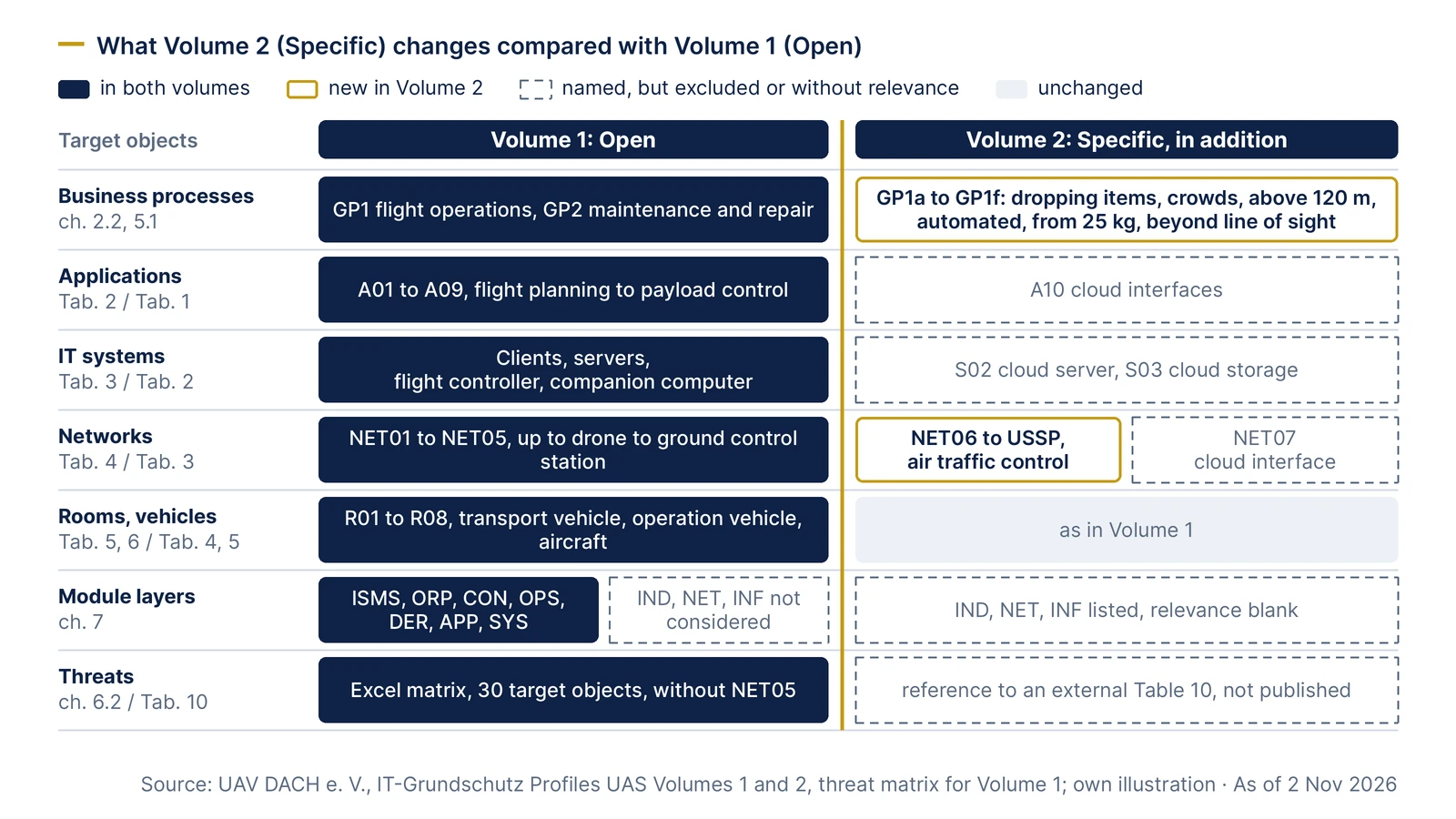
Scope: Volume 2 divides flight operations into six variants following a decision scheme of the Luftfahrt-Bundesamt (LBA), the German Federal Aviation Office: GP1a dropping of items, GP1b overflight of crowds, GP1c flight altitudes also above 120 m above ground, GP1d fully automated flight without the possibility of intervention, GP1e take-off mass of 25 kg or more, and GP1f flight beyond visual line of sight (ch. 2.2). According to the profile, GP2 can be „analog ausdifferenziert werden“ (our translation: "differentiated in the same way"). The reason for the higher requirements is technical: when flying beyond visual line of sight, direct intervention is not possible throughout, and monitoring and control run electronically (ch. 3). Compared with Open, it should be noted „dass den Kommunikationsverbindungen eine deutlich höhere Relevanz zukommt, da eine visuelle Rückmeldung zu Status und Aktivitäten des UAS entfällt“ (our translation: "that the communication links are of considerably greater relevance, as there is no visual feedback on the status and activities of the UAS") (ch. 5).
Target objects: Volume 2 adds the link from drone or ground control station to control and management institutions (NET06, for example U-space service providers and air traffic control), a cloud import and export interface with data modem (NET07), cloud interfaces as an application (A10) and cloud server and cloud storage (S02, S03). A transition to the data network, which both volumes explain in Annex 3 as „ugs.: Cloud“ (our translation: "colloquially: cloud"), already exists in Volume 1 as NET03. At the same time, Volume 2 states: „Die Cloud-basierten Systeme sind hier nicht Gegenstand der Betrachtung, da sie außerhalb der Systemgrenzen/dem Informationsverbund liegen. Gleiches gilt für den USSP-Bereich.“ (our translation: "The cloud-based systems are not considered here, as they lie outside the system boundaries/the information domain. The same applies to the USSP area.") (ch. 5.4). The cloud objects therefore appear in Tables 1 to 3 and 6, but are missing from Annex 1 and are explicitly excluded.
Requirements: For the process modules, both volumes are identical except in two places (table below). For the system modules, Volume 2 goes further. Volume 1 states: „Die Bausteine der Schichten IND: Industrielle IT, NET: Netze und Kommunikation und INF: Infrastruktur werden aktuell in diesem Profil nicht betrachtet.“ (our translation: "The modules of the layers IND: Industrial IT, NET: Networks and Communication and INF: Infrastructure are currently not considered in this profile.") (ch. 7.2). Volume 2 lists these layers, from IND.2.3 Sensors and Actuators via NET.1.1 Network Architecture and Design to INF.14 Building Automation, including INF.11 General Vehicle, but names neither relevance nor target objects. It names the modules, and the decision stays with you.
Risk: Both volumes require: „Aufgrund der Besonderheiten beim Flugbetrieb mit Drohnen ist in jedem Fall eine Risikoanalyse zu erstellen.“ (our translation: "Owing to the particular features of flight operations with drones, a risk analysis must be prepared in every case.") (ch. 6.1). Volume 2 links it to the operations manual, which according to the profile is based on a risk analysis under EASA SORA in the Specific category (ch. 1): the IT risk analyses feed „in die Risikoanalysen bzw. -minderungen der Geschäftsprozesse ein“ (our translation: "into the risk analyses and risk mitigations of the business processes") (ch. 3), and, according to Volume 2, if the principles of the profile are observed, no general residual risk assessment going beyond SORA is currently required (ch. 8, with a footnote to the EASA SORA page). Volume 1 excludes data protection (ch. 1). Volume 2 names data protection hazards among its guiding questions, for example with image data from the air (ch. 1).
| Module | Volume 1: Open | Volume 2: Specific |
|---|---|---|
| OPS.1.1.1 General IT Operation | yes, basic requirements on roles and responsibilities | row without title and without entry |
| DER.3.1 Audits and Revisions | yes, recommendation: continual improvement process at the user | no, justification „Hersteller“ (our translation: "manufacturer") |
| SYS.2.1, SYS.3.1, SYS.4.3 (clients, laptops and tablets, flight controller and companion computer) | yes, with target objects | target objects entered, relevance blank |
| SYS.4.4 General IoT Device | listed, without target object and without relevance | |
| IND.2.3, NET.1.1 to NET.4.3, INF.1 to INF.14 | not considered (ch. 7.2) | listed, without relevance and without target objects |
| all other process and application modules | same selection; same justifications except for CON.1 and CON.6, where Volume 2 omits the sentence „Unterliegt nicht dem Einfluss des Anwenders“ (our translation: "Not subject to the user's influence") | |
Source: Volume 1 Tab. 11 to 17, Volume 2 Tab. 11 and 12. The graphic shows the same comparison for the target objects.
The threat matrix for Volume 1
For preparing the risk analysis, Volume 1 refers to a separate table (ch. 6.2), which the BSI provides as an Excel file on a page of its own. The list of profiles calls it „Abschnitt 7: Gefahrenmatrix“ (our translation: "section 7: threat matrix"), the profile „Gefährdungsmatrix“ (our translation: "threat matrix"). We retrieved and evaluated the file on 2 November 2026. For 30 target objects, it marks which of the 47 elementary threats G 0.1 to G 0.47 apply. The aircraft UA01 has the most marks (35), the wireless organisation network NET02 the fewest (20). Marked for all 30 target objects are, among others, espionage (G 0.14), disclosure of sensitive information (G 0.19) and sabotage (G 0.41). Marked for none are coercion, blackmail or corruption (G 0.35), repudiation of actions (G 0.37) and social engineering (G 0.42).
There are three points you should know before adopting the matrix. First, there is no row for NET05, the link between drone and ground control station, which appears in Tab. 4 and 7 of Volume 1 and gains weight in Volume 2. Second, G 0.33 shortage of personnel appears twice in the table header. The first of these columns is empty, the second is marked for all rows. Third, failure of communication networks (G 0.9) is marked only for NET01 to NET04 and software vulnerabilities (G 0.28) only for the applications A01 to A09, not for the flight controller D01 or the aircraft UA01, although the introduction to both volumes names corrupted firmware updates and the failure of the communication infrastructure as a reason (ch. 1). Whether this is intended, the profile does not say.
We did not find a matrix for Volume 2. Table 10 there contains only the sentence „Verweis: siehe externe Tabelle 10“ (our translation: "Reference: see external Table 10"), and the BSI page for Volume 2 holds only the PDF. Anyone working in the Specific category has to extend the matrix from Volume 1 with the new target objects.
How the elementary threats are used further in Grundschutz++ is shown on the page Elementary threats.
Working aid: delta checklist from Open to Specific
The list is intended for operators who have a security concept based on Volume 1 and are taking up flights in the Specific category, for example beyond visual line of sight. For each topic, it shows what the two volumes say and what you record in your concept. The column "What you record" is our proposal.
| Check item | Volume 1: Open | Volume 2: Specific | What you record (our proposal) | Location |
|---|---|---|---|---|
| Type of operation | GP1 flight operations, GP2 maintenance | GP1a to GP1f; GP2 „analog“ (our translation: "in the same way") | which variants you fly; determine protection requirements separately for each variant | V2 ch. 2.2, 5.1 |
| Link between drone and ground control station | NET05 in Tab. 4 and 7, missing from Annex 1 and matrix | NET05, relevance of the links „deutlich höher“ (our translation: "considerably greater") | NET05 as a target object in its own right, with modules and behaviour on loss of link | V1 Tab. 4, 7; V2 ch. 5 |
| Link to USSP, air traffic control | only in the running text of ch. 5.3 | NET06, but USSP area outside the information domain | model NET06 as a transition to the outside, the remote end as a service | V2 Tab. 3, ch. 5.4 |
| Cloud | OPS.2.2 „je nach Konfiguration“ (our translation: "depending on configuration"); transition to the cloud only as NET03 „Schnittstelle zwischen Organisations- und Datennetzwerk“ (our translation: "interface between organisation network and data network") (data network according to Annex 3 „ugs.: Cloud“, our translation: "colloquially: cloud") | A10, S02, S03, NET07, but outside the information domain | which cloud services receive flight, map and payload data; delimit what runs via NET03 and what via NET07, and model both transitions | V1 Tab. 4, 14, Annex 3; V2 Tab. 1 to 3, ch. 5.4, Annex 3 |
| Threat overview | Excel matrix, 30 target objects | „externe Tabelle 10“ (our translation: "external Table 10"), not published | extend the matrix from Volume 1 with NET05, NET06, NET07, S02, S03, A10 | V1 ch. 6.2; V2 Tab. 10 |
| Network modules | not considered | NET.1.1 to NET.4.3 listed, relevance blank | decide and justify relevance for each module, assign radio and satellite links to the risk analysis | V1 ch. 7.2; V2 Tab. 12 |
| Rooms, ground control station, vehicles | R01 to R08, F01, F02 in the architecture, INF not considered | INF.1 to INF.14 listed, relevance blank | model control station and workshop; check INF.11 General Vehicle for transport vehicle and operation vehicle | V1 Tab. 5, 6; V2 Tab. 12 |
| System modules | SYS.2.1, SYS.3.1, SYS.4.3 relevant | the same, relevance blank | adopt; model tablets and smartphones (C03) with SYS.3.2.1 instead of SYS.3.1 Laptops | V1 Tab. 17; V2 Tab. 12 |
| IT operation | OPS.1.1.1 relevant | row empty | define roles and responsibilities for flight operations unchanged | V1 Tab. 14; V2 Tab. 11 |
| Audits | DER.3.1 relevant | not relevant, „Hersteller“ (our translation: "manufacturer") | who audits your own operation; the manufacturer's audit does not replace this | V1 Tab. 15; V2 Tab. 11 |
| Risk analysis | mandatory; approach under BSI Standard 200-3 recommended | mandatory, 200-3 recommended; results feed into the risk analyses of the business processes | who hands over the IT risks to those responsible for the operations manual, and when | ch. 6.1 (both); V2 ch. 3 |
| Service providers | profile as basis for commissioning, OPS3.1 „je nach Anwendungsszenario“ (our translation: "depending on the use case") | as Volume 1 | whether you offer UAS services (2023: OPS.3.2) or obtain them (2023: OPS.2.3); profile requirements into the contract | ch. 2.3, Tab. 14 and 11 respectively |
The profile helps least with two rows: the link between drone and ground control station, for which there is neither a module nor a matrix row, and the cloud, which Volume 2 both lists and excludes. How you classify such transitions in Grundschutz++ is described in the next section. The approach for target objects without suitable requirements is on the page Risk analysis.
What makes the profiles special
Protection requirements: Neither volume prescribes protection requirement values. They provide six damage scenarios with UAS examples, from flying in a prohibited flight area due to altered data to faulty control causing personal injury (Volume 1 Tab. 9, Volume 2 Tab. 8), and leave the categorisation to the users. In our assessment, the scenario „Beeinträchtigungen der persönlichen Unversehrtheit“ (our translation: "impairment of personal physical integrity") alone suggests a categorisation above "normal" for the aircraft. You have to decide that for your own operation.
No modules of their own: The introduction to both volumes announces: „Dort, wo dies nicht möglich ist, wurden individuelle Bausteine entwickelt.“ (our translation: "Where this is not possible, individual modules have been developed.") (Volume 1 ch. 1; Volume 2 to the same effect). Neither document contains such a module. Instead, both state that for the aircraft and the ground control station there are „im IT-Grundschutz-Kompendium keine passenden Bausteine“ (our translation: "no suitable modules in the IT-Grundschutz Compendium"), and therefore make the risk analysis mandatory (Volume 1 ch. 6.1). For flight controller and companion computer they use SYS.4.3 Embedded Systems.
Vehicles as infrastructure: The volumes treat the transport vehicle, the operation vehicle and the aircraft as mobile infrastructure objects, to which they assign IT systems in the same way as to rooms (Volume 1 Tab. 7, Volume 2 Tab. 6), because UAS do not usually fly at the operator's premises (ch. 5.5). Public space (R08) is a target object in its own right. That is where laptop, tablet and aircraft are located during deployment.
Legal references: Chapter 3 of both volumes names the DSGVO (GDPR), the BDSG (Federal Data Protection Act), the TTDSG and the TMG, for U-space service providers Annex III of Implementing Regulation (EU) 2021/664 and for certification the Cybersecurity Act (EU) 2019/881. Volume 2 also names Implementing Regulation (EU) 2019/947 and the EASA risk analysis SORA. The TMG has since been replaced by the Digitale-Dienste-Gesetz (DDG, Digital Services Act), and the TTDSG is now called TDDDG. The references reflect the situation at the time of writing. These regulations are not interpreted here.
Route to Grundschutz++: what the mapping draft captures
Both volumes are based on the methodology under BSI Standard 200-2. They do not name a Compendium edition, and the module lists do not fully match any edition: they contain OPS.1.1.1 General IT Operation, which has only existed since the 2023 edition, and at the same time OPS.2.1 Outsourcing for Customers and OPS.3.1 Outsourcing for Service Providers, which were dropped in the 2023 edition and replaced by OPS.2.3 and OPS.3.2. Volume 2 additionally lists NET.3.4 Network Access Control (new in 2023) and INF.4 IT Cabling, which is no longer in the 2023 Compendium, alongside INF.12 Cabling. For the count, we treated OPS.3.1 as OPS.3.2. OPS.2.1 is not relevant in either volume, and INF.4 is merged into INF.12.
The basis is the draft mapping from IT-Grundschutz 2023 to Grundschutz++ in the State-of-the-Art Library (Stand-der-Technik-Bibliothek) (status draft, as of 21 July 2026). Target requirements are resolved, where possible, in the user catalogue (Anwenderkatalog) build 2026-10-29. Seven target references from the modules of Volume 1 cannot be resolved (Volume 2: 6 and 9 respectively). All of them point to the same identifier VRB.1.2, which does not occur in the catalogue. They are not included in the figures below. The figures are a draft based on a draft, and they say nothing about aircraft, radio link and ground control station, because the volumes assign no module to them.
| Count | Volume 1: Open | Volume 2: explicitly relevant | Volume 2: including the modules without relevance entry |
|---|---|---|---|
| Compendium modules (2023 identifiers) | 40 | 35 | 64 |
| 2023 requirement identifiers in these modules | 745, of which 127 marked as dropped | 610, of which 113 dropped | 1,221, of which 161 dropped |
| identifiers with at least one assignment in the mapping draft | 210 | 171 | 340 |
| distinct resolvable target requirements in Grundschutz++ | 240 in 16 practices (Praktiken) | 214 in 16 practices | 284 in 17 practices |
| target references to an unresolvable identifier (all VRB.1.2) | 7 | 6 | 9 |
| profile-specific requirements | none; aircraft, radio link and ground control station are handled through the risk analysis and are not in any mapping | ||
Volume 2 looks narrower than Volume 1 in the first column because it enters no relevance for OPS.1.1.1, DER.3.1 and three system modules. Adding the 29 listed modules without a relevance entry, mainly NET and INF, increases the set considerably. Left without any assignment in the draft are, among others, ORP.4 Identity and Access Management (24 identifiers), which matches the access controls in both volumes (ch. 7.3 and 7.2 respectively), CON.3 Backup Concept (15 identifiers, 4 dropped) and CON.6 Deleting and Destroying (14 identifiers, 6 dropped). Of OPS.2.2 Cloud Usage, one of 19 identifiers is assigned, of OPS.3.2 one of 21.
Example 1, both volumes: integrity of firmware updates. Profile reference: GP2 includes updating the flight operations software, „z.B. der Firmware oder Systemsoftware des zentralen Steuerrechners im UAS“ (our translation: "e.g. the firmware or system software of the central control computer in the UAS") (ch. 5.1). OPS.1.1.3 Patch and Change Management is relevant in both volumes. Requirement 2023: OPS.1.1.3.A10 „Sicherstellung der Integrität und Authentizität von Softwarepaketen“ (our translation: "Ensuring the integrity and authenticity of software packages") (standard). Mapping draft: implementation aspect UA.3 as a superset of DET.5.10.4 Integrity check of patches (Integritätsprüfung von Patches), DEV.4.4 Integrity of external software (Integrität externer Software) and TEST.3.1.3 Integrity test (Integritätstest) (still listed in the draft under the older identifier TEST.3.1.2, resolved via the UUID), UA.5 as a superset of DET.5.10.1 Authorised sources (Autorisierte Bezugsquellen), all with SOLLTE (SHOULD). Gap: only two implementation aspects are assigned. The updates come from the manufacturer and end up on the flight controller, an embedded system. Whether you can carry out the check yourself or demand it from the manufacturer is decided by the assignment to target objects, not by the mapping.
Example 2, both volumes: aircraft in public space. Profile reference: SYS.4.3 Embedded Systems on flight controller and companion computer (Volume 1 Tab. 17), place of use public space R08. The threat matrix marks theft (G 0.16) and manipulation of hardware or software (G 0.21) for UA01. Requirement 2023: SYS.4.3.A16 „Tamper-Schutz bei eingebetteten Systemen“ (our translation: "Tamper protection for embedded systems") (elevated protection needs). Mapping draft: only UA.2, as an overlap with DET.4.9 Tampering check-up (Manipulations-Checkup), a KANN (MAY) requirement at the security level elevated (erhöht). Gap: tamper protection concept and response specifications have no assignment. SYS.4.3.A14 „Abgesicherter und authentisierter Bootprozess bei eingebetteten Systemen“ (our translation: "Secured and authenticated boot process for embedded systems") also remains without any assignment. Overall, 4 of the 18 identifiers of SYS.4.3 are assigned.
Example 3, both volumes: backup of flight data. Profile reference: after landing, „die Dokumentation und Sicherung der Flugdaten“ (our translation: "the documentation and backup of the flight data") takes place, and „ggf. Nutzlastdaten zu sichern“ (our translation: "payload data to be backed up where applicable") (ch. 5.1). CON.3 Backup Concept is relevant in both volumes. Requirement 2023: CON.3.A5 „Regelmäßige Datensicherung“ (our translation: "Regular data backup") (basic). Mapping draft: no assignment, as for all identifiers of CON.3. Gap: CON.3.A5 in full. In our assessment, the main candidates in the catalogue are NOT.4.4 Automatic data backup (Automatische Datensicherung) and NOT.4.2 Backup of the system (Sicherung des Systems), supplemented by NOT.4.1 Documentation of sources (Dokumentation der Quellen). All three are SOLLTE requirements, whereas CON.3.A5 was a MUSS (MUST) requirement. NOT.4.16 Test of the data backup (Test der Datensicherung) belongs rather to CON.3.A15. This assignment is ours, not the draft's.
For the transitions that Volume 2 places at the boundary of the information domain, BSI Standard 300-1 helps: Annex 1 has „Externe Netzanschlüsse“ (our translation: "external network connections") as „Übergänge in Netze außerhalb des Informationsverbundes“ (our translation: "transitions into networks outside the information domain") and „Cloud-Dienste“ (our translation: "cloud services") as a target object category (Zielobjektkategorie) of its own. NET06 to air traffic control and U-space service providers, NET07 and the cloud services behind S02 and S03 will therefore probably end up as target objects in their own right within the information domain. Volume 2 itself lists NET06 in Annex 1. It declares NET07, S02, S03 and A10 to be outside the information domain (ch. 5.4). You make the classification yourself (page Modelling with target object categories). You can retrace the three examples above with the approach on the page Checking the IT-Grundschutz 2023 mapping and apply it to further modules of the volumes.
Rights notice on the UAS profiles: Quotations and information from the IT-Grundschutz-Profil für den Betrieb von UAS Band 1 (version 1.1), from Band 2 (version 1.0) and from the threat matrix for Volume 1, publisher UAV DACH e. V.; note in the document (ch. 1.1, row „Vertraulichkeit“ (our translation: "confidentiality")): „Dieses Dokument darf in unveränderter Version weitergegeben werden.“ (our translation: "This document may be passed on in unchanged form.") The documents contain no copyright or licence notice. We do not distribute the documents, but quote briefly and unchanged with reference (Section 51 UrhG, German Copyright Act). Summaries and the evaluation of the threat matrix are our own. Sources: BSI page Volume 1, BSI page threat matrix, BSI page Volume 2, retrieved on 2 November 2026. The quotation from the IT-Grundschutz-Profil für den Betrieb von Uncrewed Aircraft Systems in Behörden und Organisationen mit Sicherheitsaufgaben, likewise published by UAV DACH e. V., is subject to the same note on passing it on unchanged (source: BSI page, retrieved on 2 November 2026).
Rights notice on BSI texts: Quotation from BSI-Standard 300-1 „Methodik Grundschutz++“ (BSI Standard 300-1 "Grundschutz++ methodology"), version 1.0, © Bundesamt für Sicherheit in der Informationstechnik 2026, source: BSI page Grundschutz++, retrieved on 2 November 2026, quoted verbatim. Module and requirement titles from the IT-Grundschutz-Kompendium (IT-Grundschutz Compendium), edition 2023, © 2023 Reguvis Fachmedien GmbH and © 2023 Bundesamt für Sicherheit in der Informationstechnik, source: BSI page on the IT-Grundschutz Compendium. This content is not licensed under CC BY-SA 4.0. The licence notice at the end of the page applies only to the extracts from catalogue and mapping data.
What this page does not decide
Which operating category your flight operations fall into, what they require under aviation law and what a risk assessment under SORA must contain is governed by aviation law. The profiles name the relevant regulations and the decision scheme of the Luftfahrt-Bundesamt for this. We only reproduce them and do not interpret them. Nor do we check whether a security concept based on these profiles will be recognised by an aviation authority. The volumes themselves only say that applying the profile „kann als Element der Zulassung oder Genehmigung von Luftfahrtbetrieben nach den einschlägigen Richtlinien und Bestimmungen dienen“ (our translation: "can serve as an element of the approval or authorisation of aviation operations under the relevant guidelines and provisions") (ch. 2.3).
Clarify data protection, in particular for image and video recordings from the air, with your data protection officer. Both volumes describe a model operator with their reference architecture. They do not replace your own structure analysis, the categorisation of the aircraft and the risk analysis that both volumes require in every case, and they are no proof towards the aviation authority or a client. We have not checked the statement in both volumes that Standard Protection is conformant or compatible with ISO 27001 (ch. 3), nor their classification under the Cybersecurity Act.
Support
If you want to transfer the reference architecture of the UAS profiles to your flight operations, the team at Blackfort Technology supports you in closing the gaps for radio link, ground control station and cloud in a risk analysis and in transferring the requirements into a requirements package under Grundschutz++. How we go about this is described on the page Consulting.