

What the elementary threats do in Grundschutz++
Annex 4 of BSI Standard 300-1 assigns two tasks to the elementary threats. The BSI derived the requirements of the user catalogue (Anwenderkatalog) from them; for normal protection requirements this contains an implicit risk assessment carried out by the BSI. And users take them as the starting point for their own risk assessments, for example where protection requirements are high. According to the BSI definition quoted there, a threat (Gefährdung) is „eine Bedrohung, die konkret über eine Schwachstelle auf ein Objekt einwirkt“ (our translation: "a threat (Bedrohung) that acts specifically on an object through a vulnerability"). A missing safeguard, on the other hand, is „grundsätzlich keine elementare Gefährdung“ (our translation: "in principle not an elementary threat") (300-1, Annex 4).
The link is visible in the catalogue: the threats field of a requirement names the G0 IDs it is meant to counter. In the build of 29 October 2026, 901 of the 1,000 requirements have this field, with 2,009 mappings in total; the 99 requirements on methodology and risk management have none (own count). The detailed description of each threat with examples is in the file basethreats.csv of the State-of-the-Art Library (Stand-der-Technik-Bibliothek), together with a UUID for each threat.
Three places in 300-1 make the threats binding or useful for your own work. Chapter 2.11 allows the threats stored in the metadata to be used for your own risk assessment. Minimum criterion 10 in Annex 3 requires the methodological basis of risk identification to be defined and gives as examples „Bedrohungen und Schwachstellen oder Risikoszenarien“ (our translation: "threats and vulnerabilities or risk scenarios"). Minimum criterion 17 requires that, for SOLLTE requirements (SHOULD) that are permanently not fulfilled, the mapped elementary threats are taken into account in the risk assessment.
G 0.11 and other titles: Compendium 2023, 200-3 and 300-1 compared
The numbers G 0.1 to G 0.47 are the same in all sources, the titles not quite. The most important difference concerns G 0.11. In the IT-Grundschutz Compendium, Edition 2023, it is called „Ausfall oder Störung von Dienstleistungsunternehmen“ (failure or disruption of service companies). BSI Standard 300-1 (Annex 4) and the library file basethreats.csv use „Ausfall oder Störung von Dienstleistern“ (failure or disruption of service providers), as does Table 1 in BSI Standard 200-3 of 2017. The description has kept its structure, causes and examples; what has changed is the wording, for example „Unterauftragnehmer“ (subcontractor) in the library where the Compendium writes „Subunternehmen“ (subcontracting company). For the other 46 threats the titles in the Compendium 2023 and in 300-1 match.
BSI Standard 200-3 differs from the Compendium 2023 and 300-1 in six further titles, partly only in spelling, for G 0.20 also in substance („oder Produkte“, "or products"). Anyone who takes over an old risk analysis under 200-3 or the Compendium and searches for threats by title will therefore not find everything. Link by ID, and in tools preferably by the UUID from basethreats.csv.
| ID | BSI Standard 200-3 (2017), Table 1 | Compendium 2023 | 300-1 Annex 4 and basethreats.csv |
|---|---|---|---|
| G 0.11 | Ausfall oder Störung von Dienstleistern | Ausfall oder Störung von Dienstleistungsunternehmen | Ausfall oder Störung von Dienstleistern |
| G 0.14 | Ausspähen von Informationen/Spionage | Ausspähen von Informationen (Spionage) | |
| G 0.16 | Diebstahl von Geräten, Datenträgern und Dokumenten | Diebstahl von Geräten, Datenträgern oder Dokumenten | |
| G 0.17 | Verlust von Geräten, Datenträgern und Dokumenten | Verlust von Geräten, Datenträgern oder Dokumenten | |
| G 0.20 | Informationen aus unzuverlässiger Quelle | Informationen oder Produkte aus unzuverlässiger Quelle | |
| G 0.21 | Manipulation von Hard- und Software | Manipulation von Hard- oder Software | |
| G 0.28 | Softwareschwachstellen oder -fehler | Software-Schwachstellen oder -Fehler | |
One more difference that matters in practice: Table 1 in 200-3 assigns each threat the basic values mainly affected. In Annex 4, 300-1 only says that each threat is assigned to one or more basic values, and the file basethreats.csv has no column for this. The catalogue records the protection goals per requirement (fields confidentiality, integrity, availability, authenticity). You therefore define the protection goals of a scenario yourself, as minimum criterion 14 requires for every risk.
From threat title to auditable scenario
A threat title such as „Datenverlust“ (data loss) cannot be audited. What can be audited is a statement about a specific asset that can be confirmed or refuted with evidence. The following schema is our working format; it ties the minimum criteria from Annex 3 that apply to risk identification to every scenario.
| Field | Content | Reference in 300-1 |
|---|---|---|
| Scenario ID | unique identifier, e.g. SZ-01 | Annex 3, criterion 15 (unique ID in the risk register) |
| Object of analysis | business process, where needed a critical asset | Criteria 11 and 13; ch. 4.2.1 |
| Chain | the elementary threats in the order in which they follow one another in the scenario | Annex 4 (starting point for own assessments) |
| Sequence of events | one to three sentences: trigger, vulnerability, effect | Definition of threat in Annex 4 |
| Protection goals | assess at least confidentiality, integrity, availability | Criterion 14 |
| Audit question per link | answerable with yes or no, tied to an asset | own definition |
| Evidence | document, log or test result that supports the answer | Ch. 4.3 (assign evidence to the safeguard) |
| Catalogue check | requirements with the same G0 ID and their implementation status | Criterion 12 (take existing and planned safeguards into account) |
| Risk owner | the owner of the business process, unless otherwise specified | Criterion 16; ch. 4.2.1 |
This is how we proceed:
- Choose the object of analysis, starting with the business processes with high protection requirements (criterion 32).
- Go through all 47 threats and record which are relevant to the object. In Annex 4, 300-1 requires you to check which threats are „tatsächlich relevant“ (our translation: "actually relevant"); a short justification for the ones excluded makes this traceable later.
- Link relevant threats into chains where one triggers the next. A chain shows at which link a safeguard interrupts the sequence.
- For each link, formulate an audit question and the expected evidence.
- Check against the catalogue: which requirements name the same ID, and what status do they have in the requirements package?
- If a link remains without an effective safeguard, the scenario becomes a risk in the risk register with assessment and treatment.
Scenario chain 1: from phishing to data loss
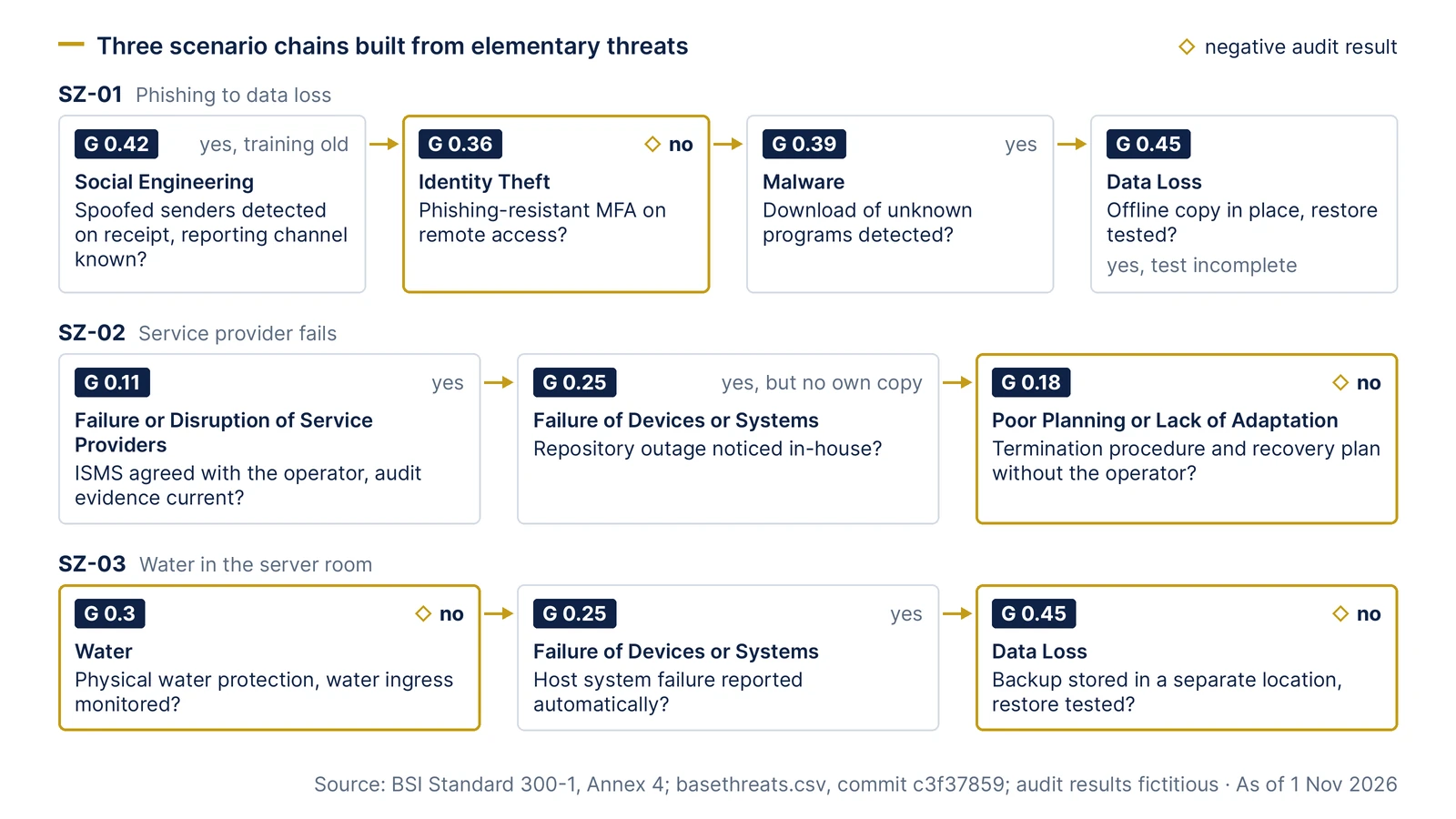
All three chains take place in the same fictitious organisation: a software company that runs a specialist application for public-sector clients in its own data centre. The object of analysis is the business process "operating the specialist application", with high protection requirements for confidentiality and availability. The audit results are invented and show how a negative result is followed up.
SZ-01, sequence of events: An administrator receives a forged email in the name of a service provider and enters her credentials on a copied website. Using these credentials, an attacker logs in to the remote access, places malware on a server and encrypts data and reachable backups. Confidentiality, integrity and availability are affected.
| Link | Audit question | Evidence | Requirements with this ID (selection, build 2026-10-29) | Audit result (fictitious) |
|---|---|---|---|---|
| G 0.42 Social Engineering (26 requirements) | Does the mail gateway check incoming mail for spoofed senders (SPF, DKIM, DMARC of the sender domain) and filter phishing, and do the administrators know the reporting channel for suspicious mail? | Configuration extract of the mail gateway with check rules and test result, extract of training records | KONF.13.1.1 Spam filter (SOLLTE), SENS.2.8 Reporting events (SOLLTE); KONF.13.9 Publication of the DMARC policy (SOLLTE), by contrast, protects the organisation's own domain towards third parties and proves nothing about incoming mail | yes; last training 14 months ago |
| G 0.36 Identity Theft (110) | Does the remote access require phishing-resistant multi-factor authentication for all accounts? | Configuration extract of the access, list of accounts | BER.5.8 Multi-factor authentication at the perimeter (SOLLTE), BER.3.10 Login attempt limit on the system (SOLLTE), BER.4.1 Principle of least privilege (SOLLTE) | no; MFA active, but by push confirmation without binding to the site being accessed |
| G 0.39 Malware (95) | Does monitoring on the servers detect the download and execution of unknown programs and raise an alert? | Rule set of the attack detection, test alert | DET.4.2 Automatic attack detection (SOLLTE), ARCH.5.1.10.1 Known malicious content (SOLLTE), REA.2.1 Triage and initial response (SOLLTE) | yes |
| G 0.45 Data Loss (47) | Is there a copy of the backups that cannot be reached from the remote access, and has restoring from it been tested? | Backup concept, log of the last restore test | NOT.4.14 Offline copy (SOLLTE), NOT.4.7 Versioned data backup (SOLLTE), NOT.4.16.1 Restore test (SOLLTE) | yes for the offline copy; test only for the database, not for the application servers |
Conclusion: Link 2 is open. BER.5.8 is given the status "not fulfilled" in the requirements package. If the switch to phishing-resistant methods is planned, this is a temporary non-fulfilment, and the risk not yet mitigated is reported to top management (300-1, ch. 4.1.1). If it will not happen in the foreseeable future, the non-fulfilment is permanent, and BER.5.8 triggers a risk assessment of its own in which, under criterion 17, the mapped threats G 0.36, G 0.30 and G 0.42 must be taken into account. Because the business process has high protection requirements, SZ-01 is in the risk register either way. The incomplete tests from link 4 and the old training from link 1 go into the implementation plan as safeguards.
Scenario chain 2: a service provider fails
SZ-02, sequence of events: The organisation has the document repository of the specialist application run by an external data centre operator. The operator files for insolvency and ceases operations at short notice. The repository can no longer be reached, and there is no rehearsed way of bringing data and operations back. Availability is affected above all.
| Link | Audit question | Evidence | Requirements with this ID (selection, build 2026-10-29) | Audit result (fictitious) |
|---|---|---|---|---|
| G 0.11 Failure or Disruption of Service Providers (13) | Is it contractually agreed that the operator runs an ISMS, and is current audit evidence available? | Contract, certificate or audit report with period of validity | BES.4.7 ISMS at the service provider (SOLLTE), DLS.3.1.1 Audit or certificate (SOLLTE), DLS.3.6 Portability (KANN, i.e. MAY; elevated (erhöht)) | yes |
| G 0.25 Failure of Devices or Systems (56) | Does the organisation's own monitoring notice the failure of the repository before users report it? | Monitoring rule, alert log | DET.4.14 Availability of the application (SOLLTE), DET.6.1.2 Automatic alerting (SOLLTE), NOT.4.14 Offline copy (SOLLTE) | yes; no own copy of the repository data |
| G 0.18 Poor Planning or Lack of Adaptation (385) | Is there a procedure for the orderly termination of the contract and a recovery plan without this operator? | Termination procedure, recovery plan | DLS.1.1 Procedures and rules (MUSS, i.e. MUST), NOT.3.1 Recovery plan (SOLLTE), BES.8.2 Procedure for transferring business processes (KANN, elevated) | no |
Conclusion: DLS.1.1 is a MUSS requirement. Safeguards must be defined for it; risk acceptance is not possible (300-1, ch. 4.1.2). The missing own copy from link 2 goes into the risk assessment for SZ-02.
Lesson for searching the catalogue: Requirement BES.6.3 „Übertragbarkeit von Daten“ (portability of data) reads „Beschaffungsmanagement für Dienstleistungen SOLLTE die Übertragbarkeit von Daten, Konfigurationen und der Funktionalität für den Fall einer Kündigung vereinbaren.“ (our translation: "Procurement management for services SHOULD agree the portability of data, configurations and functionality in the event of termination.") It fits SZ-02 exactly, but in the build it is mapped only to G 0.20. Anyone who filters exclusively by G 0.11 will miss it. Checking the catalogue by ID is therefore an aid; it cannot replace a subject-matter review of the practices (Praktiken) BES and DLS.
Scenario chain 3: water in the server room
SZ-03, sequence of events: After heavy rain, water enters the basement server room through a floor drain. Two host systems fail. The backup storage is in the same room and is also affected. Availability and integrity are affected.
| Link | Audit question | Evidence | Requirements with this ID (selection, build 2026-10-29) | Audit result (fictitious) |
|---|---|---|---|---|
| G 0.3 Water (6) | Is there at least one physical protective measure between the equipment and the water hazards in the room, and is water ingress monitored? | Site inspection report, building documentation | GEB.10.3 Water protection (SOLLTE), GEB.10.3.2 Leak sensor (KANN, elevated), NOT.4.6 Protected storage (SOLLTE) | no; floor drain without backflow protection, no sensor |
| G 0.25 Failure of Devices or Systems (56) | Is the failure of a host system detected and reported automatically? | Monitoring rule, alert log | DET.4.13 Availability of the host system (SOLLTE), DET.6.1.2 Automatic alerting (SOLLTE) | yes |
| G 0.45 Data Loss (47) | Is at least one backup stored in a separate location from the original data, and is restoring from it documented and tested? | List of backup locations, restore log | NOT.4.10 Separate storage (SOLLTE), NOT.4.15 Restore procedure (SOLLTE), NOT.4.16.1 Restore test (SOLLTE) | no; backup storage in the same room |
Conclusion: The chain shows how a single event hits systems and backups at the same time if both are in the same room. GEB.10.3 and NOT.4.10 are SOLLTE requirements. If the safeguards are planned, both are given the status "not fulfilled" as a temporary non-fulfilment with a date in the implementation plan; the risk not yet mitigated is reported to top management (ch. 4.1.1). For SOLLTE requirements that are included in implementation planning but not yet fulfilled, chapter 2.11 requires a residual risk assessment; chapter 4.1.2 says a temporary non-fulfilment does not trigger a risk assessment. How the two fit together is an open question of interpretation, which we set out on the page Assessing requirements, documenting deviations. For SZ-03 the question does not matter: the business process has high protection requirements for availability, so under chapter 2.11 and criterion 32 the scenario belongs in the risk assessment anyway. How a similar case is fully assessed and treated is shown in the case file, part 3: implementation.
The 47 elementary threats with catalogue references
The table gives the ID and title according to BSI Standard 300-1, Annex 4, identical to basethreats.csv. The third column is our count: how many requirements of the build of 29 October 2026 name the ID in the threats field. A requirement can be mapped to several threats, so the total exceeds 901. The figure is not a measure of the frequency or severity of a threat, only of its share in the derivation of the catalogue. G 0.18 „Fehlplanung oder fehlende Anpassung“ (poor planning or lack of adaptation) appears in 385 requirements, G 0.4, G 0.12 and G 0.13 in only one each.
| ID | Title (German original in brackets) | Requirements in build 2026-10-29 with this ID |
|---|---|---|
| G 0.1 | Fire (Feuer) | 19 |
| G 0.2 | Unfavourable Climatic Conditions (Ungünstige klimatische Bedingungen) | 6 |
| G 0.3 | Water (Wasser) | 6 |
| G 0.4 | Pollution, Dust, Corrosion (Verschmutzung, Staub, Korrosion) | 1 |
| G 0.5 | Natural Disasters (Naturkatastrophen) | 4 |
| G 0.6 | Catastrophes in the Vicinity (Katastrophen im Umfeld) | 2 |
| G 0.7 | Major Events in the Vicinity (Großereignisse im Umfeld) | 2 |
| G 0.8 | Failure or Disruption of the Power Supply (Ausfall oder Störung der Stromversorgung) | 5 |
| G 0.9 | Failure or Disruption of Communication Networks (Ausfall oder Störung von Kommunikationsnetzen) | 8 |
| G 0.10 | Failure or Disruption of Supply Networks (Ausfall oder Störung von Versorgungsnetzen) | 3 |
| G 0.11 | Failure or Disruption of Service Providers (Ausfall oder Störung von Dienstleistern) | 13 |
| G 0.12 | Electromagnetic Interference (Elektromagnetische Störstrahlung) | 1 |
| G 0.13 | Interception of Compromising Interference Signals (Abfangen kompromittierender Strahlung) | 1 |
| G 0.14 | Interception of Information (Espionage) (Ausspähen von Informationen (Spionage)) | 26 |
| G 0.15 | Eavesdropping (Abhören) | 18 |
| G 0.16 | Theft of Devices, Storage Media or Documents (Diebstahl von Geräten, Datenträgern oder Dokumenten) | 45 |
| G 0.17 | Loss of Devices, Storage Media or Documents (Verlust von Geräten, Datenträgern oder Dokumenten) | 13 |
| G 0.18 | Poor Planning or Lack of Adaptation (Fehlplanung oder fehlende Anpassung) | 385 |
| G 0.19 | Disclosure of Sensitive Information (Offenlegung schützenswerter Informationen) | 98 |
| G 0.20 | Information or Products from an Unreliable Source (Informationen oder Produkte aus unzuverlässiger Quelle) | 70 |
| G 0.21 | Manipulation of Hardware or Software (Manipulation von Hard- oder Software) | 27 |
| G 0.22 | Manipulation of Information (Manipulation von Informationen) | 43 |
| G 0.23 | Unauthorised Access to IT Systems (Unbefugtes Eindringen in IT-Systeme) | 142 |
| G 0.24 | Destruction of Devices or Storage Media (Zerstörung von Geräten oder Datenträgern) | 19 |
| G 0.25 | Failure of Devices or Systems (Ausfall von Geräten oder Systemen) | 56 |
| G 0.26 | Malfunction of Devices or Systems (Fehlfunktion von Geräten oder Systemen) | 36 |
| G 0.27 | Lack of Resources (Ressourcenmangel) | 35 |
| G 0.28 | Software Vulnerabilities or Errors (Software-Schwachstellen oder -Fehler) | 79 |
| G 0.29 | Violation of Laws or Regulations (Verstoß gegen Gesetze oder Regelungen) | 39 |
| G 0.30 | Unauthorised Use or Administration of Devices and Systems (Unberechtigte Nutzung oder Administration von Geräten und Systemen) | 130 |
| G 0.31 | Incorrect Use or Administration of Devices and Systems (Fehlerhafte Nutzung oder Administration von Geräten und Systemen) | 69 |
| G 0.32 | Misuse of Authorisations (Missbrauch von Berechtigungen) | 83 |
| G 0.33 | Shortage of Personnel (Personalausfall) | 18 |
| G 0.34 | Assault (Anschlag) | 9 |
| G 0.35 | Coercion, Blackmail or Corruption (Nötigung, Erpressung oder Korruption) | 8 |
| G 0.36 | Identity Theft (Identitätsdiebstahl) | 110 |
| G 0.37 | Repudiation of Actions (Abstreiten von Handlungen) | 53 |
| G 0.38 | Misuse of Personal Information (Missbrauch personenbezogener Daten) | 17 |
| G 0.39 | Malware (Schadprogramme) | 95 |
| G 0.40 | Denial of Service (Verhinderung von Diensten (Denial of Service)) | 30 |
| G 0.41 | Sabotage (Sabotage) | 12 |
| G 0.42 | Social Engineering (Social Engineering) | 26 |
| G 0.43 | Attack with Specially Crafted Messages (Einspielen von Nachrichten) | 29 |
| G 0.44 | Unauthorised Entry to Premises (Unbefugtes Eindringen in Räumlichkeiten) | 23 |
| G 0.45 | Data Loss (Datenverlust) | 47 |
| G 0.46 | Loss of Integrity of Sensitive Information (Integritätsverlust schützenswerter Informationen) | 23 |
| G 0.47 | Harmful Side Effects of IT-Supported Attacks (Schädliche Seiteneffekte IT-gestützter Angriffe) | 25 |
What scenarios built from elementary threats do not provide
The scenario chains on this page do not replace a risk assessment. They provide the risk identification; assessing likelihood and impact, comparing against the acceptance criteria and treatment follow your own procedure (300-1, ch. 4.2). An explicit risk assessment is required in the three cases from chapter 2.11: where a business process has high protection requirements, for assets not adequately covered by the target object categories (Zielobjektkategorien), and for SOLLTE requirements that are permanently not fulfilled. For SOLLTE requirements that are planned but not yet fulfilled, chapter 2.11 also requires a residual risk assessment.
The 47 threats are deliberately abstract and product-neutral. Minimum criterion 10 leaves open whether you work with threats and vulnerabilities or with risk scenarios; your own, more detailed scenarios alongside the 47 are therefore possible, provided the method is documented and authorised by top management (criteria 3 and 9).
Blackfort Technology supports you in setting up the risk method under Annex 3 and in reviewing existing threat overviews from 200-3 for Grundschutz++. The services are described on the consulting page.
The page Risk analysis shows how a complete risk case runs, and the page Risk register shows how scenarios are recorded as entries. Go to consulting on IT-Grundschutz and Grundschutz++.
Rights notice: IDs and titles of the elementary threats are taken from the file basethreats.csv of the State-of-the-Art Library, where they are licensed under CC BY-SA 4.0. Quotations from BSI Standard 300-1 (source: BSI page on Grundschutz++) and from BSI Standard 200-3 (source: BSI page on 200-3) are © Bundesamt für Sicherheit in der Informationstechnik. According to the imprint of that edition, quotations from the IT-Grundschutz Compendium, Edition 2023, are © 2023 Reguvis Fachmedien GmbH and © 2023 Bundesamt für Sicherheit in der Informationstechnik, Bonn (source: BSI page on the Compendium). Neither is licensed under CC BY-SA 4.0.