
Profile summary
| Original title | „IT-Grundschutz-Profil für kleine und mittlere Flughäfen“ (IT-Grundschutz Profile for small and medium-sized airports), short form „GSP-KMF“ (Tab. 2) |
|---|---|
| Publisher | „Arbeitskreis GSP-KMF“ (our translation: "GSP-KMF working group") (Tab. 2). According to the foreword, the BSI set up the working group in 2023 with experts from small and medium-sized airports. The authors come from the BSI and from the airports of Nuremberg, Münster/Osnabrück, Memmingen and Hahn (ch. 4). The document carries the notice „© Bundesamt für Sicherheit in der Informationstechnik 2024“. |
| Version and date | Version 1.0 of 12 Nov 2024 (first publication) according to the change history; before that, version 0.1 of 28 Oct 2024 as a „Community Draft“. The BSI page on the profile gives the date 19 Feb 2025. |
| Revision cycle | „2 Jahre“ (our translation: "2 years") according to Tab. 2; arithmetically, the first revision is therefore due from November 2026. We did not find a version after 1.0 on the BSI page on 2 Nov 2026. |
| Compendium edition | IT-Grundschutz Compendium 2023 |
| Methodology | BSI Standard 200-2, Standard Protection, individual requirements in case of elevated protection needs recommended (ch. 6.3, 6.4); protection requirements in the levels normal, high and very high (ch. 9.1) |
| Scope | 50 pages (PDF, about 800 KB), 11 chapters, 16 tables, one figure (simplified network plan) |
| Accessibility | freely available via the BSI page on the profile, without registration; confidentiality according to Tab. 2 „öffentlich“ (our translation: "public") |
| Licence and rights | The document contains no licence statement, only the BSI's copyright notice. We therefore quote only individual phrases from the profile with the chapter reference, everything else is in our own words; we do not reproduce the 16 tables or the network plan. |
| Type | IT-Grundschutz Profile of a working group, published by the BSI (not a KRITIS profile, not a thesis) |
| Location | BSI page „IT-Grundschutz-Profil für kleine und mittlere Flughäfen“, retrieved on 2 Nov 2026 |
An overview of all profiles, with publisher, status and Compendium edition, is on the page Finding and reusing IT-Grundschutz Profiles.
Scope and reference architecture
The profile describes itself as a „Schablone“ (our translation: "template") and defines an „empfohlenes Mindestschutzniveau“ (our translation: "recommended minimum level of protection") for information security at airports (chapter 5.2). Users are to take the particular features of their airport into account; the profile names ownership structures, interfaces to clients, partner companies, supervisory and police authorities, and the type of flight operations, such as the take-off mass of the aircraft or passenger and cargo volumes (ibid.). It does not define what makes an airport "small" or "medium-sized".
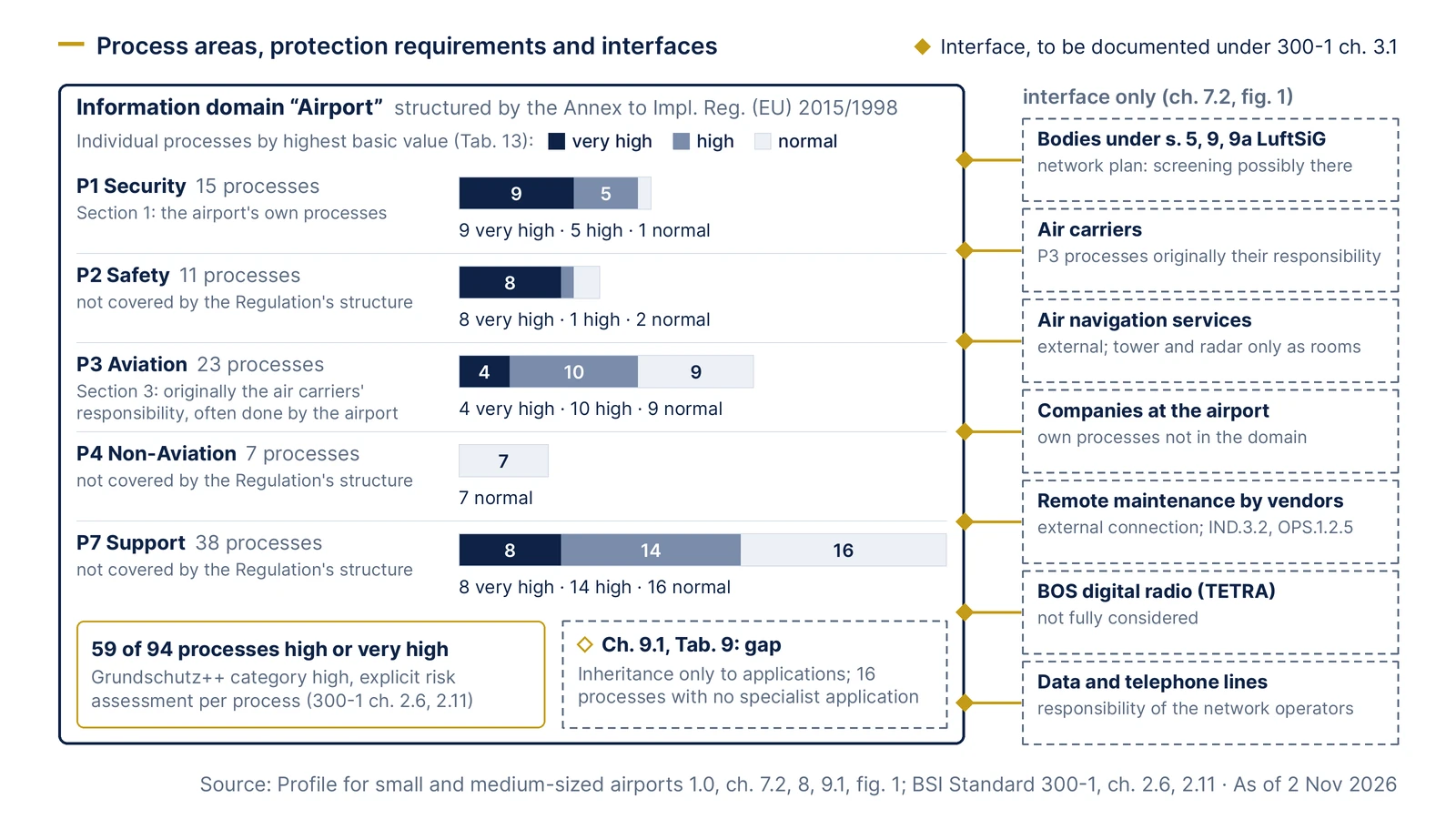
The profile groups the processes into five areas (chapter 8.1, Tables 4 to 8). Security (P1, 15 individual processes) covers ID card and key management, access control, surveillance of sensitive areas, boarding pass, passenger and baggage screening including the multi-level hold baggage screening system, and cargo acceptance. Safety (P2, 11) ranges from the lighting of the movement areas through apron control and building management to the safety management system and the control centre for fire and rescue services. Aviation (P3, 23) contains passenger, baggage and cargo handling, ten ground handling services from refuelling to push-back, and the traffic control centre. In addition there are Non-Aviation (P4, 7) with parking, real estate and retail, and the support processes (P7, 38) from asset and identity management to traffic billing. The structure follows the Annex to Implementing Regulation (EU) 2015/1998: P1 corresponds to its Section 1 and contains processes originally belonging to the airport, P3 corresponds to its Section 3 and concerns processes originally in the responsibility of an air carrier; P2, P4 and P7 are not covered there (chapter 8.1). The numbers P5 and P6 do not occur in the profile.
Chapter 8 explains why air carriers' processes are in the profile: at small and medium-sized airports, the operator is often itself contracted for ground handling and performs these processes as a contractor. If you do not, shorten the list; the profile expressly requires the processes to be checked for their usability in your own information domain.
In addition to the processes there are 32 applications, from the Airport Operational Database (A1) as the central flight data management system, through the ID card, access control and video surveillance systems, the building management system with fire alarm system, Common Use Terminal Equipment, Baggage Handling System and Baggage Reconciliation System, to airfield lighting, dispatch system and aircraft noise monitoring (Table 9). Besides servers, network components and clients, the IT systems and networks (Table 10) contain entries typical of airports, such as a SITATEX server for the automatic exchange of messages between airports and airlines and a boarding pass control server. The 27 areas and rooms (Table 11) range from the traffic control centre and security control centre through the tower, airport surveillance radar and emergency power supply of air navigation services to the apron, runway, hangar, workshops and the airport vehicles with their mobile devices.
The simplified network plan (chapter 8.4, fig. 1) shows a fictitious airport with internal network, DMZ and internet; all objects shown „sollten mindestens im Netzplan des Anwendenden dieses Profils vorhanden sein“ (our translation: "should at least be present in the network plan of the user of this profile"). Connected via the internet are remote maintenance, air navigation services, air carriers, the aviation security authority, ground handling, parties in the secure supply chain, remote workstations and the airport's management body.
Not covered are (chapter 7.2): processes of companies offering services at the airport that the airport does not usually perform itself; the tasks of the bodies and operators under Sections 5, 9 and 9a of the Luftsicherheitsgesetz (LuftSiG, Aviation Security Act), which the profile considers only as interfaces unless the airport takes them on as a service provider; BOS digital radio (the radio network of the German authorities and organisations with security tasks) to the TETRA standard, which is not fully considered; and the data and telephone lines, as long as the airport is not itself the network operator. If your airport differs from the reference architecture, additional or missing objects are to be documented and assigned to suitable modules (chapter 8.6).
Does the profile fit your airport?
The profile fits if …
- you operate an airport that, besides security, safety and infrastructure, also handles ground handling for air carriers itself: this is exactly the case the process list depicts (chapter 8);
- you are building a security concept under BSI Standard 200-2 with the 2023 Compendium and are looking for a complete list of an airport's processes, applications and rooms as a starting point;
- you operate the building management system, airfield lighting or baggage conveyor system yourself and need an initial assignment to the Industrial IT modules (Table 16);
- you compile security requirements as a manufacturer of airport technology or as a technical planner; the profile expressly names this role as a target group (chapter 6.1);
- you want to oblige service providers contractually to a minimum level of protection and are looking for a common reference for this (chapter 5.3);
- you operate an aerodrome that only applies alternative security measures under Regulation (EU) 1254/2009: according to chapter 6.6 of the profile (as of November 2024), such aerodromes are not obliged to apply the information security measures under chapter 1.7 of the Annex to Implementing Regulation (EU) 2015/1998, but the profile is meant to help them too. We do not interpret this statement of the profile; whether and which obligations apply to your aerodrome is something you clarify with the competent body.
The profile does not fit, or only partly, if …
- handling, cargo or refuelling at your airport are mainly provided by independent companies: then cut process area P3 and parts of P1 considerably and document interfaces instead (chapters 7.2, 8);
- you want to adopt ready-made protection requirements for IT systems, networks and rooms: the profile passes them on only as far as the applications (chapter 9.1);
- you expect a selection at requirement level or specific implementation guidance: the profile marks 108 of 111 modules as relevant and does not select individual requirements;
- you have to secure air navigation technology, BOS digital radio or the data and telephone lines: air navigation services appear in the network plan as an external connection; tower and radar appear in the reference architecture only as rooms without a module of their own, the emergency power supply of air navigation services (R19) only with INF.5; digital radio and lines are excluded (chapter 7.2, Table 11, Table 16, fig. 1);
- screening and X-ray technology at your site is the responsibility of another body: the profile leaves open whether it attributes these systems to the airport (network plan: „evtl. in Zuständigkeit der §5 LuftSiG Behörde“ (our translation: "possibly the responsibility of the Section 5 LuftSiG authority")); you clarify the responsibility yourself;
- you start directly with Grundschutz++: then take over the 94 processes, 32 applications and 27 areas and rooms as a subject-matter source, map the three protection requirement levels to normal and high, and replace the list of 108 modules with the assignment to target object categories (Zielobjektkategorien) (see below).
What makes the profile distinctive
High protection requirements across the board: the profile argues that at airports the basic values must „über das übliche Maß hinaus erreicht werden“ (our translation: "be achieved beyond the usual extent") (chapter 6.3). The protection requirements determination of the processes turns out accordingly (Table 13). Counted by the highest basic value in each case, 29 of the 94 individual processes are very high, 30 high and 35 normal. In Security, 9 of 15 processes have very high protection requirements, almost always because of integrity, for example because dangerous objects could get into the security area undetected. In Safety it is 8 of 11, including airfield lighting for integrity and availability. The profile rates operation and maintenance of the application, communication, information and security systems, operation and maintenance of the technical installations, and identity and access management as very high for all three basic values. The Non-Aviation processes remain normal throughout.
Inheritance only as far as the application: the profile presents inheritance „ausschließlich aus den Prozessen in die Anwendungen“ (our translation: "exclusively from the processes into the applications"); it leaves the consideration for IT systems and other objects to the users, because the IT infrastructure of airports differs greatly (chapter 9.1). Of 32 applications, 17 are very high, 9 high and 6 normal (Table 14). According to Table 9, office communication (A31) supports „alle Prozesse“ (our translation: "all processes") and is therefore very high for all three basic values. Since clients, network components, DNS, firewall and VPN support office communication in Table 10, consistent inheritance puts most of the infrastructure at very high as well; the profile does not draw this conclusion itself.
Module selection by the maximum principle: „Es werden alle Bausteine modelliert, die grundsätzlich für kleine und mittlere Flughäfen bedeutend sein könnten“ (our translation: "All modules that could in principle be significant for small and medium-sized airports are modelled") (chapter 9.2). We compared Tables 15 and 16 against the 2023 Compendium: all 111 modules are listed, 108 marked as relevant; only classified information protection VS-NfD (CON.11.1), auditing under the Leitfaden IS-Revision (IS audit guideline) (DER.3.2) and IBM Z (SYS.1.7) are excluded. Many entries carry additions such as „wenn vorhanden“ (our translation: "if present"). The actual selection is therefore made by you, by deleting whatever does not exist at your site.
Airport technology as Industrial IT: unlike some profiles, this one models the IND modules. It assigns the building management system, fire alarm system, Baggage Handling System, airfield lighting, Baggage Reconciliation System, parking management and aircraft noise monitoring to process control and automation technology, general ICS components, sensors and actuators, and remote maintenance in industrial environments; for the Baggage Handling System, programmable logic controller, machine and Safety Instrumented Systems are added (Table 16). The apron vehicles are covered by the module General Vehicle (INF.11). Chapter 9.5 names the Baggage Handling System in particular as an example of an object that cannot be adequately represented with the existing modules, and the foreword announces airport-specific modules as a supplement. We did not find such modules in the sources we evaluated.
No intervention at requirement level: chapter 9 explains that a profile can select requirements, make them more specific and add new ones. This profile stays at module level; it does not select individual requirements and does not name specific requirements in case of elevated protection needs, although it generally recommends implementing them (chapter 6.3). The guidance takes the form of short notes on the modules, for example that the WLAN is to be separated from the critical systems (NET.2.1), that service providers and manufacturers of airport systems use remote maintenance (OPS.2.3), that airports themselves provide outsourced services for other companies (OPS.3.2) or that Microsoft Entra, lacking a module of its own, is to be represented via Active Directory and cloud usage (APP.2.2). According to chapter 11, the first to be implemented are security management, ORP.1 to ORP.4, the data backup concept (CON.3), deletion and destruction (CON.6) and all modules from OPS.1.1.
For top management, the profile recommends obliging external service providers, when IT or processes are outsourced, to demonstrate a minimum level of protection, for example on the basis of this profile (chapter 5.3). This is one of the few places where the profile proposes a specific organisational safeguard.
Where the profile contradicts itself: sixteen processes, including the security checks, the multi-level hold baggage screening system, cargo and aircraft refuelling, have no specialist application in Table 9; the checklist further down deals with them. The network plan shows systems that are missing from Table 9: an identity and access management system, walk-through metal detectors and X-ray and detection systems with the note „evtl. in Zuständigkeit der §5 LuftSiG Behörde“ (our translation: "possibly the responsibility of the Section 5 LuftSiG authority"), an airport dispatch system that controls the conveyor and sorting system, and a location and guidance system for mobile objects. For the BCMS (A20), Table 9 refers to „A23 / ISMS“ and for the ISMS (A21) to „A22 / BCMS“, although A23 is human resources management and A22 the ERP system; in our reading, A21 and A20 are meant. Table 14 justifies the high confidentiality of the access control system partly with P1.1.8, which according to Table 13 has normal confidentiality. Chapter 11 speaks of protection requirements „der Kategorie ‚Standard‘“ (our translation: "of the category 'Standard'"), which does not exist in Table 12. And 14 of the 27 areas and rooms, including tower, radar, security control centre, fire brigade control centre, apron and runway, are not assigned to a module of their own in Table 16; for them only General Building (INF.1) remains.
If your airport operates its own control centre for fire and rescue services (process area P2.5, application A28 dispatch system), the IT-Grundschutz Profile for control centres covers this part in considerably more detail with its own reference architecture.
Working aid: checklist for 16 processes without a specialist application
Table 9 assigns to each application the processes it supports. Sixteen of the 94 processes appear there only via office communication (A31, „alle Prozesse“ (our translation: "all processes")), not via any specialist application. For them, the profile has no chain from process to application and therefore no inheritance of protection requirements either. Thirteen of them have high or very high protection requirements for at least one basic value.
Go through the list and enter for each process which system supports it at your site and who operates it. If you operate the system yourself, record it as an asset of the process (in Grundschutz++ under BSI Standard 300-1 Annex 1, usually as an application and IT system). If it lies with an air carrier, an authority or another company, document the interface, as chapter 3.1 of 300-1 requires for technical assignment and the delimitation of outsourcing. If the process does not exist at your site, delete it with a justification. For every process with high protection requirements, Grundschutz++ requires an explicit risk assessment (300-1 chapter 2.11).
| No. | Process (profile Tab. 4 to 8) | Protection requirements C / I / A (Tab. 13) | Check question for your airport |
|---|---|---|---|
| 1 | P1.1.3 Control of deliveries | normal / very high / normal | Which system is used to record and check deliveries, and who runs it? |
| 2 | P1.1.4 Security screening (staff) | normal / very high / normal | Which screening technology is in use, who operates it, and is it connected to the ID card or access control system (A2, A3)? |
| 3 | P1.2.1 Passenger control | normal / high / normal | Which system checks travel documents and the assignment to the flight, and does it belong to the airport or to the air carrier? |
| 4 | P1.2.2 Security screening under Section 5 LuftSiG | normal / very high / normal | Who operates walk-through metal detectors, X-ray and detection systems? The network plan notes „evtl. in Zuständigkeit der §5 LuftSiG Behörde“ (our translation: "possibly the responsibility of the Section 5 LuftSiG authority"). Depending on the answer, asset or interface. |
| 5 | P1.3.3 Multi-level hold baggage screening system (Mehrstufige Reisegepäckkontrollanlage, MRKA) | high / very high / normal | How is the system connected to the Baggage Handling System (A8) and the dispatch system? The network plan shows a conveyor and sorting system with security scan controlled by the dispatch system. Where are the evaluation data, for which Tab. 13 mentions a retention period, stored? |
| 6 | P1.3.4 Oversized baggage | normal / very high / normal | Is screening done via the MRKA or with separate equipment? |
| 7 | P1.4.1 Cargo acceptance | high / very high / normal | Which cargo system is used, who operates it, and which data do you exchange with parties in the supply chain (an external connection in the network plan)? |
| 8 | P2.5.2 Emergency and alarm management | high / high / very high | The dispatch system (A28) is assigned only to P2.5.1, the emergency management system (A11) only to P2.4.1 and P7.1.14. Which system do you actually use to raise the alarm? |
| 9 | P3.3.1 Cargo release | high / very high / normal | as no. 7, for handover to recipients |
| 10 | P3.3.2 Cargo sorting, transport and loading | high / high / normal | Is there a cargo conveyor system or warehouse management? It would be another candidate for the IND modules. |
| 11 | P3.4.2 Aircraft refuelling | normal / very high / high | According to Tab. 9, the fuel system (A15) covers only ground vehicles. Which system records fuel grade, quantity and quality for aircraft, and who operates it? |
| 12 | P7.1.1 Requirements management | high / high / normal | Are requirements kept in a tool, for example in project management (A24) or in the CAFM (A27)? |
| 13 | P7.1.9 Identity & Access Management | very high / very high / very high | Tab. 10 lists authentication and MFA servers, the network plan an IAM system, Tab. 9 no application. Record the IAM as an application of its own; ORP.4 has no entry in the draft mapping (see below). |
| 14 | P4.3.1 Delivery management, P7.1.7 Disposal and cleaning, P7.1.16 Incident and problem management | normal in each case | Do these processes use a system of their own or only office communication and the ticket system (A19)? |
C / I / A stands for confidentiality, integrity and availability. Whether a system counts as an application, IT system or interface is our suggestion; for the classification, the definitions in Annex 1 of 300-1 apply. How to draw the boundaries of your airport information domain is explained on the page Delimiting the information domain; how the risk assessment for the processes with high protection requirements works, on the page Carrying out a risk analysis.
Path to Grundschutz++: protection requirements, airport technology, modules
For an airport, moving to Grundschutz++ changes three things: 59 of the 94 processes end up in the high category and each needs an explicit risk assessment, Annex 1 of 300-1 has no target object category of its own for the baggage conveyor system, airfield lighting and building management system, and of the 1,759 valid requirements of the 108 marked modules, 496 have an entry in the draft mapping. We did not find a Grundschutz++ version of the airport profile on 2 November 2026.
First, protection requirements. You map the profile's three levels onto the two categories of Grundschutz++ (300-1 chapter 2.6): 29 processes with very high and 30 with high protection requirements become 59 processes in the high category. For every business process that has high protection requirements for at least one basic value, 300-1 requires an explicit risk assessment (chapter 2.11). This is the biggest cost driver in the transfer. So first check which processes exist at your site, and follow the recommendation in 300-1 to start with the most important process in the highest category (chapter 2.6). You can reuse the justifications from Table 13 for your own classification; you replace inheritance to applications with the assignment of assets to processes (chapters 3.1, 3.4.2).
Second, airport technology. Annex 1 of 300-1 has no target object category of its own for control technology or vehicles. You treat the baggage conveyor system, airfield lighting and building management system as applications which, according to the definition, also serve the „Steuerung, Konfiguration, Überwachung oder Administration von Hardware, technischen Anlagen“ (our translation: "control, configuration, monitoring or administration of hardware, technical installations"), and as IT systems. Where that is not sufficient, 300-1 provides for an explicit risk assessment if a relevant asset is not adequately covered by the existing target object categories (chapter 2.11), and for supplementary requirements (chapter 3.4.3). This is the same gap that the profile describes in chapter 9.5 for the Baggage Handling System.
Third, the modules. Because the profile marks 108 of 111 modules as relevant, an overall count covers almost the entire Compendium; the subsets the profile itself highlights say more: the modules to be implemented first from chapter 11 and the seven IND modules for airport technology. The basis is the draft mapping (status "draft", as of 21 July 2026), resolved in the user catalogue (Anwenderkatalog) build 2026-10-29. The result is a draft and not an official mapping.
How to justify the classification of your processes and use the justifications from Table 13 in doing so is shown on the page Protection requirements determination: rating business processes with a justification.
| Metric (108 modules of the profile) | Value |
|---|---|
| Requirement identifiers in the 2023 Compendium | 2,043, of which 284 marked as removed (entfallen), so 1,759 valid |
| Requirements with at least one entry in the draft mapping | 496 (about 28% of the valid ones); no removed requirement has an entry |
| different Grundschutz++ requirements as target | 337 from 18 practices; most in DET (77), ARCH (63), KONF (53) and TEST (34) |
| Modules without a single entry | 17: ORP.4 Identity and Access Management, CON.2 Data Protection, CON.3 Data Backup Concept, CON.6 Deletion and Destruction, OPS.1.2.4 Teleworking, APP.2.3 OpenLDAP, SYS.1.2.2 Windows Server 2012, SYS.1.3 Linux and Unix Servers, SYS.2.4 macOS Clients, SYS.3.2.3 iOS (for Enterprise), IND.2.2 Programmable Logic Controller (PLC), IND.2.3 Sensors and Actuators, NET.4.3 Fax Machines and Fax Servers, INF.5 Room or Cabinet for Technical Infrastructure, INF.6 Data Media Archive, INF.7 Office Workplace, INF.9 Mobile Workplace |
| of these, modules the profile has you implement first (ch. 11) | ORP.4, CON.3 and CON.6 with 43 valid requirements in total; across all ch. 11 modules, 79 of 208 valid requirements have an entry |
| Industrial IT modules (7) | 69 valid requirements, 26 of them with an entry |
| Target references that cannot be resolved in the catalogue | 12, all to VRB.1.2 |
That a requirement has an entry says nothing yet about how much of it arrives in the target; the draft distinguishes equivalent mappings, subsets and supersets, and mere overlaps. For remote maintenance of airport technology, WLAN separation and data backup we traced the chain individually:
| Profile reference | Requirement 2023 Compendium | Target in Grundschutz++ (catalogue build 2026-10-29) | Gap |
|---|---|---|---|
| Tab. 16 on IND.3.2 for building management system, fire alarm system, baggage conveyor system, airfield lighting and other installations, „insofern für die Anwendungen Fernwartungszugänge vorhanden sind“ (our translation: "insofar as remote maintenance access exists for the applications") | IND.3.2.A7 „Technische Entkopplung von Zugriffen“ (our translation: "Technical decoupling of access") (standard, SOLLTE (SHOULD)): every remote access to the OT via a decoupling system, such as a jump server in a DMZ | Mapping: sub-requirements 1, 2 and 4 as a subset (subset-of) of ARCH.2.2.5 „OT-Systeme“ (our translation: "OT systems") (normal-SdT, SOLLTE: restrict connections between OT systems and other IT systems); sub-requirement 4 additionally as a superset (superset-of) of ARCH.2.2.12 „Sprungserver“ (our translation: "Jump server") (elevated (erhöht), KANN (MAY)) | The draft treats decoupling as part of ARCH.2.2.5 (SOLLTE); its requirement text, however, only requires connections between OT and other IT systems to be restricted, and the decoupling system appears only in the guidance. As a requirement of its own, the jump server exists only as a KANN (ARCH.2.2.12). Sub-requirements 3 and 5, including the OT's responsibility for the decoupling system, remain unmapped, as does the basic requirement IND.3.2.A6 (MUSS (MUST): every remote maintenance access to the OT through a security component under the responsibility of the OT). Our suggestion: record decoupling and OT responsibility as the outcome of the risk assessment for the OT assets |
| Tab. 16 on NET.2.1: „Trennung zu den kritischen Systemen erforderlich“ (our translation: "separation from the critical systems required") | NET.2.1.A9 „Sichere Anbindung von WLANs an ein LAN“ (our translation: "Secure connection of WLANs to a LAN") (standard, SOLLTE: secure the transition, for example with a packet filter) | Mapping: no entry, nor for NET.2.1.A7 on the distribution system. Own search in the catalogue: ARCH.2.1 „Netzsegmente“ (our translation: "Network segments") (normal-SdT, SOLLTE; the guidance names WLANs, building automation and industrial control systems as areas to be considered) and ARCH.2.2 „Einschränkung von Verbindungen zwischen Segmenten“ (our translation: "Restriction of connections between segments") (normal-SdT, SOLLTE, criteria as a parameter) | The mapping is ours, not the draft's. The profile does not say which systems are „kritisch“ (our translation: "critical"); our suggestion: name the applications with very high protection requirements from Tab. 14 as criteria in the parameter of ARCH.2.2 |
| Tab. 15 on CON.3: retain data „gem. gesetzlicher Fristen“ (our translation: "in accordance with statutory periods"), „auch nach Datenverlust“ (our translation: "also after data loss"); ch. 11: implement CON.3 first | CON.3.A5 „Regelmäßige Datensicherung“ (our translation: "Regular data backup") (basic, MUSS) | Mapping: no entry; for CON.3 the draft contains no mapping at all. Own search in the catalogue: NOT.4.2 „Sicherung des Systems“ (our translation: "Backup of the system") and NOT.4.3 „Sicherung der Anwendung“ (our translation: "Backup of the application") (normal-SdT, SOLLTE, frequency „regelmäßig“ (our translation: "regularly") as a parameter), NOT.4.4 „Automatische Datensicherung“ (our translation: "Automatic data backup") (normal-SdT, SOLLTE) | The modal verb drops from MUSS to SOLLTE. Retention periods are not in any of these targets; neither the profile nor this page determines which periods apply to your data. Record them as a supplementary requirement |
The airport profile contains hardly any profile-specific requirements in the narrower sense; it does not add any requirements. What you take from it are the process list, the justifications of protection requirements, the assignments and the notes on the modules. These notes are not in any mapping. If you want to keep them, for example the separation of the WLAN from critical systems or proof of a minimum level of protection by service providers, write them into your requirements package as supplementary requirements (300-1 chapter 3.4.3). You check individual mappings from the draft using the procedure on the page Checking the IT-Grundschutz 2023 mapping.
Rights notice: Quotations and information from the IT-Grundschutz-Profil für kleine und mittlere Flughäfen, published by the Arbeitskreis GSP-KMF, according to the document © Bundesamt für Sicherheit in der Informationstechnik 2024; the document contains no open licence. Source: BSI page on the profile, retrieved on 2 November 2026. Quotations from BSI Standard 300-1 © Bundesamt für Sicherheit in der Informationstechnik 2026, source: BSI page on Grundschutz++. The quotations are unchanged; summaries and counts are our own. Module and requirement titles from the IT-Grundschutz-Kompendium, Edition 2023, © 2023 Reguvis Fachmedien GmbH and © 2023 Bundesamt für Sicherheit in der Informationstechnik, source: BSI page on the IT-Grundschutz Compendium. These titles are not under CC BY-SA 4.0; the licence notice at the end of the page applies to the extracts from catalogue and mapping data.
What this page does not decide
The profile names a number of legal sources: Implementing Regulation (EU) 2015/1998 with chapter 1.7 of its Annex, Regulation (EC) 300/2008, Regulation (EU) 1254/2009, Regulation (EU) 139/2014, Implementing Regulation (EU) 2022/1645 (applicable from 16 October 2025 according to the profile), the Luftsicherheitsgesetz, Section 45 LuftVZO, Annex I of the Nationales Luftsicherheitsprogramm (National Aviation Security Programme) and the NIS and NIS2 Directives (chapters 6.3, 6.6). We do not interpret these provisions. Whether and how they apply to your airport, what minimum level of protection they require and who is responsible for what under Sections 5, 9 and 9a of the Luftsicherheitsgesetz follows from the relevant law and your approval; you clarify this with the competent bodies.
The profile's references to Section 8a and Section 8f of the BSI Act (BSIG) and to the critical infrastructure (KRITIS) and UBI Ordinances reflect the legal situation at publication in November 2024 and are to that extent historical. The BSI Act has since been re-enacted. Whether and with which obligations the current BSI Act applies to your airport is not decided on this page.
Implementing the airport profile gives you neither proof towards a supervisory authority nor a certification. The profile describes itself as „Empfehlung und Handreichung“ (our translation: "recommendation and guidance") (foreword); each airport has to check the actual application of the recommended requirements itself (chapter 5.2). The fact that the BSI published the profile and contributed to it does not make it a requirement for your airport.
The general relationship between Grundschutz and the obligations under NIS2 is covered on the page NIS2 and Grundschutz.
Support with the transfer
If you want to move a security concept based on the airport profile to Grundschutz++ or tailor the profile to the processes and systems of your airport, the team at Blackfort Technology supports you with process delimitation, protection requirements, risk assessment and requirements package. How the consulting works and what it covers is described under Consulting on IT-Grundschutz and Grundschutz++. Profiles from other sectors and the general path from profile to requirements package are shown in the overview of IT-Grundschutz Profiles.