
Profile summary
| Original title | „IT-Grundschutz-Profil für Papierfabriken“ (IT-Grundschutz Profile for paper mills) |
|---|---|
| Publisher | Verband Deutscher Papierfabriken e. V. (VDP), in English German Pulp and Paper Association (ch. 3). Developed in a VDP workshop series, moderated by the BSI; 15 authors from eleven companies in the paper industry and the VDP (ch. 1, 6). |
| Publisher today | The VDP no longer exists under this name. According to a company announcement by the association of 29 Jul 2021, published on the industry portal paper-world.com, it is called „DIE PAPIERINDUSTRIE e. V.“; according to the Bundestag lobby register (historical version of the entry of 18 Aug 2025; the current version no longer contains the sentence), the association was formed by the merger of the VDP with the Vereinigung der Arbeitgeberverbände der Deutschen Papierindustrie (VAP), the federation of employers' associations of the German paper industry. We have not found whether the new association is continuing the profile. |
| Version and date | Version 1.0. The change history lists three steps: working draft by the BSI on 23 Apr 2019, summary of the workshop results on 5 Jun 2019, finalisation by the VDP on 1 Jul 2019. Chapter 3, by contrast, states „Veröffentlicht am 04.07.2019, Version 1.0, finalisiert im Juni 2019“ (our translation: "Published on 04.07.2019, version 1.0, finalised in June 2019"). The BSI page on the profile gives the date 4 Jul 2019. |
| Revision cycle | „alle zwei Jahre“ (our translation: "every two years") (ch. 3); on 2 Nov 2026 we found no version newer than 1.0 on the BSI page |
| Compendium edition | not stated in the document. Inferred from the modules: Edition 2019. All 75 identifiers used and their titles appear in this edition, eight of them are new there (including IND.2.7, NET.4.1 and OPS.2.2), and three (OPS.2.4, OPS.1.2.3, SYS.3.4) no longer exist from the 2020 edition onwards. |
| Methodology | BSI Standard 200-2, Basic Protection; for the sub-process energy supply additionally standard requirements (ch. 7.2, 8.3, 11.1) |
| Registration | no number; the field refers to an allocation „nach erfolgreichem Durchlaufen des Registrierungsverfahrens“ (our translation: "after successful completion of the registration procedure") (ch. 3) |
| Scope | 25 pages (PDF, about 1 MB), 14 chapters, three maps as appendices |
| Accessibility | freely available via the BSI page on the profile; according to ch. 3 „offen zugänglich“ (our translation: "openly accessible") |
| Licence and rights | no licence. According to ch. 5, copyright lies with the participants in the workshop series; „Eine Weitergabe an Dritte ist ausdrücklich erwünscht.“ (our translation: "Passing it on to third parties is expressly encouraged.") We quote only briefly and with a reference; we do not reproduce the maps or the network plan. |
| Type | IT-Grundschutz Profile of an industry association published by the BSI (no KRITIS profile, no thesis) |
| Location | BSI page „IT-Grundschutz-Profil für Papierfabriken“, retrieved on 2 Nov 2026 |
A comparison of all profiles, with publisher, date and Compendium edition, is on the page Finding and reusing IT-Grundschutz Profiles.
Scope and the model paper mill
The profile sees itself as a template: „Ein IT-Grundschutz-Profil ist ein Muster-Sicherheitskonzept, das als Schablone für Institutionen mit vergleichbaren Rahmenbedingungen dient“ (our translation: "An IT-Grundschutz Profile is a model security concept that serves as a template for institutions with comparable conditions") (chapter 2). It is aimed at the management, IT administration and quality management of a paper mill (chapter 7.1) and deliberately covers only three business processes: order-to-cash with sales and order processing, finance and controlling, and planning; production with raw material supply, energy supply, waste disposal, maintenance and servicing, MES and process control system, and quality control system; logistics with automated warehouse, shipping and transport (chapter 10.1.1). The map (Landkarte) for logistics adds scheduling and customs declaration via the Atlas procedure (Appendix 3).
All other processes of a paper mill are excluded. The authors consider the three processes „ausreichend repräsentativ für alle nicht berücksichtigten Geschäftsprozesse“ (our translation: "sufficiently representative of all business processes not considered") (chapter 9.2), but also say that, to determine the need for action for the whole operation, the remaining processes would have to be captured using the same approach (chapter 7.2). There are no references to other profiles (chapter 9.3).
The reference architecture lists 23 applications, from SAP ERP via EDI, banking software, Office 365 and the customs application to production planning, MES, quality and process control systems, environmental and energy management systems, warehouse management and yard management with lorry self-service and weighbridge (chapter 10.1.2). The IT systems include, besides servers, clients and mobile devices, kiosk systems, IP cameras, sensors, PLCs (SPS), EWS, HMI and „Maschine“ (machine) (chapter 10.1.3). The word paper machine does not appear in the profile; production technology appears only in these general object types. The rooms include an outsourced data centre, a technical room, a network distribution cabinet or room, the factory site with yard, home office and mobile working (chapter 10.1.5).
The network plan of the „Muster-Papierfabrik“ (model paper mill) (chapter 10.3) shows administration with a server room, production with production control, logistics with warehouse and factory site, and a „Kraftwerk“ (power plant) with its own control system. A firewall is drawn only at the transition to mobile working; production, power plant and logistics are connected to the server room via switches. The network plan shows no access for remote maintenance. If your mill differs from the reference architecture, additional or missing target objects are to be documented and assigned to suitable modules (chapter 10.2).
Production and remote maintenance: how the profile handles them
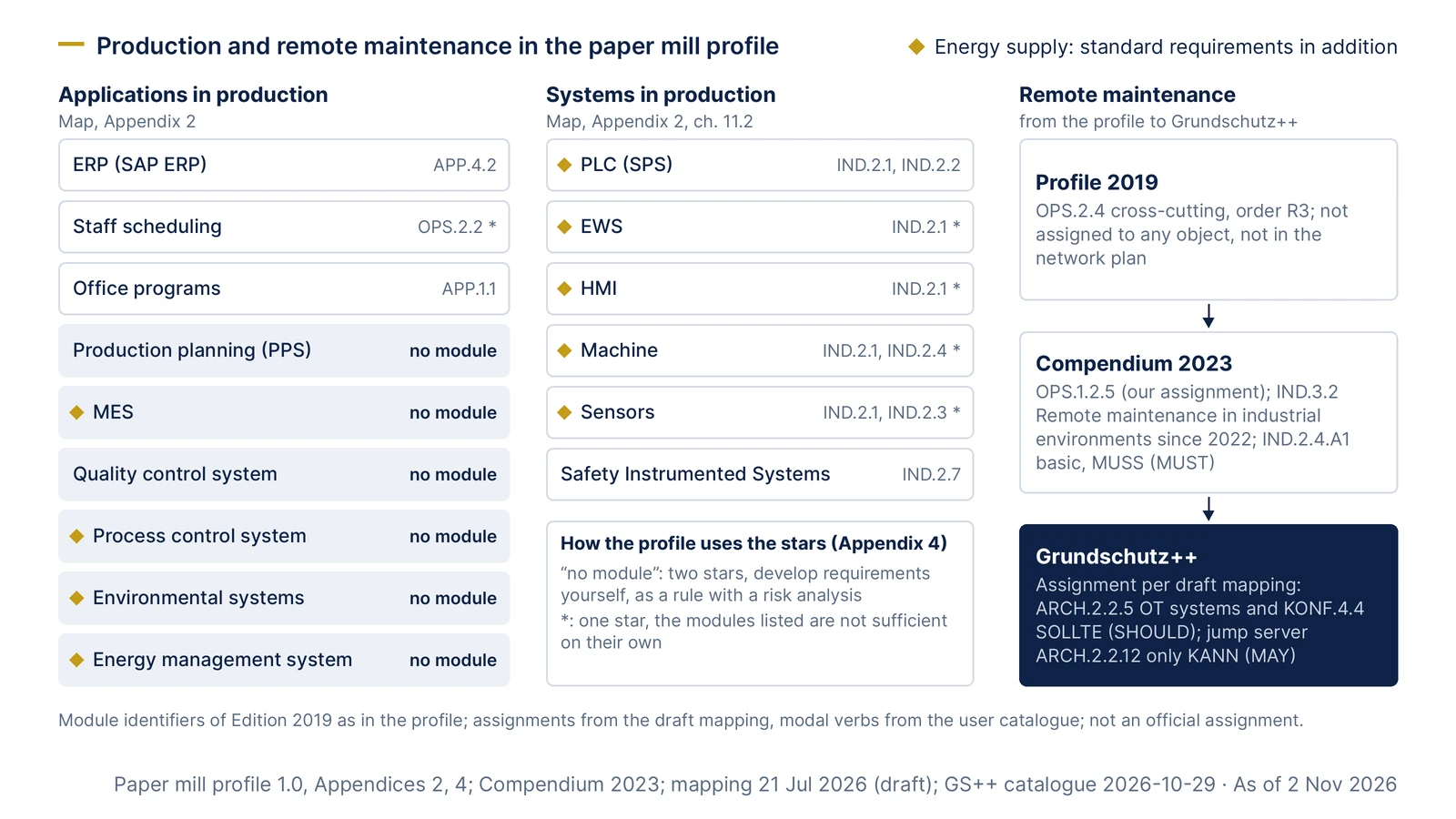
The maps in the appendix are the profile's real working tool. For each business process they assign applications, IT systems and rooms to modules and use stars to mark where the modules are not enough: one star means the modules are „allein nicht ausreichend“ (our translation: "not sufficient on their own"), two stars that „im IT-Grundschutz-Kompendium dazu kein Baustein“ (our translation: "no module for this in the IT-Grundschutz Compendium") exists and requirements have to be developed individually, as a rule with a risk analysis (Appendix 4). Exclamation marks identify objects with high priority.
In the map for production (Appendix 2), six of nine applications have two stars: production planning, MES, quality control system, process control system, environmental systems and energy management system, plus the interface between MES and ERP. Only ERP and Office have a module, plus the cloud-based staff scheduling with OPS.2.2 and one star. For the systems it is the other way round: PLC, EWS, HMI, machine, sensors and Safety Instrumented Systems receive the industrial modules IND.2.1, IND.2.2, IND.2.3, IND.2.4 and IND.2.7, but EWS, HMI, machine and sensors with one star. The cross-cutting module IND.1 is listed with priority R2 in chapter 11.2. The profile thus openly states that in the 2019 Compendium there was no module for the process control applications, that is MES, process control and quality control system.
The profile models remote maintenance only as the cross-cutting module OPS.2.4 with the order R3, meaning it is to be worked on „erst nach den anderen Bausteinen“ (our translation: "only after the other modules") (chapter 11.2). No map assigns it to an object, and the network plan shows no remote maintenance path. What exists today could not have been known to the profile: since the 2022 edition, the Compendium has contained the module IND.3.2 „Fernwartung im industriellen Umfeld“ (remote maintenance in industrial environments); among other things it describes plant components that manufacturers deliver as a closed unit and equip with their own remote maintenance access (IND.3.2 chapter 1.1). Even in IND.2.4 Machine, a basic requirement calls for a central policy on remote maintenance by machine and plant manufacturers (IND.2.4.A1). In practice this means: according to the profile, the remote maintenance of your production plants is the most weakly modelled part, although the profile itself recommends writing the requirements on service providers into the contracts: „Die hier formulierten Anforderungen sollten in den Vertragsbedingungen enthalten sein“ (our translation: "The requirements formulated here should be included in the contractual terms") (chapter 7.2).
For the sub-process energy supply, the profile additionally recommends the standard requirements (chapter 8.3, Appendix 4). In the map, the associated objects are underlined: MES, process control system, environmental and energy management system, Windows servers and clients, networks, PLC, EWS, HMI, machine, sensors, and smartphones and tablets. The network plan shows the segment „Kraftwerk“ (power plant) for this. In the text the sub-process is only called energy supply; whether an in-house generating plant is meant, the profile does not say.
Does the profile fit your paper mill?
The profile fits if …
- you are entering information security in a structured way for the first time at a mill with its own administration, production and logistics and are looking for a selection of modules as a starting point;
- your systems resemble those of the model paper mill: SAP ERP, own servers at the mill, outsourced data centre, MES and process control system in production, automated warehouse and yard management;
- you want to show management where modules are missing at the mill; this is what the maps with their stars are made for;
- you want to compile requirements for IT service providers: the profile itself recommends using it as a basis for this (chapter 7.2).
The profile does not fit, or only to a limited extent, if …
- you need an ISO 27001 certification on the basis of IT-Grundschutz or a security concept for the whole mill: the profile stays at Basic Protection for three processes (chapters 7.2, 8.4);
- process control technology, not administrative IT, is your focus: for MES, process control and quality control system the profile only states that a module is missing (Appendix 2);
- manufacturers or integrators look after your plants via remote maintenance: these access routes do not appear in the reference architecture or the network plan (chapters 10, 11.2);
- your production or your energy supply has high protection requirements: the profile assumes normal protection requirements throughout (chapter 13);
- several mills share central IT or group services: the profile knows only one site and does not regulate responsibilities between mill and headquarters;
- you are starting directly with Grundschutz++: then use the profile as a list of typical objects and open points; you set up protection requirements and the selection of requirements afresh (see below).
Working aid: checklist for the open objects of the model paper mill
The checklist brings together the objects that the profile marks with one or two stars, treats inconsistently or does not cover at all. Go through it with IT management, production or process control engineering and purchasing. Every row that applies to your mill is an asset or an interface that you document (profile chapter 10.2), and in most cases a candidate for risk assessment. The right-hand column shows where the result ends up in Grundschutz++: as an asset of a target object category (Zielobjektkategorie) according to BSI Standard 300-1 Annex 1, as an interface according to chapter 3.1 or as a supplementary requirement according to chapter 3.4.3.
| No. | Object (map) | What the profile says about it | Question to check for your mill | In Grundschutz++ (our proposal) |
|---|---|---|---|---|
| 1 | Production planning (PPS), process control system, MES, quality control system (production) | two stars, no module; process control system and MES with high priority and part of energy supply | On which systems do they run, who operates them, in which network segment are they located? | Assets of the category applications; its definition includes the control and monitoring of technical plants (Annex 1). Justify the protection requirements of production, with high protection requirements carry out a risk assessment |
| 2 | Remote maintenance of machines and plants | only OPS.2.4 cross-cutting, R3; no object, not in the network plan | Which manufacturers or integrators access from outside, by which route, under which contract? | document each access as an external interface; the service as an asset of the category services; check requirements ARCH.2.2.5 and KONF.4.4, decide on a jump server via the risk assessment |
| 3 | Machine, sensors, EWS, HMI (production) | IND.2.1, for the machine also IND.2.4, for the sensors IND.2.3; all four with one star: modules not sufficient on their own | Which control and operator computers belong to which plant, which firmware and operating system versions are running? | maintain an inventory of the systems; formulate additions as your own requirements |
| 4 | PLC (SPS) (production) | IND.2.1 and IND.2.2, without a star | Are control programs backed up before every change and are changes documented? | IND.2.2 has no entry in the draft mapping; record backup and documentation as a supplementary requirement (example 3 below) |
| 5 | Safety Instrumented Systems (production) | IND.2.7 in map and module list, not in the list of IT systems | Are there safety controllers, and who is responsible for them? | include in the structure analysis; Grundschutz++ does not assess functional safety itself |
| 6 | Environmental systems, energy management system, segment „Kraftwerk“ (power plant) | two stars; energy supply with standard requirements; power plant only in the network plan | Do you operate your own energy generation, and is its control separated from the rest of the network? | run a separate business process energy supply with its own protection requirements determination (300-1 ch. 2.5, 2.6) |
| 7 | Interfaces MES-ERP, EDI, banks, freight forwarding marketplace | two stars | Which data flows where, via which service, with which authentication? | document interfaces according to ch. 3.1; external counterparts as external network connections or services |
| 8 | Customs application (Atlas), e-commerce, CRM, banking, DMS, reporting | two stars, DMS archiving in logistics one star | Which of these applications do you operate yourself, which do you obtain as a service? | Assets of the categories applications, web applications or cloud services |
| 9 | Yard management with lorry self-service and weighbridge, kiosk systems, IP cameras, factory site (logistics) | two stars, IP cameras with SYS.4.4 and one star; self-service terminal in the network plan on the warehouse switch | Can drivers from outside hauliers operate devices that are on the same network as warehouse and production, and are the cameras on the same network? | terminals as IT systems, factory site as a site; define the separation of the segments |
| 10 | Office 365, staff scheduling (cloud), data centre (outsourcing) | OPS.2.2 with one star; data centre with OPS.2.1 | Which contracts govern security and data backup at the provider? | Assets of the categories cloud services and outsourcing; OPS.2.1 no longer exists, replaced in the 2023 Compendium by OPS.2.3 |
| 11 | Technical room and control cabinet | without a module, sometimes one, sometimes two stars | Where are network distributors and control cabinets located, who has access? | Asset of the category rooms for technical infrastructure; the Compendium has had INF.5 for this since 2020 |
| 12 | Terminal servers, Linux servers, home office | servers with one star; INF.8 only in the map for production | Which server roles and home workplaces actually exist? | Assign host systems, mobile devices and sites; the 2023 Compendium has SYS.1.9 Terminal Server |
The assignments to target object categories are our proposal; the definitions in Annex 1 of 300-1 are authoritative. How assets are assigned to the categories is described on the page Modelling: from asset to requirements package, the procedure for risk assessment on the page Carrying out a risk analysis. For safety controllers (row 5) and remote access via a jump server (row 2), the chemical profile goes considerably further; the page The IT-Grundschutz Profile for the chemical industry shows its zone model and a responsibility matrix.
What else makes the profile special
Basic Protection as an entry point: the profile deliberately places no focus on protection requirements, because Basic Protection is said to be „eine grundlegende Absicherung in der Breite und nicht Tiefe“ (our translation: "a fundamental protection in breadth and not depth") (chapter 8.2). It assumes normal protection requirements for all three processes, but strongly recommends a separate protection requirements determination (chapter 13). The tables on the three categories remain general, with tolerable downtimes of 24 to 72 hours for normal, one to 24 hours for high and less than one hour for very high; they contain no examples from the paper mill (Tables 1 to 3). It sees ISO 27001 compatibility only with Standard Protection throughout (chapter 8.4).
Order for top management: the maps are intended to serve both as a basis for decisions by company management and as an „Umsetzungs-Fahrplan“ (our translation: "implementation roadmap") for IT specialists (chapter 11.1). The cross-cutting modules have orders from R1 to R3; priority (R1) goes to security management, organisation, personnel, training, identity and access management, data backup, deletion, administration, patches, protection against malware, logging and software approvals (chapter 11.2).
Inconsistencies to watch out for when adopting it: INF.8 Home Workplace appears in the map for production at the home office, but is missing from the module list in chapter 11.3. Safety Instrumented Systems appear with IND.2.7 in the map and module list, but not in the list of IT systems in chapter 10.1.3. Technical room and control cabinet have one star in the order-to-cash map and two stars in production and logistics. The date of finalisation is 1 July 2019 in the change history and „Juni 2019“ (June 2019) in chapter 3.
Route to Grundschutz++: from Basic Protection 2019 to normal-SdT
The paper mill profile is two steps away from Grundschutz++: it uses modules from the 2019 edition, nine of which no longer exist under their identifier in the 2023 Compendium, and it stays at Basic Protection, which BSI Standard 300-1 no longer recognises. We had not found a version for the 2023 Compendium or for Grundschutz++ by 2 November 2026.
First, the level. The profile requires the basic requirements as a minimum, standard requirements only for energy supply. BSI Standard 300-1 has no Basic Protection. It sets two protection requirement categories, normal and high, and states: „Im Ergebnis muss, für ein zertifizierbares ISMS, in der niedrigsten Kategorie stets der Stand der Technik eingehalten werden“ (our translation: "As a result, for a certifiable ISMS, the state of the art must always be complied with in the lowest category") (chapter 2.6). For normal protection requirements, the security level normal-SdT (SdT stands for Stand der Technik, state of the art) of the user catalogue (Anwenderkatalog) applies (chapter 3.4.2). Anyone who has implemented only the basic requirements of the profile will therefore find considerably more requirements in the catalogue that apply to production.
Second, the identifiers. The profile names 74 modules in chapter 11 and one more, INF.8, only in a map. Nine of the 74 no longer exist under their identifier in the 2023 Compendium. For six, the Compendium names a successor: CON.4 became APP.6 General Software, CON.5 became APP.7 Development of Individual Software, APP.5.1 became APP.5.3 General E-Mail Client and Server, INF.3 and INF.4 were merged into INF.12 Cabling (Compendium 2021, table of renamed and moved modules), and OPS.2.1 was replaced by OPS.2.3 Use of Outsourcing (Compendium 2023, chapter „Neues“, what's new). For OPS.2.4 Remote Maintenance, OPS.1.2.3 Exchange of Information and Storage Media and SYS.3.4 Removable Storage Media we have found no expressly named successor; based on title and subject matter we assign OPS.1.2.5 Remote Maintenance, CON.9 Exchange of Information and SYS.4.5 Removable Media and count them separately. Several modules have different names today, IND.1 for example has been called „Prozessleit- und Automatisierungstechnik“ (process control and automation technology) instead of „Betriebs- und Steuerungstechnik“ (operational and control technology) since 2021.
Third, the modules themselves. For the 66 modules that exist in 2023 under the same identifier, we counted the draft mapping IT-Grundschutz 2023 to Grundschutz++. The file has the status „draft“ (as of 21 July 2026), and we resolved the targets in the user catalogue build 2026-10-29. The result is a draft and not an official assignment.
| Metric | Value |
|---|---|
| Requirement identifiers of the 66 modules in the 2023 Compendium | 1,247, of which 224 marked as withdrawn, leaving 1,023 valid |
| Requirements with at least one entry in the draft mapping | 321 (around 31% of the valid ones) |
| Distinct Grundschutz++ requirements as targets | 285 from 17 practices (Praktiken); most in DET (72), ARCH (62), KONF (36) and TEST (28) |
| Modules without a single entry | 13: ORP.4, CON.2, CON.3, CON.6, OPS.1.2.4, SYS.1.2.2, SYS.1.3, SYS.3.2.3, IND.2.2 Programmable Logic Controller (PLC), IND.2.3 Sensors and Actuators, NET.4.3, INF.7, INF.9 |
| of which the six industrial modules (IND.1, IND.2.1, IND.2.2, IND.2.3, IND.2.4, IND.2.7) | 64 identifiers, 9 withdrawn, 21 with an entry, 46 distinct targets |
| Successors according to the Compendium (APP.6, APP.7, APP.5.3, INF.12, OPS.2.3) | 78 identifiers, none withdrawn, 21 with an entry |
| Successors by our assignment (OPS.1.2.5, CON.9, SYS.4.5) | 51 identifiers, 11 withdrawn, 8 with an entry |
| not in the profile, obvious for remote maintenance in production: IND.3.2 | 14 identifiers, 5 with an entry |
| Target references that cannot be resolved in the catalogue | 11, all to the same identifier VRB.1.2 |
An entry in the mapping does not mean that the requirement is fully covered; the relationships range from equivalent to partial overlap. We traced three requirements from the production part individually:
| Profile reference | Requirement Compendium 2023 | Target in Grundschutz++ (catalogue build 2026-10-29) | Gap |
|---|---|---|---|
| App. 2: machine with IND.2.1 and IND.2.4, one star | IND.2.4.A1 „Fernwartung durch Maschinen- und Anlagenbauende“ (remote maintenance by machine and plant manufacturers) (basic, MUSS, i.e. MUST): central policy, protection of connections, monitoring, no access via the machine to other systems, agreement on the use of machine data | Mapping: only sub-requirement 5 (in our reading the sentence on access to other systems), each subset-of ARCH.2.2.5 „OT-Systeme“ (OT systems), ARCH.5.1 „Einschränkung und Inspektion von Verbindungen“ (restriction and inspection of connections) and KONF.4.4 „Einschränkung von Fernwartungsfunktionen“ (restriction of remote maintenance functions); all normal-SdT, SOLLTE (SHOULD) | Policy, protection of connections, monitoring and use of data, the four MUSS parts of the basic requirement, have no target in the draft. Only the sentence on access to other systems is assigned, and that is already a SOLLTE requirement in the Compendium („SOLLTE NICHT möglich sein“, our translation: "SHOULD NOT be possible"). In our proposal, the contractual parts belong in the procurement of services |
| Ch. 11.2.4: OPS.2.4 Remote Maintenance, R3, cross-cutting | Successor by our assignment OPS.1.2.5; there A25 „Entkopplung der Kommunikation bei der Fernwartung“ (decoupling of communication in remote maintenance) (standard, SOLLTE). For production also IND.3.2.A7 „Technische Entkopplung von Zugriffen“ (technical decoupling of access) (standard, SOLLTE, since Edition 2022) | Mapping: OPS.1.2.5.A25 part 1 subset-of ARCH.5.1.6 „Blockieren direkter Management-Verbindungen“ (blocking direct management connections) (normal-SdT, SOLLTE), part 3 equivalent-to ARCH.2.2.12 „Sprungserver“ (jump server) (elevated (erhöht), KANN, i.e. MAY); IND.3.2.A7 parts 1, 2 and 4 subset-of ARCH.2.2.5 „OT-Systeme“ (OT systems), part 4 also superset-of ARCH.2.2.12 „Sprungserver“ (jump server): decoupling in OT accordingly requires more than a jump server | The jump server is optional in Grundschutz++. If you want remote access to the plants to be routed through an intermediate station without exception, record this as the result of the risk assessment or as a supplementary requirement. The profile's order R3 has no counterpart in Grundschutz++ |
| App. 2: PLC with IND.2.1 and IND.2.2, without a star, part of energy supply | IND.2.2.A1 „Erweiterte Systemdokumentation für Speicherprogrammierbare Steuerungen“ (extended system documentation for programmable logic controllers) (standard, SOLLTE): back up control programs and configurations before changes, document changes and component replacements | Mapping: no entry, the whole module IND.2.2 is missing from the draft. Our own search in the catalogue: NOT.4.2 „Sicherung des Systems“ (system backup) (normal-SdT, SOLLTE, frequency as a parameter) and TEST.2.2.2 „Anpassung der Dokumentation“ (updating the documentation) (normal-SdT, SOLLTE) | The assignment is ours, not the draft's. The backup before every change that IND.2.2.A1 requires is in neither of the two requirements; set it in the parameter of NOT.4.2 or write it as a supplementary requirement |
Profile-specific provisions do not appear in any mapping, because the draft links only requirements from the Compendium. For the paper mill profile these are mainly the stars in the maps, the priorities (exclamation marks, R1 to R3) and the recommendation to bind service providers contractually to the requirements. Whatever of these you want to keep, write as supplementary requirements into your requirements package (300-1 chapter 3.4.3). How to check individual assignments from the draft is described on the page Checking the IT-Grundschutz 2023 mapping; the difference between the classic approaches on the page Basic, Core and Standard Protection.
Rights notice: Quotations and information from the IT-Grundschutz-Profil für Papierfabriken, version 1.0, publisher Verband Deutscher Papierfabriken e. V. (VDP): protected by copyright, rights according to chapter 5 held by the participants in the workshop series „IT-Grundschutz-Profil für Papierfabriken“; the document contains no open licence. Source: BSI page on the profile. The quotations are verbatim, the summaries, checklist and graphic are our own. Module and requirement titles from the IT-Grundschutz-Kompendium, Editions 2019 to 2023, © Reguvis Fachmedien GmbH or Bundesanzeiger Verlag GmbH and © Bundesamt für Sicherheit in der Informationstechnik, source: BSI page on the IT-Grundschutz Compendium. These quotations and titles are not covered by CC BY-SA 4.0; the licence notice at the end of the page applies to the excerpts from catalogue and mapping data.
What this page does not decide
The profile names neither individual laws nor a supervisory authority. Whether a paper mill falls under today's BSI Act (BSIG) is not examined on this page. The same applies to obligations under environmental or energy law that may affect environmental systems and in-house energy generation.
The functional safety of safety controllers (Safety Instrumented Systems) is a specialist field of its own. The profile assigns them the module IND.2.7; whether a change to these systems is permissible in terms of safety engineering is answered by neither the profile nor Grundschutz++.
Implementing the profile is not evidence towards an authority and not a certification; according to chapter 4 of the profile, the authors accept no liability for the effects on the legal position of the parties. The fact that the BSI moderated the workshops and published the profile does not make it a requirement for your mill.
The general relationship between Grundschutz and the obligations under NIS2 is explained on the page NIS2 and Grundschutz.
Support with the transfer
If you want to move a security concept based on the paper mill profile to Grundschutz++ or bring the process control technology and remote maintenance of your production into an existing concept, the team at Blackfort Technology supports you with structure analysis, protection requirements and requirements package. How such support works is described on the page Consulting on IT-Grundschutz and Grundschutz++. What else Blackfort offers for industry and production is described on the company website Cybersecurity for industry and production. Profiles for other sectors and the general transfer route can be found in the overview of IT-Grundschutz Profiles.