
Profile summary
| Original title | „IT-Grundschutz-Profil „Chemie““ (title page); in the formal details „IT-Grundschutz-Profil für Produktionsanlagen der chemischen Industrie“ (IT-Grundschutz Profile for production plants of the chemical industry) (ch. 2) |
|---|---|
| Publisher | Bundesamt für Sicherheit in der Informationstechnik (BSI). According to the acknowledgements, version 2 was produced in a BSI working group with experts from chemical companies and from testing, consulting and automation companies, version 1 with people from the NAMUR working group 4.18 |
| Version and date | Version 2.0 (version status „2.0.0“, ch. 2), released on 15 Jan 2025 according to the change history; version 1.0 on 19 Jan 2023. The title page says „Version 2025“. |
| Discrepancy BSI page | The BSI page on the profile gives the date 8 Sep 2025 and states that the document was published in March 2023 and updated in September 2025. The PDF version available there on 2 Nov 2026 contains no entry in its change history after 15 Jan 2025. What was changed in September 2025 cannot be read from the document. |
| Revision cycle | „alle 2 Jahre“ (our translation: "every 2 years") (ch. 2); the BSI page speaks of an intended revision |
| Compendium edition | according to ch. 8 the IT-Grundschutz Compendium 2023; the module list, however, corresponds to the 2022 status (see below), and Annex C expressly names the 2022 Compendium |
| Methodology | BSI Standard 200-2, Standard Protection; as protection level „Standard-Absicherung mit hohem & sehr hohem Schutzbedarf“ (our translation: "Standard Protection with high & very high protection requirements") (ch. 4.2), three categories normal, high, very high |
| Scope | 59 pages (PDF, about 1 MB), 11 chapters, of which chapter 11 contains Annexes A to D, 17 tables |
| Accessibility | freely available via the BSI page on the profile, without registration; confidentiality „öffentlich“ (public) (ch. 2). We have not found the „Exceltabelle“ (Excel table) of components and connections mentioned in ch. 6.6 on the BSI page. |
| Licence and rights | „© Bundesamt für Sicherheit in der Informationstechnik 2025“, no open licence. We therefore quote only briefly and with a reference and otherwise reproduce the content in our own words. We do not reproduce tables and figures from the profile. |
| Type | IT-Grundschutz Profile published by the BSI (no KRITIS profile, no thesis) |
| Reference | BSI page „IT-Grundschutz-Profil „Chemie““ (German), retrieved on 2 Nov 2026 |
An overview of all profiles, with publisher, status and Compendium edition, is on the page Finding and reusing IT-Grundschutz Profiles.
Scope: zones and model architectures
The profile is aimed at operators of process plants that use PLT-S and process control operating devices with a safety function (PLT-Betriebseinrichtungen mit Sicherheitsfunktion, PLT-BS) to prevent major accidents, and within them at the people responsible for all life phases of the OT, as well as those who provide IT services for the OT (chapter 3.1). Its subject is narrower than the title suggests: at its centre is the function of the safety device, consisting of sensor, logic system and actuator (chapter 7). It deliberately excludes protection goals such as plant availability or protection of know-how, unless they affect the safety function (chapter 3.2, Annex A).
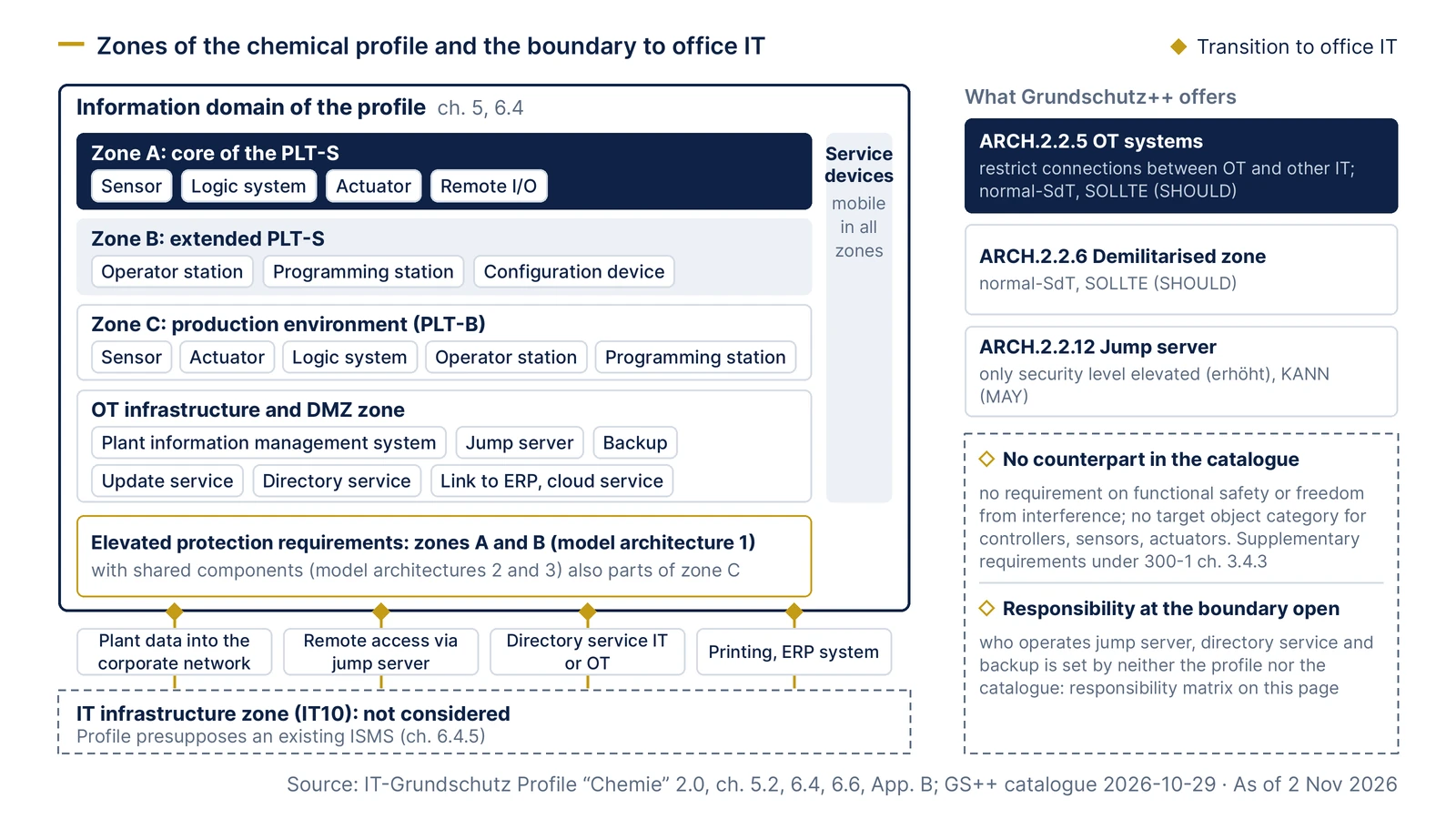
The reference architecture divides the plant into zones (chapter 6.4). Zone A, the core of the PLT-S, comprises everything indispensable for executing the safety function: logic system, input and output modules, remote I/O, sensors, actuators and the connections between them. Zone B, the extended PLT-S, contains components that can act on zone A, such as operator stations, programming stations and configuration devices. Zone C is the production environment with basic process control (Betriebsleittechnik, PLT-B), that is its sensors, actuators, logic system, operator and programming station. In addition there is the zone OT infrastructure and DMZ with supporting services such as backup and the connection to central IT systems, in which Figures 1 to 3 also show the plant information management system (Betriebsdateninformationssystem), jump server, directory service, ERP system and cloud service, and the zone IT infrastructure, which the profile presents only „der Vollständigkeit“ halber (our translation: "for the sake of completeness") (chapter 6.4.5).
Across these are three model architectures (chapter 6.6). In model architecture 1, basic process control and safety device are completely separate, with their own sensors, actuators, logic systems, programming and operator stations. The elevated protection requirements are then limited to zones A and B. In model architecture 2, both share a programming station and shared field devices, which makes access from zone C into zone A possible. The protection requirements of the shared field devices are inherited by their connections, and the shared programming station has higher protection requirements than a pure PLT-S programming station. In model architecture 3, the logic systems are combined in one component and operated via a shared operator station. The profile notes that mixed forms can occur in real plants and that the operator must assess the plant against the models themselves (chapter 6.3).
The IT infrastructure of the institution is excluded: the information domain extends „bis hin zu den Schnittstellen zur allgemeinen IT-Infrastruktur“ (our translation: "up to the interfaces to the general IT infrastructure") (chapter 5.2). Also not considered are the physical network structure with switches, firewalls and gateways, because it varies too much depending on plant and manufacturer (Annex B, 11.2.15), and components that can cause a major accident only if further safety functions fail. Protecting those is at the operator's discretion (chapter 5.2). For service devices such as laptops and smartphones of the operator or service providers, the profile shows no connections to zones A, B and C, because they are used as mobile devices in all zones (chapter 6.6).
Does the profile fit your plant?
The profile fits if …
- you operate a process plant in which process control safety devices protect people and the environment, and you want to define their protection against cyber attacks on a justified basis;
- you have to determine for your plant which components basic process control and safety device share: the three model architectures and Annex B provide a template for this;
- your office IT is already managed in an ISMS and you are setting up a separate information domain for the OT;
- you need a regulated exception and compensation procedure for requirements that cannot be implemented in the OT (chapter 9);
- you want to formulate security requirements for manufacturers and service providers of programming, configuration and service devices. Annex B names typical threats for this.
The profile does not fit, or only to a limited extent, if …
- you want to protect production availability or recipes: the profile excludes these protection goals. Anyone who wants protection against spurious trips of the safety function (A1, see below) has to extend the scope themselves according to Annex A, 11.1.1;
- you are building an ISMS for the whole site: the profile does not consider the IT infrastructure and the physical network structure (chapters 5.2, 11.2.15);
- your plant has components covered by modules of the 2023 edition, such as terminal servers, virtual desktops or network access control: the module list contains no assignment for them;
- you want to adopt the module selection without further work: many assignments read „Ja, ggf. im Rahmen von speziellen Anwendungen“ (our translation: "Yes, possibly within the scope of special applications") and have to be decided for your plant;
- you are starting directly with Grundschutz++: then use the zone model, model architectures, Annex B and the exception procedure as a technical source. You set up protection requirements categories and module selection anew (see below).
What makes the profile special
Protection requirements from functional safety: the profile combines the damage scenarios of IT-Grundschutz with a categorisation from the NAMUR recommendation NA 163 (Annex A). A1 means the safety function trips without demand. This is not dangerous but can interrupt production, and corresponds to normal protection requirements. A2 means the function is deactivated, A3 that it is deactivated and the demand case is brought about at the same time. A2 and A3 stand for high and very high protection requirements (Tables 11 to 13). Because a deactivated function would probably be noticed during the regular function tests, the profile always assumes A3 as the goal of an attack (Annex A, 11.1.1). Of the six damage scenarios, it considers only three relevant: violation of laws, regulations or contracts, impairment of personal integrity, and financial consequences (11.1.2).
Shared components as the core of the risk assessment: instead of only assigning modules to target objects, the profile shows for each component how the same threat has different effects depending on the model architecture. A manipulated sensor leads to A2 with separate use, and to A3 with shared use by basic process control and safety device, because both logic systems receive the same false values (Table 14). For an integrated logic system, every manipulation leads to A3 (11.2.3.3). In this way Annex B describes sensor, actuator, logic system, programming, operator, configuration and service devices, the plant information management system and the services of the OT infrastructure with typical protocols, threats and common safeguards. It expressly does not carry out a risk assessment (11.2).
Exceptions with a procedure: for OT operators, chapter 9 is probably the most practical part. It separates generic residual risks, which already result from a catalogue of safeguards, from specific ones that only become visible in the plant, and gives examples of compensating safeguards, such as placing a system that cannot be updated in its own segment with an upstream DMZ, or compensating organisationally for missing personal accounts with shift logs (chapter 9.2). Exceptions are approved by a named expert committee of the OT security management system together with the operator, limited in time, stored centrally and with fixed review questions on extension (chapter 9.3).
Relation to other rules and standards: according to its own statement, the profile takes into account the guides and worksheets KAS-51, TRBS 1115-1, VDI/VDE 2182, NA 163, NE 165 and NA 169 and aims to show operators which aspects should already be fulfilled through other standards (chapter 3.2). Chapter 1 ends with the sentence that the IT-Grundschutz approach represents „eine Lösungsvariante für die Erfüllung der Anforderungen aus dem KAS-51 dar“ (our translation: "a possible solution for fulfilling the requirements from KAS-51"). Annex C maps sections of KAS-51 to sections of standards and to modules. We reproduce these references but do not check them.
Module selection by majority principle: chapter 8 selects the modules that „für eine Mehrheit der Anlagen zur Anwendung kommen“ (our translation: "are applied for a majority of plants") and expressly allows module-specific requirements to be dispensed with on the basis of a systemic risk assessment. Beyond the basic and standard requirements, it expressly demands only one requirement for elevated protection needs: ISMS.1.A16 „Erstellung von zielgruppengerechten Sicherheitsrichtlinien“ (our translation: "Creation of security guidelines tailored to target groups") (Table 4). Which further requirements the above-normal protection level described in chapter 4.1 calls for is left to the operator.
Working aid: responsibility matrix for the boundary between office IT and OT
The profile presupposes that the IT infrastructure is managed in its own ISMS and considers its information domain only up to the interfaces to it. It describes the objects that sit on this boundary or cross it in Annex B, but leaves open who is responsible for them. The matrix brings these objects together. For each row, define three things: who operates the object (OT operations, IT operations or service provider), in which information domain it is managed, and who approves changes. Every row that touches two information domains is an interface that you document in accordance with BSI Standard 300-1 chapter 3.1.
| Object (profile) | What the profile says about it | Typical conflict | To be defined |
|---|---|---|---|
| Plant information management system, IT8 | process data archives are „in der Regel“ (our translation: "as a rule") made usable for higher levels via the corporate network; clients often run on office computers; risk of DoS on the PLT-S logic system and of manipulated setpoints (11.2.8) | departments need the data, OT does not want access from outside | direction of data and transfer point (mirror in the DMZ or direct access); who operates servers and clients |
| Jump server, IT9b | connects remote stations, including from the IT infrastructure into the ICS; a separate session for each connection, with the function of an operator station (11.2.9) | IT operates the remote access platform, OT knows the target systems | operator of the server, approval of each session, which zones can be reached (zones A and B: according to 11.2.4.1, remote access to PLT-S programming stations is „nicht üblich“ (our translation: "not usual")) |
| Directory service, IT9g | sits „entweder in der IT-Infrastruktur oder als separater Verzeichnisdienst mit eigener Domäne in der OT-Infrastruktur“ (our translation: "either in the IT infrastructure or as a separate directory service with its own domain in the OT infrastructure") (11.2.12.2) | a shared domain saves effort but connects both worlds | own OT domain yes or no; who manages accounts and groups for the OT |
| Backup, IT9d | backups contain programs of the logic systems and know-how; store checksums separately, storage with restricted access (11.2.10) | central backup infrastructure of IT versus backups within the OT | storage location, access to the backups, who tests restoration |
| Update service, IT9f | not all patches are approved for the components; data lock and integrity check as common safeguards (11.2.11) | patch cycle of IT versus manufacturer approvals in OT | who approves patches for OT systems, source of the updates |
| Printing, print server (IT9h) | printer sits in the IT infrastructure because the control system may have no local printer; „Damit besteht eine Verbindung in die IT-Infrastruktur“ (our translation: "This creates a connection into the IT infrastructure") (11.2.13.4) | a small function, but a permanent connection | whether the connection is needed, via which route |
| File exchange, ERP system, cloud service (IT9c, IT9e, IT9a) | listed as target objects (Table 2), with modules such as APP.3.3 and APP.4.2 (Table 5); placed in the zone OT infrastructure in the profile, not described in more detail in the annex | applications that functionally belong to corporate IT, with data flow into production | which data flow in which direction, who operates the application |
| QR and barcode scanners (IT9h) | data go via a computer directly into the recipes; manipulation can swap the order of the ingredients (11.2.13.3) | an inconspicuous device with an effect on the recipe | operation of the computer, checking of the imported data |
| Service devices, IT7 | not permanently in the OT network, often a laptop or smartphone, owned or from service providers; network segments bridged through portability (11.2.7) | devices of service providers and old devices with outdated software | devices per plant or zone, checking of third-party devices, who keeps replacement devices and VM images |
| Physical network components (switch, firewall, gateway) | not considered, but must be „mitbetrachtet“ (our translation: "considered as well") when protecting, especially with shared segments (11.2.15) | IT network team versus automation engineering | operator of the firewall between OT and IT, who changes rules |
The columns "Typical conflict" and "To be defined" are our proposal. The profile contains no such allocation of responsibilities. How to define the information domain and its boundaries in general is described on the page Defining the information domain.
Points to check when adopting the profile
- Compendium edition: Chapter 8 names the 2023 edition. Tables 4 to 9, however, list exactly the module set of the 2022 edition without APP.6 General Software: they contain the modules OPS.2.1 and OPS.3.1, which were dropped in 2023 (replaced by OPS.2.3 and OPS.3.2), and SYS.2.2.2 (marked as deleted by the profile itself), and the ten modules newly added in 2023 are missing, including OPS.1.1.1 General IT Operations, SYS.1.9 Terminal Server and NET.3.4 Network Access Control. SYS.1.9 is not a side issue for chemical operators: the profile describes the jump server as a terminal server (Annex B, 11.2.9).
- Zone names: The table of contents speaks of „Kern SIS“ (core SIS) and „Erweitertes SIS“ (extended SIS) and lists the zone IT infrastructure under 6.4.4. In the text the zones are called „Kern PLT-S“ (core PLT-S) and „Erweiterte PLT-S“ (extended PLT-S), and 6.4.4 is the zone „OT-Infrastruktur & DMZ“ (OT infrastructure & DMZ).
- Identifiers: Chapter 6.6.2 compares the shared programming station IT4c with the „PLT-S-Programmierstation (IT4b)“ (PLT-S programming station (IT4b)); according to Table 2, IT4a is the PLT-S and IT4b the PLT-B programming station. Annex B, 11.2.8.2, says „PLT-B-Logiksystem (IT3c)“ (PLT-B logic system (IT3c)), which according to Table 2 means IT3b. Room IN01 is called „Leitstand“ (control station) in Table 3 and „Leitwarte“ (control room) in Table 9.
- Network modules: Table 8 assigns the NET modules to „IT9h OT-Infrastruktur“ (IT9h OT infrastructure) and „IT10 IT-Infrastruktur“ (IT10 IT infrastructure). In Table 2, IT9h stands for „Weitere Dienste“ (other services), and the profile expressly does not consider IT10 (chapters 6.4.5, 11.2.14).
- Annex C: The mapping refers to „ISO/IEC 27001:2018“; the numbers given, such as A.5.15 or A.8.20, follow the structure of Annex A of the 2022 version (93 controls, numbered 5.1 to 8.34; compare the BSI mapping "ISO/IEC 27001:2022 Annex A to GS++ Mapping" in the State-of-the-Art Library (Stand-der-Technik-Bibliothek), retrieved on 2 November 2026). In addition, Annex C refers to the 2022 Compendium.
- Historical legal reference: The profile excludes DER.3.2 with a reference to the evidence audit under „§8a BSIG“ (Section 8a BSI Act) (Table 4). This is a reference to the BSI Act (BSIG) in the version before its revision, and therefore historical.
Route to Grundschutz++: what the catalogue offers for OT
For a chemical plant, the switch to Grundschutz++ changes three things: the NA 163 levels have to fit two protection requirements categories, controllers, sensors and actuators find no target object category (Zielobjektkategorie) of their own, and the catalogue names OT in only one requirement. We had not found a version of the chemical profile for Grundschutz++ by 2 November 2026. It is based on BSI Standard 200-2 and on modules of the 2022 and 2023 editions.
First, protection requirements. The profile assigns A1 to normal and A2 and A3 to high and very high protection requirements. For business processes, Grundschutz++ knows only normal and high, and categories of your own „sind hierbei auf die Schutzbedarfskategorien des GS++ zu mappen“ (our translation: "are to be mapped to the protection requirements categories of GS++") (300-1 chapter 2.6). Among the aids for determining high protection requirements, 300-1 names impairment of personal integrity without qualification (ibid.). A production process whose safety devices protect against A2 and A3 according to the profile will, under this guidance, as a rule have to be classified as high. The classification is made by the operator. For processes with high protection requirements, a risk assessment is required (chapters 2.6, 2.11). You can use the profile's NA 163 classification as justification. The distinction between the model architectures remains important: it decides which assets are assigned to the process with high protection requirements.
Second, target objects. Annex 1 of 300-1 has no target object category for controllers, sensors or actuators, and in the user catalogue (Anwenderkatalog) build 2026-10-29 no requirement is assigned to such a category either. You manage logic systems, programming and operator stations as IT systems, and the EMSR switch room as a room for technical infrastructure, for which 300-1 expressly names „Schaltraum“ (switch room) as an example. For sensors and actuators that are „nicht hinreichend abgedeckt“ (our translation: "not sufficiently covered") by the existing categories, an explicit risk assessment is required under 300-1 chapter 2.11.
Third, the catalogue itself. Of the 1,000 requirements in the user catalogue, exactly one expressly addresses OT: ARCH.2.2.5 „OT-Systeme“ (our translation: "OT systems") requires connections between OT systems and other IT systems to be restricted (normal-SdT, SOLLTE, i.e. SHOULD). In addition, some guidance texts name OT or industrial control systems, for example on ARCH.2.1 „Netzsegmente“ (our translation: "Network segments") and ARCH.2.4 „Inventar der Netze“ (our translation: "Inventory of networks"), on BES.2.1.4.1 „Kompatibilität der Schnittstellen“ (our translation: "Compatibility of interfaces") and on DET.4.2 „Automatische Angriffserkennung“ (our translation: "Automatic attack detection"), which names a combined approach of network and log analysis as sensible for OT systems where nothing can be installed. The catalogue contains no requirement on functional safety, on freedom from interference (Rückwirkungsfreiheit) of a safety device or on change management under Functional Safety Management. What the profile and the IND modules require on this, you manage in Grundschutz++ as supplementary requirements (300-1 chapter 3.4.3).
For the 91 modules that the profile marks as relevant, we have counted the draft mapping IT-Grundschutz 2023 to Grundschutz++. This includes the modules the profile considers only conditionally relevant. SYS.2.2.2 is not included, and for the dropped OPS.2.1 and OPS.3.1 we have used their successors OPS.2.3 and OPS.3.2 (our proposal). The file has status „draft“ (as of 21 July 2026), and we resolved the targets in the user catalogue build 2026-10-29. The result is a draft and not an official mapping.
How to substantiate the classification is described on the page Assessing protection requirements on a justified basis; how assets are assigned to target object categories, on the page Modelling: building a requirements package from assets.
| Measure | 91 relevant modules | of which 7 IND modules |
|---|---|---|
| Requirement identifiers in the 2023 Compendium | 1,747, of which 269 are marked as dropped, i.e. 1,478 valid | 78, of which 9 dropped, i.e. 69 valid |
| Requirements with at least one entry in the draft mapping | 431 (around 29 % of the valid ones) | 26 (around 38 %) |
| Different Grundschutz++ requirements as target | 325 from 18 practices; most in DET (75), ARCH (63), KONF (48) and TEST (34) | 49, mainly DET (17), ARCH and TEST (8 each) |
| Modules without a single entry | 15: ORP.4, CON.2, CON.3, CON.6, OPS.1.2.4, APP.2.3, SYS.1.2.2, SYS.1.3, SYS.2.4, SYS.3.2.3, IND.2.2, IND.2.3, INF.5, INF.7, INF.9 | IND.2.2 Programmable Logic Controller (PLC) and IND.2.3 Sensors and Actuators |
| Target references that cannot be resolved in the catalogue | 12, all to the same identifier VRB.1.2 | 1 (from IND.1, also VRB.1.2) |
For OT this means: for the module IND.2.7 „Safety Instrumented Systems“ with 12 requirements there are 3 entries (A5, A6, A12, on emergency management, planning and integrity of application programs); for logic systems, sensors and actuators there are none. An entry also does not mean that the requirement is fully covered. The relationships range from equivalent to partial overlap. We have traced three requirements that touch the profile individually:
| Profile reference | Requirement Compendium 2023 | Target in Grundschutz++ (catalogue build 2026-10-29) | Gap |
|---|---|---|---|
| Ch. 6.6: separation of basic process control and safety device, model architectures 1 to 3; Table 7 assigns IND.2.7 to the PLT-S components | IND.2.7.A7 „Trennung und Unabhängigkeit des SIS von der Umgebung“ (our translation: "Separation and independence of the SIS from its environment") (standard, SOLLTE): operation free from interference, changes affecting the SIS under the change management of Functional Safety Management | Mapping: no entry. Our own search: ARCH.2.2.5 „OT-Systeme“ (OT systems) (normal-SdT, SOLLTE) restricts connections between OT and other IT systems; ARCH.2.1 „Netzsegmente“ (network segments) (normal-SdT, SOLLTE) | The assignment is ours, not that of the draft. The boundary the profile draws lies within the OT, between zones A/B and zone C; ARCH.2.2.5 regulates only the boundary to the rest of IT. Manage freedom from interference and the link to Functional Safety Management as a supplementary requirement |
| Annex B, 11.2.9: jump server IT9b for connections from the IT infrastructure into the ICS; Table 7 assigns IND.3.2 to it | IND.3.2.A7 „Technische Entkopplung von Zugriffen“ (our translation: "Technical decoupling of access") (standard, SOLLTE): every remote access into an OT zone via a system that terminates the connection, such as a jump server in an OT DMZ, for which the OT is responsible | Mapping: sub-requirements 1, 2 and 4 as subset-of to ARCH.2.2.5 „OT-Systeme“ (OT systems) (normal-SdT, SOLLTE); sub-requirement 4 as superset-of to ARCH.2.2.12 „Sprungserver“ (jump server) (elevated (erhöht), KANN, i.e. MAY) | In Grundschutz++ the jump server is optional. That the OT is responsible for it is stated nowhere in the catalogue. This belongs in your responsibility matrix (above) and as a supplementary requirement in the requirements package |
| Ch. 9.2: if personal accounts are missing, „Schichttagebücher helfen, das Restrisiko organisatorisch zu kompensieren“ (our translation: "shift logs [can] help to compensate for the residual risk organisationally"); 11.2.12: directory service in IT or OT | IND.1.A7 „Etablieren einer übergreifenden Berechtigungsverwaltung zwischen der OT und in der Office-IT“ (our translation: "Establishing overarching authorisation management between the OT and in the office IT") (standard, SOLLTE) | Mapping: no entry. Our own search: BER.1.1 „Verfahren und Regelungen“ (our translation: "Procedures and rules") (normal-SdT, MUSS, i.e. MUST), BER.3.16 „Keine Gruppenkonten“ (our translation: "No group accounts") (normal-SdT, SOLLTE, prohibit in regular operation), BER.3.18 „Gruppenkonten - Wechsel dokumentieren“ (our translation: "Group accounts - document changes") (normal-SdT, SOLLTE) | The assignment is ours. A shift log corresponds most closely to BER.3.18. If BER.3.16 remains permanently unfulfilled at operator stations, an explicit risk assessment is required under 300-1 ch. 2.11. The residual risk is approved by top management. You can reuse the expert committee from ch. 9.3 of the profile for this |
Profile-specific requirements appear in no mapping, because the draft only links requirements of the Compendium. This concerns the NA 163 classification, the assessment of shared components per model architecture, the common safeguards from Annex B (for example checksums for backup images, timestamps against replay attacks on the plant information management system, two operator stations or key switches for deactivating a safety function) and the exception procedure from chapter 9. ISMS.1.A16, the only requirement for elevated protection needs that the profile expressly demands, also has no entry. If you want to keep these requirements, write them into your requirements package as supplementary requirements. How to check assignments from the draft individually is described on the page Checking the IT-Grundschutz 2023 mapping.
Rights notice: Quotations and information from the IT-Grundschutz-Profil „Chemie“, version 2.0, publisher Bundesamt für Sicherheit in der Informationstechnik, according to the acknowledgements further developed in a BSI working group (version 1 with people from the NAMUR working group 4.18), © Bundesamt für Sicherheit in der Informationstechnik 2025; the document contains no open licence. Source: BSI page on the profile (German). The quotations are verbatim, the summaries, matrix and graphic are our own. Requirement and module titles from the IT-Grundschutz-Kompendium, Edition 2023, © 2023 Reguvis Fachmedien GmbH and © 2023 Bundesamt für Sicherheit in der Informationstechnik, source: BSI page on the IT-Grundschutz Compendium (German). These quotations and titles are not covered by CC BY-SA 4.0; the licence notice at the end of the page applies to the excerpts from catalogue and mapping data.
What this page does not decide
The profile names the Major Accidents Ordinance (Störfall-Verordnung, 12. BImSchV), the Hazardous Substances Ordinance (Gefahrstoffverordnung), the Industrial Safety and Health Ordinance (Betriebssicherheitsverordnung), KAS guides, TRBS 1115-1, NAMUR recommendations, VDI/VDE guidelines and IEC 61511. Among other things, it distinguishes PLT-S from safety-relevant plant parts within the meaning of the Major Accidents Ordinance and states that it can be applied to both (chapter 5.1). We only reproduce these classifications. This page does not decide which obligations under plant safety, occupational safety or immission control law apply to your plant, or whether implementing the profile fulfils them.
Nor does this page decide whether, and with which obligations, the current BSI Act applies to your company. The profile's reference to Section 8a BSIG relates to the legal situation before the Act was revised.
Implementing the profile is not evidence towards an authority, an expert assessor or a certification body. The profile itself expects the effort for preparing audits to decrease (chapter 3.2). It does not claim any evidential effect for itself. The fact that the BSI published it does not make it a requirement for your plant.
How Grundschutz and the obligations under NIS2 relate in general is described on the page NIS2 and Grundschutz.
Support with the transfer
If you want to convert an OT security concept based on the chemical profile to Grundschutz++ or reorganise the boundary between office IT and production, the team at Blackfort Technology supports you with scoping, protection requirements and the requirements package. The process and scope of services are on the page Consulting on IT-Grundschutz and Grundschutz++. Information on information security in industry and production beyond Grundschutz is on the company website at https://www.blackfort-tec.de/en. Refineries work with the same kind of safety devices but have their own KRITIS profile. How it deals with process control and remote access is shown on the page KRITIS IT-Grundschutz Profile for refineries. Further profiles for other sectors are in the overview of IT-Grundschutz Profiles.