

Profile summary: what is publicly established
| Title according to the information sheet | „IT-Grundschutz-Profil - Internetbasierte Kraftfahrzeugzulassung (i-Kfz) -“ (our translation: "IT-Grundschutz Profile - internet-based motor vehicle registration (i-Kfz) -"); on the BSI page „IT-Grundschutz-Profil „i-Kfz““ |
|---|---|
| Author | Arbeitskreis i-Kfz (i-Kfz working group) made up of representatives of the registration authorities, the technical service providers and the KBA (information sheet); the cover page of the information sheet shows the KBA logo, and it is provided on a page of the Bundesamt für Sicherheit in der Informationstechnik (BSI), the German Federal Office for Information Security |
| Version and date | The information sheet is dated August 2023, the BSI page gives the date 5 Dec 2023. The version and version date of the profile itself are not stated publicly. |
| Compendium edition | cannot be verified |
| Scope | information sheet 2 pages (PDF, 160 KB); scope of the profile unknown |
| Accessibility | profile only in the protected area of the KBA, after registration; the information sheet is freely available |
| Licence and rights | The information sheet contains no licence information. We quote it only briefly, with a reference. |
| Type | profile of a working group of authorities and service providers, listed by the BSI in its list of profiles with the information sheet (not a KRITIS profile, not a thesis) |
| Reference | BSI page „IT-Grundschutz-Profil „i-Kfz““ (German), retrieved on 2 Nov 2026 |
All other profiles with publisher, status and Compendium edition are listed in the overview of IT-Grundschutz Profiles.
What the information sheet says about the profile
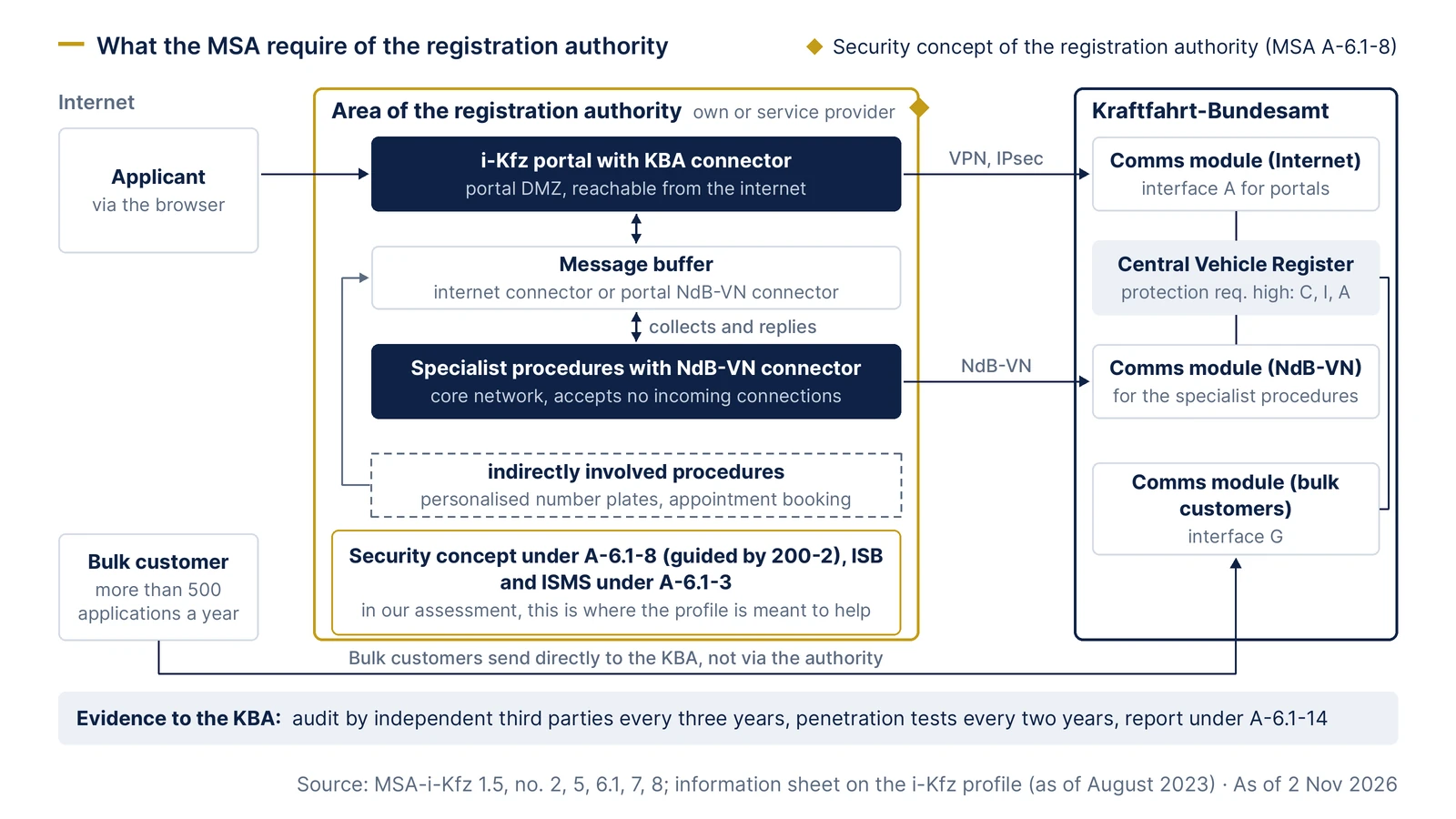
The information sheet describes the starting point in three sentences: in the i-Kfz procedure, the registration authorities access the KBA's infrastructure via i-Kfz portals and thus via the internet as an „unsicheres Netz“ (our translation: "insecure network"); data in need of protection is processed, particularly in communication with the KBA's central registers; there are therefore minimum security requirements whose fulfilment „für i-Kfz zwingend erforderlich ist“ (our translation: "is mandatory for i-Kfz"). The profile is meant to help the registration authorities „bei der Etablierung einer Sicherheitskonzeption, die im Anforderungskatalog gefordert wird“ (our translation: "in establishing a security concept as required in the requirements catalogue") (information sheet, p. 2).
The information sheet does not say which catalogue is meant. What the KBA has officially published are the „Mindestsicherheitsanforderungen an die internetbasierte Fahrzeugzulassung“ (our translation: "minimum security requirements for internet-based vehicle registration") (MSA-i-Kfz), version 1.5, valid from 1 September 2023 (BAnz AT 31.08.2023 B3). In requirement A-6.1-8, they require the components and interfaces of the i-Kfz architecture to be subject to an information security concept „die sich am BSI-ITG-200-2 IT-Grundschutz orientiert“ (our translation: "which is guided by BSI-ITG-200-2 IT-Grundschutz"), with a choice of Core or Standard Protection. In our assessment, this is the security concept the profile is meant to help with; timing and wording fit together, but the link is not expressly documented.
Why each authority has to develop its own concept is also stated in the MSA: „Ein Sicherheitskonzept mit gegebenenfalls integrierter Risikoanalyse existiert für das Gesamtverfahren i-Kfz nicht.“ (our translation: "A security concept, with a risk analysis integrated where applicable, does not exist for the i-Kfz procedure as a whole.") (no. 2). The KBA has determined the protection requirements of the Central Vehicle Register (Zentrales Fahrzeugregister) as high for confidentiality, integrity and availability in each case and has derived minimum requirements for portals and registration authorities from this (ibid.). The KBA published the MSA on the basis of Section 18(3) of the Vehicle Registration Ordinance (Fahrzeug-Zulassungsverordnung, FZV). Under this provision, where internet-based registration procedures rely on systems that provide access to data held by the KBA or to its bulk customer interface (Großkundenschnittstelle), the standards laid down by the KBA must be complied with, including those for minimum security requirements.
How to obtain the profile
According to the information sheet, the profile is held in the KBA's protected area. According to the MSA, that is also where the applicable supplementary documents are kept, such as the standards for data transmission and the information on the network connection (MSA no. 1.1). Anyone applying for authorisation to communicate with the KBA infrastructure orders the application documents from the KBA's user support (Anwenderbetreuung) and receives them by email or via access credentials for the protected area (MSA no. 7.5). If you already have this access, first ask there whether it also covers the profile.
For questions about registration, the information sheet gives a contact address at the KBA. We do not reproduce it here because we could not confirm it on any public KBA page; you will find it on the BSI page on the profile at https://www.bsi.bund.de/SharedDocs/Downloads/DE/BSI/Grundschutz/Hilfsmittel/Profile/Profil_i-Kfz.html. The contact points for technology, user support and procedure support are listed in number 9 of the MSA.
After downloading, first check three details in the document itself: version and date, the edition of the IT-Grundschutz Compendium on which the profile is based, and the version of the MSA it refers to. These determine how much reconciliation you need before adopting it.
Working aid: checklist for placing the profile in your Grundschutz or Grundschutz++ project
The checklist is based on the public MSA-i-Kfz and on BSI Standard 300-1. It works without the profile and helps you put the profile in the right place in your project once you have obtained it. The right-hand column shows where the result ends up in Grundschutz++; the identifiers come from the user catalogue (Anwenderkatalog), build 2026-10-29. Where you still work under BSI Standard 200-2, the same question applies to your structure analysis and modelling.
| No. | Check question | Requirement from MSA-i-Kfz 1.5 | How to handle it in Grundschutz++ |
|---|---|---|---|
| 1 | Which of the six case scenarios applies to you: who operates the i-Kfz portal, the specialist procedures (Fachverfahren) and the indirectly involved procedures, and is the portal connected via the internet or the NdB-VN (Netze des Bundes - Verbindungsnetz, the federal connecting network)? | No. 8 specifies for each scenario who fulfils which requirements; several service providers for different parts are not covered there | Answer the outsourcing delimitation under 300-1 ch. 3.1; outsourced parts as assets of the category Outsourcing or Cloud-Dienste (cloud services) (Annex 1). With several service providers, plan for coordination with the KBA before the audit (no. 8, note) |
| 2 | Are all components from A-6.1-8 within your information domain: portal, KBA connector, internet connector, specialist procedures, NdB-VN connector, portal NdB-VN connector, indirectly involved procedures? | A-6.1-8 names these components expressly; A-6.1-3 requires an ISB and an ISMS at least for them | Delimit the information domain so that it contains them (STM.1.1); a separate „i-Kfz“ domain or part of a larger one, both are possible under 300-1 ch. 3.1 |
| 3 | Are the transitions to the KBA and between the portal and the specialist procedures documented? | Portal to the KBA only via VPN with IPsec (A-6.1-1, A-6.2.1-1); specialist procedures to the KBA via the NdB-VN; portal and specialist procedures only indirectly via a message buffer (no. 5.3, A-6.1-9) | document each transition as an interface, organisationally, technically and in terms of infrastructure (300-1 ch. 3.1, STM.1.2); connections as assets of the category Externe Netzanschlüsse (external network connections) |
| 4 | Do you operate personalised number plate reservation, appointment booking or other procedures linked to the registration portal? | They count as indirectly involved procedures and fall under the general requirements (no. 6.1); tests are dispensed with only if an independent third party confirms complete separation in writing; this is then stated in the test report (no. 8, note); Section 19(2) FZV | include them in the domain or evidence the separation and document it as an interface with justification |
| 5 | Do several registration authorities use a shared portal or specialist procedure, for instance in the state data centre? | Tenant separation with defined administration responsibilities for each tenant; if implemented by virtualisation, then as virtualisation of entire servers under module SYS.1.5 (A-6.1-11, no. 5.1.4) | Virtualisation environment as an asset (Virtualisierungslösungen, virtualisation solutions); agree tenant separation contractually (BES.4.5.2, elevated (erhöht)) and configure it in the application (KONF.6.6.1, SOLLTE, i.e. SHOULD). Our suggestion: carry the MSA requirement as a supplementary requirement, because BES.4.5.2 is only KANN (MAY) |
| 6 | Do parts run in an external cloud, for instance virtual servers or e-payment? | Comply with the BSI requirements for the use of external cloud services (A-6.1-12) | Asset of the category Cloud-Dienste (cloud services); record the requirement as an external obligation (no. 8 of this list) |
| 7 | How do your service providers demonstrate that they fulfil the requirements? | The registration authority ensures that service providers and their subcontractors fulfil the requirements (no. 8); existing audit reports may be referenced with title, version and date; the report must be submitted to the KBA, and the auditor confirms transferability (no. 7.2) | DLS.3.1.1 „Audit oder Zertifikat“ (our translation: "audit or certificate") (SOLLTE): set the parameter for type and frequency of the evidence to the MSA requirements |
| 8 | Are the MSA recorded as an obligation in your compliance register? | Section 18(3) FZV requires compliance with the KBA standards; no. 7.3 names the requirements that „über den Rahmen der IT-Grundschutz-Stufe hinausreichen“ (our translation: "go beyond the scope of the IT-Grundschutz level"), such as a DMZ in a packet filter-ALG-packet filter structure, hardening with penetration tests and a ban on direct forwarding | record as a legal obligation (300-1 ch. 2.2, GC.3.1.1) and adopt the MSA requirements as supplementary requirements in the requirements package (ch. 3.4.3, STM.2.1.7) |
| 9 | Do your audit intervals match the KBA deadlines? | Audit by independent third parties every three years, penetration tests of the hardened components every two years, in all case scenarios (no. 7.2, 8) | DET.5.4 „Regelmäßige Penetrationstests“ (our translation: "regular penetration tests") has the security level elevated in the catalogue (KANN); for i-Kfz the test is mandatory. Our suggestion: carry it as a supplementary requirement with a two-year cycle and set the parameter „regelmäßig“ (our translation: "regularly") accordingly |
| 10 | What do you base the protection requirements of the process „internetbasierte Zulassung“ (internet-based registration) on? | Protection requirements of the Central Vehicle Register high in all three basic values (no. 2) | Include the KBA as an interested party with its classification (300-1 ch. 2.4); you determine the protection requirements of your own business process yourself (ch. 2.6). With high protection requirements, a risk assessment is required (ch. 2.11) |
| 11 | What does your evidence to the KBA look like if you work under Grundschutz++? | Concept guided by BSI Standard 200-2 (A-6.1-8); audit team leader with authorisation for ISO 27001 on the basis of IT-Grundschutz; such a certificate for the entire i-Kfz domain limits the audit to the additional requirements (no. 7.2, 7.3) | Version 1.5 of the MSA does not mention Grundschutz++. Clarify with the KBA, before commissioning the audit, how it assesses an ISMS under 300-1 (no. 8, note on coordination) |
The assignment to target object categories (Zielobjektkategorien) and catalogue identifiers is our suggestion; for the assignment, Annex 1 of 300-1 and the MSA in the version the KBA provides in the protected area apply. How to define boundaries and interfaces is described on the page Delimiting the information domain; how to manage service providers in Grundschutz++, on the page Practice: procurement and service providers.
The profile and Grundschutz++: what can be said
The version and date of the profile are not stated publicly; the information sheet dates from August 2023, that is, before Grundschutz++. It seems likely that the profile is based on BSI Standard 200-2, because A-6.1-8 of the MSA refers to it; we cannot verify this, any more than the Compendium edition. For the other profiles, we count the modules on their pages against the draft mapping IT-Grundschutz 2023 to Grundschutz++. For the i-Kfz profile this is not possible, because the list of modules is not public.
Irrespective of the profile, moving to Grundschutz++ changes where the KBA requirements sit. In classic IT-Grundschutz, the profile stands alongside the MSA: it is meant to help with the security concept, and you fulfil the MSA in addition. In Grundschutz++, the MSA belong in compliance management as an external obligation and in the requirements package as supplementary requirements (300-1 chapters 2.2 and 3.4.3); there, 300-1 expressly names „Anforderungskataloge“ (our translation: "requirements catalogues") as a subject of the analysis. The MSA requirements do not disappear into catalogue identifiers in the process: they have their own identifiers (A-6.1-1 to A-6.2.11-3) with their own degree of obligation, and the audit report for the KBA must list each requirement checked with its identifier and the result (no. 6, 7.2). Our suggestion: carry the MSA identifier in every supplementary requirement, so that the audit report can be derived directly from the requirements package.
If you have obtained the profile, you can count its modules against the draft mapping yourself; how to do this and where the limits of the draft lie is described on the page Checking the mapping IT-Grundschutz 2023.
What this page cannot do and does not decide
This page contains no statement about the content of the profile: no list of modules, no protection requirements, no reference architecture and no mapping to Grundschutz++. We have read only the public information sheet. The checklist is based on the MSA-i-Kfz and BSI Standard 300-1 and does not replace the profile.
Participation in i-Kfz is governed by the standards laid down by the KBA under Section 18(3) FZV, in the version in force at the time. We read version 1.5; we did not find a newer one on 2 November 2026, and we could not access the KBA website on that day. The KBA publishes the standards on its website; Section 18(3) sentence 2 FZV provides for a notice in the Bundesanzeiger (Federal Gazette) and the Verkehrsblatt for changes to the main versions. Check the current version in the KBA's protected area, therefore, before relying on any number on this page.
Whether your authority fulfils the requirements, whether a concept under Grundschutz++ fulfils requirement A-6.1-8 and which conditions apply is decided solely by the KBA in the authorisation procedure (MSA no. 7). Applying the profile is not evidence to the KBA; evidence is provided through audit and penetration test reports (A-6.1-14). We do not interpret data protection obligations under Section 18(2) FZV and the GDPR.
Rights notice: Quotations from the information sheet on the IT-Grundschutz-Profil „i-Kfz“ (as of August 2023, cover page with the logo of the Kraftfahrt-Bundesamt; the same text appears on the BSI page on the profile). The information sheet names no publisher and contains no rights or licence information; we therefore quote it only briefly and verbatim. Quotations and identifiers from the minimum security requirements come from the official notice of the Kraftfahrt-Bundesamt in the Bundesanzeiger (BAnz AT 31.08.2023 B3). Quotations from BSI Standard 300-1 © Bundesamt für Sicherheit in der Informationstechnik, source: BSI page on Grundschutz++. The CC BY-SA 4.0 licence notice at the end of the page applies only to the extracts from the user catalogue.
Support
If you want to transfer your authority's i-Kfz security concept into an ISMS under Grundschutz++ or prepare the MSA requirements as supplementary requirements, the team at Blackfort Technology supports you with delimitation, service provider management and the requirements package. How such a transfer works for a registration authority and its service providers is described on the page Consulting on IT-Grundschutz and Grundschutz++. How Grundschutz is built up in municipalities as a whole is described on the page Grundschutz in municipalities; further profiles from other sectors are listed in the overview of IT-Grundschutz Profiles.