
Profile summary
| Original title | „IT-Grundschutz-Profil für die Verkehrssteuerungs- und Leitsysteme der Bundesautobahn (IT-Grundschutz-Profil Bundesautobahn)“ (IT-Grundschutz Profile for the traffic control and management systems of the federal motorway) |
|---|---|
| Publisher | Die Autobahn GmbH des Bundes; the cover page names it as author: „von Die Autobahn GmbH des Bundes“ (our translation: "by Die Autobahn GmbH des Bundes"). The publisher field of the document details names „Die Autobahn GmbH des Bundes“ and Frank Felde; eleven employees of Autobahn GmbH are listed as authors (p. 2). The list of profiles of the Bundesamt für Sicherheit in der Informationstechnik (BSI), the German Federal Office for Information Security, names the same publisher. |
| Version and date | Version 1.0, as of 22 Jun 2022, status „freigegeben, öffentlich“ (our translation: "released, public"). Change history: versions 0.1 to 0.92 on 31 Mar 2021 (initial creation), 0.99 on 28 Mar 2022 (final draft), 1.0 on 22 Jun 2022 (release). The BSI page on the profile gives the date 29 Jun 2022. |
| Revision cycle | „alle zwei Jahre“ (our translation: "every two years") according to the document details; we did not find a version newer than 1.0 on the BSI page on 2 Nov 2026 |
| Compendium edition | IT-Grundschutz Compendium 2021, as of February 2021 (ch. 4 and 8.3) |
| Methodology | BSI Standard 200-2, security level of Standard Protection (ch. 1.2), risk analysis under BSI Standard 200-3 (ch. 6); protection requirements in three categories normal, high, very high for confidentiality, integrity, availability and additionally authenticity (ch. 3) |
| Scope | 85 pages (PDF, about 2 MB), 8 chapters, 33 tables, 3 figures |
| Accessibility | freely available via the BSI page on the profile, without registration |
| Licence and rights | The document contains no licence statement, only the marking „öffentlich“ (our translation: "public") in the footer. We therefore quote only briefly and with references and otherwise render the content in our own words; we do not reproduce the profile's tables and network diagrams. |
| Type | IT-Grundschutz Profile of an operator, published by the BSI. It is on the general list of profiles, not in the series of IT-Grundschutz Profiles for critical infrastructure (KRITIS), but its content refers throughout to the scope of the BSI-Kritisverordnung (BSI Critical Infrastructure Ordinance). Not a thesis. |
| Location | BSI page „IT-Grundschutz-Profil für die Verkehrssteuerungs- und Leitsysteme der Bundesautobahn“, retrieved on 2 Nov 2026 |
All profiles at a glance, with publisher, date and Compendium edition, are listed on the page Finding and reusing IT-Grundschutz Profiles.
Scope: three processes, open road and tunnel
The profile is aimed at „die für Informationstechnik verantwortlichen Entscheidungsträger aus dem Bereich des Betriebs der Bundesautobahnen“ (our translation: "the decision-makers responsible for information technology in the field of federal motorway operations") (chapter 1.2). It is also meant to help other road operators with similar processes and to serve manufacturers and service providers as a guide for security design (ibid.). It sees itself as a „Schablone“ (our translation: "template") intended to reach the security level of Standard Protection.
Three main processes are considered (Table 1): the road operations service with route inspection, winter maintenance including the road condition and weather information system, and immediate measures; maintenance of the traffic, operational, communications and electrical infrastructure with system monitoring, servicing and repair; and operational traffic management with the operation of traffic control systems and tunnel operating equipment, incident management and traffic information. The information domain extends from the traffic control centre and its backup centre via motorway maintenance depots (Autobahnmeistereien) and cable houses with the sub-control centres to the roadside stations along the route and, for tunnels, via the tunnel control centre, the tunnel operations building with a local backup control station and the tunnel itself to the pump house (Table 7). A road tunnel is a structure for motor vehicle traffic with a closed length of at least 80 m and a design speed of 80 or 100 km/h (chapter 1.3).
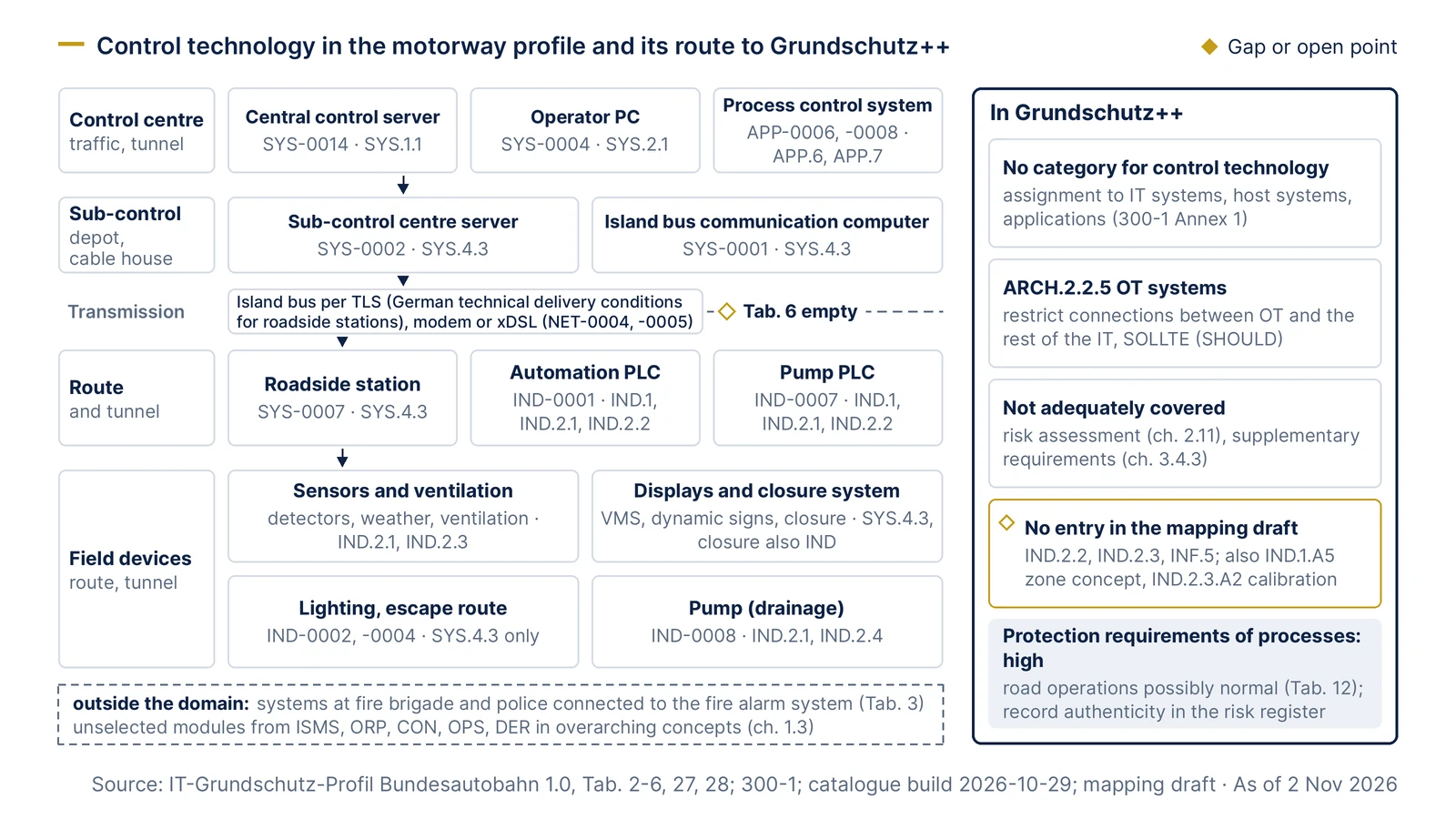
The technical core lies in the control technology. The sub-control centre processes the traffic and environmental data of the outdoor installations, determines the display programmes for the variable message signs from stored parameter sets and sends control commands to the roadside in accordance with the Technische Lieferbedingungen für Streckenstationen (TLS, technical delivery conditions for roadside stations) (Table 2, APP-0011). In between sits the island bus communication computer (Kommunikationsrechner Inselbus), which coordinates the data flow to the roadside stations (Table 3, SYS-0001). In the roadside station, sensors and actuators are connected via input and output concentrators to a control module; if the sub-control centre stops polling, the roadside station switches to an „autarken Modus“ (our translation: "autonomous mode") (Table 3, SYS-0002 and SYS-0007). In the tunnel, all technical installations are visualised and operated via a process control system (Table 2, APP-0006); the control technology there includes the PLCs (SPS) of the automation level, ventilation, lighting and escape route signage, plus a PLC for the drainage pumps. The BOS emergency control console (BOS-Notfallbedienkonsole, BOS meaning authorities and organisations with security tasks) gives the fire brigade and police on site control over lighting, ventilation and closure (Tables 3 and 4).
Outside the domain are the systems at the fire brigade and police that are connected to the fire alarm system of the tunnel operations building (Table 3, SYS-0016). The unused modules of the process layers ISMS, ORP, CON, OPS and DER „müssen in übergreifenden Informationsverbünden sowie im Teilverbund zur Administration behandelt werden“ (our translation: "must be dealt with in overarching information domains and in the administration sub-domain") (chapter 1.3); you therefore have to cover these parts elsewhere in your security concept. The table of communication links with protocol, port and encryption is empty and is to be filled in by the institution (chapter 2.5, Table 6).
Does the profile fit your operation?
The profile fits if …
- you operate traffic control systems with sub-control centres and roadside stations under TLS and MARZ or equip tunnels under EABT and RABT, i.e. the technology the profile describes;
- you are another road operator with similar processes; the profile names this group explicitly (chapter 1.2);
- you are a manufacturer or service provider for traffic or tunnel technology looking for a template for the structure analysis of your deliverable;
- you need a structure analysis that lists control technology from the control centre down to the field device as target objects in their own right.
The profile does not fit, or only to a limited extent, if …
- you want to adopt results of an IT-Grundschutz Check or a risk analysis: the profile only provides the procedure (chapters 5, 6);
- you expect a ready-made communication matrix for TLS, island bus and operational network: Table 6 is empty;
- dangerous goods transport or the supply relevance of a structure matter in your case: then the assumption of normal availability does not automatically hold (Tables 13, 14);
- you operate buses, trams or underground railways: for transport companies, the BSI has published the KRITIS IT-Grundschutz Profile ÖSPV (public road passenger transport), which covers the control centre, interlockings and vehicles;
- you use laptops, tablets, smartphones, WLAN or IoT devices in operation: these modules are marked as not applicable (Tables 27, 29);
- your clients and servers run other Windows versions: the modelling names Windows 8.1, Windows 10 and Windows Server 2012 R2, alongside Linux and Unix, and requires separate target objects for further operating systems (Table 27); in the 2023 Compendium the module for Windows 8.1 has been dropped, and SYS.2.2.3 is now simply called „Clients unter Windows“ (Clients under Windows);
- you want to derive information security management, personnel, business continuity management or incident handling from the profile: it refers these modules to overarching concepts (chapter 1.3, Tables 21 to 25);
- you start directly with Grundschutz++: then adopt the 74 target objects of the structure analysis from the traffic control centre to the pump house and the justifications for the protection requirements, for example for tunnel control; you redefine target object categories and requirements under BSI Standard 300-1 (see below).
What makes the profile special
Control technology as an object group of its own: alongside applications, IT systems, networks and rooms, the profile has a separate group „Industrielle IT“ (industrial IT) with eight objects: PLC of the automation level, lighting, ventilation, active guidance system with escape route signage, traffic detectors, weather sensors, PLC of the pump control and the pump itself (Table 4). They are modelled with IND.1 Process Control and Automation Technology, IND.2.1 General ICS Component, IND.2.2 Programmable Logic Controller (PLC), IND.2.3 Sensors and Actuators and IND.2.4 Machine (Table 28). Many devices along the route, however, are listed by the profile as embedded systems and modelled only with SYS.4.3: roadside station, island bus communication computer, sub-control centre server, variable message signs, dynamic route signs, cameras, fire alarm systems, BOS emergency control console, modems, and lighting and guidance system in the tunnel (Table 27). Only the traffic control system with tunnel closure system gets both, SYS.4.3 and the IND modules.
Four basic values instead of three: for the KRITIS area, the profile additionally assesses authenticity (chapter 3). The justifications show why: for maintenance and traffic management, „Manipulierte oder verfälschte Softwarekomponenten der Tunnelsteuerung können zu nicht akzeptierbaren Personenschäden (persönliche Unversehrtheit) führen“ (our translation: "Manipulated or falsified software components of the tunnel control system can lead to unacceptable personal injury (personal physical integrity)") (Tables 13, 14). Integrity and authenticity are therefore high. For the road operations service, the profile considers authenticity normal, partly because the sensors are linked to the controllers in hardware (Table 12).
Availability normal throughout: for all three processes, the profile sets availability to normal (Table 15). For maintenance and traffic management, this applies under one condition: only as long as traffic flow is not endangered by dangerous goods transport and the structure has no particular importance for supplying a city, a region or a critical service provider (Tables 13, 14). Very high does not occur in any table; under the maximum principle, all applications, systems, controllers, network components and rooms are high (Tables 16 to 20). Chapter 7 allows an individual tunnel control centre to be rated lower with justification, because the protection requirements result across all tunnel control centres.
The sector's technical rules as the framework: the profile is based on the Empfehlungen für die Ausstattung und den Betrieb von Straßentunneln (EABT-80/100, 2019 edition; recommendations for the equipment and operation of road tunnels), the RABT 2006 guidelines, the Technische Lieferbedingungen für Streckenstationen (TLS 2012) and the Merkblatt für die Ausstattung von Verkehrsrechnerzentralen und Unterzentralen (MARZ 2018; guidance note on equipping traffic computer centres and sub-control centres). It describes RABT, TLS and MARZ as introduced and binding for federal trunk roads, and the EABT as recommendations that reflect the state of the art (chapters 8.1, 8.2, as of 2022). As publisher of TLS and MARZ, it names „Bundesministerium für Verkehr, Bau und Stadtentwicklung, heute BMVI“ (our translation: "Federal Ministry of Transport, Building and Urban Development, now BMVI") (chapter 8.2). From the EABT, it carries specific requirements into the structure analysis, for example video surveillance in tunnels from 400 m with data retained for at least 72 hours (Table 3, SYS-0019 and SYS-0023).
What the profile does not provide: the IT-Grundschutz Check and the risk analysis are described only as procedures, with rating scales but without results (chapters 5, 6). It contains no guidance on implementing individual requirements. Its value lies in the structure analysis with 74 target objects from the control centre to the field device and in the selection of modules.
Inconsistencies to watch for when adopting it: for NET.4.1 TC Systems, the cross is in the „Nein“ (No) column, but the justification applies the module to the tunnel emergency call and emergency services radio (Table 29). According to Table 3, the ring buffer works together with „SYS-0020 - Videoüberwachung“ (video surveillance); SYS-0020 is the broadcast radio coverage, video surveillance is SYS-0019. The roadside station software, which according to the description runs in the roadside station, is entered as an application on the sub-control centre server, whereas the control software of the sub-control centre is entered on the central control server (Tables 2, 3). The justifications for SYS.2.2.2, SYS.4.1 and INF.7 contain wrong identifiers or objects (Tables 27, 30). Clarify these points before you transfer the modelling into a tool.
Working aid: transfer table for the control technology
Grundschutz++ has no target object category (Zielobjektkategorie) of its own for control technology. Annex 1 of BSI Standard 300-1 lists categories such as IT systems, host systems, applications, networks and rooms for technical infrastructure; the definition of applications includes the „Steuerung, Konfiguration, Überwachung oder Administration von Hardware, technischen Anlagen oder anderen Softwaresystemen“ (our translation: "control, configuration, monitoring or administration of hardware, technical installations or other software systems"). Assets that are „nicht hinreichend abgedeckt“ (our translation: "not adequately covered") by the categories and their requirements trigger an explicit risk assessment (300-1 chapter 2.11, Annex 3 no. 33); this gives rise to supplementary requirements in Grundschutz++ format (chapter 3.4.3). For the profile's control technology, the table shows where the objects end up in Grundschutz++ and what you check along the way. The assignment of the motorway objects to target object categories is our proposal; the definitions in Annex 1 are authoritative.
| Objects in the profile | Modules in the profile | Target object category in Grundschutz++ (our proposal) | What you check |
|---|---|---|---|
| Sub-control centre server, island bus communication computer (SYS-0002, SYS-0001) in the technical room of the motorway maintenance depot or cable house | SYS.4.3 | Host systems, because they provide services to other systems | As host systems, they fall under GEB.6.2.1: host systems only in server rooms (SOLLTE, i.e. SHOULD). Clarify whether the technical room in the cable house meets this requirement or whether you justify a deviation. Assign the control software to the actual system (inconsistency in Tab. 2, 3). |
| Transmission to the roadside: island bus under TLS, analogue modem, xDSL modem (NET-0004, NET-0005), CE router to the operational network (NET-0001) | SYS.4.3 for the modems; NET.1.1, NET.1.2, NET.3.1 | Internal network segments; lines from third-party providers as external network connections | Fill in Table 6: for each connection, direction, protocol, port, encryption, authentication (ch. 2.5). The result belongs in the network inventory under ARCH.2.4, whose guidance explicitly names SCADA and process control networks. IND.1.A21 „Dokumentation der Kommunikationsbeziehungen“ (documentation of communication relationships) has no entry in the mapping draft. |
| Electronic roadside station with control module and I/O concentrators (SYS-0007) in the external roadside station (INF-0008) | SYS.4.3; for the station INF.5 and INF.12 | IT systems; the station as a room for technical infrastructure | Describe the autonomous mode when the sub-control centre fails (Tab. 3) and record it as a requirement, see example 2 below. INF.5 has no entry in the mapping draft; handle the protection of the station at the roadside through the risk assessment. |
| Traffic detectors, weather sensors, ventilation (IND-0005, IND-0006, IND-0003) | IND.2.1, IND.2.3 | IT systems | IND.2.3 has no entry in the mapping draft. Formulate calibration and the lane-specific calculation parameters of the detectors (Tab. 4) as a supplementary requirement, see example 3. |
| PLC of the automation level in the tunnel operations building (IND-0001), traffic control system with tunnel closure system (SYS-0022) | IND.1, IND.2.1, IND.2.2; for SYS-0022 additionally SYS.4.3 | IT systems; visualisation and database of the process control system as applications | Restrict connections between control technology and the rest of the IT under ARCH.2.2.5. IND.2.2 has no entry in the mapping draft. According to the profile, the tunnel closure system, alternating light signals and upstream variable message signs form a functional unit (Tab. 3); assess them together. |
| Lighting, active guidance system and escape route signage (IND-0002, IND-0004) | SYS.4.3 only, no IND module | IT systems | Check whether these devices are controlled via the PLC; if so, the considerations of the previous row apply. According to the profile, the orientation lighting switches on automatically in the event of fire via the fire detectors, or manually (Tab. 4). |
| PLC of the pump control and pump in the pump house (IND-0007, IND-0008, INF-0018) | IND.1, IND.2.1, IND.2.2; for the pump IND.2.1, IND.2.4 | IT systems; pump house as a building | Record remote maintenance by the plant manufacturer as a service and as an external network connection. The mapping draft links IND.2.4.A1 with ARCH.2.2.5, ARCH.5.1 and KONF.4.4 „Einschränkung von Fernwartungsfunktionen“ (restriction of remote maintenance functions). |
| Variable message signs, dynamic route signs, cameras (SYS-0008, SYS-0009, SYS-0010) | SYS.4.3 | IT systems | For cameras, clarify whether personal data are involved: the profile also names automatic number plate recognition as a purpose (Tab. 3, SYS-0010), but for the protection requirements it assumes that number plates and faces are as a rule processed only internally in the camera (ch. 1.4, Tab. 12). The confidentiality of the process depends on this; for the camera itself, it remains high according to the profile. |
| BOS emergency control console, fire alarm systems (SYS-0017, SYS-0016, SYS-0018) | SYS.4.3 | IT systems; connection to fire brigade and police as an external network connection | The remote stations lie outside the domain (Tab. 3); document the interface. The profile names unauthorised use of the emergency control console as a reason for high confidentiality (Tab. 14). |
| Tunnel emergency call, emergency services radio and operational radio in the tunnel (NET-0006, NET-0007) | NET.4.1 (cross under „Nein“, No), NET.4.2 for radio | Telecommunications applications; the installations as IT systems | Resolve the contradictory marking for NET.4.1. According to the profile, the tunnel emergency call is connected directly to the permanently staffed station (Tab. 5). |
For every row: whatever you classify as not adequately covered goes into the risk assessment. How to assign assets to the categories is described on the page Modelling with target object categories, and the risk assessment procedure on the page Carrying out a risk analysis.
Route to Grundschutz++: what remains of the profile
For traffic control, four things change when moving to Grundschutz++: the protection requirements of the three processes, authenticity as a fourth protection goal, the classification of control technology without IND modules, and the module basis, which the profile still takes from the 2021 Compendium. On 2 November 2026, we did not find a version of the profile for the 2023 Compendium or for Grundschutz++.
First, protection requirements. Grundschutz++ determines them for business processes, for confidentiality, integrity and availability, in two categories, normal and high (300-1 chapter 2.6). All three processes of the profile have high protection requirements for at least one basic value; an explicit risk assessment is therefore required for them (chapters 2.6, 2.11). The road operations service may be an exception: the profile allows its confidentiality to be set to normal if personal data are only ever processed in the cameras (Table 12). You can use the profile's justifications, such as personal injury through manipulated tunnel control, for your own classification.
Second, authenticity. 300-1 determines protection requirements only for the three classic basic values. In the risk register, however, it requires „mindestens“ (our translation: "at least") confidentiality, integrity and availability as affected protection goals (Annex 3 no. 14); you can continue to record authenticity there. In the user catalogue build 2026-10-29, 900 of the 1,000 requirements also contain a value for authenticity in their metadata.
Third, control technology. Sub-control centre, island bus, roadside station and tunnel PLC lose their modules SYS.4.3 and IND; you assign them to general target object categories (table above). Along the route, the catalogue applies at two points: you restrict the connections between the operational network and control technology under ARCH.2.2.5 „OT-Systeme“ (OT systems) (security level normal-SdT, SOLLTE), and the communication matrix that Table 6 of the profile leaves empty belongs in the network inventory under ARCH.2.4 (normal-SdT, SOLLTE). There is no requirement for the autonomous mode of the roadside station, for zones that continue to operate when other zones fail, or for the calibration of the detectors; these arise in your risk assessment (examples 2 and 3 below).
Fourth, the modules. We counted the mapping draft IT-Grundschutz 2023 → Grundschutz++ for 47 modules of the profile: the 47 marked „Ja“ (Yes) without the dropped SYS.2.2.2, plus NET.4.1. Beforehand, we converted the identifiers to the 2023 Compendium: SYS.2.2.2 Clients under Windows 8.1 has been dropped and is not counted, OPS.2.1 Outsourcing for Customers has been replaced by OPS.2.3 Use of Outsourcing, SYS.2.2.3 is now called „Clients unter Windows“, APP.2.2 „Active Directory Domain Services“. We included NET.4.1 despite the „Nein“ marking, because the profile assigns the module to target objects. The mapping file has the status „draft“ (as of 21 July 2026); we resolved the targets in the user catalogue build 2026-10-29. The result is a draft and is not an official assignment.
| Metric | 47 modules of the profile | of which control technology (IND.1, IND.2.1 to IND.2.4) |
|---|---|---|
| Requirement identifiers in the 2023 Compendium | 976, of which 155 marked as dropped, leaving 821 valid | 52, of which 9 dropped, leaving 43 valid |
| Requirements with at least one entry in the mapping draft | 255 (around 31% of the valid ones) | 18 (around 42% of the valid ones) |
| Distinct Grundschutz++ requirements as targets | 231 from 15 practices (Praktiken); most in DET (64), ARCH (57), KONF (33) and TEST (27) | 43, mainly in DET (17) |
| Modules without a single entry | 9: ORP.4 Identity and Access Management, CON.3 Backup Concept, APP.2.3 OpenLDAP, SYS.1.2.2 Windows Server 2012, SYS.1.3 Linux and Unix Servers, IND.2.2 Programmable Logic Controller (PLC), IND.2.3 Sensors and Actuators, INF.5 Room or Cabinet for Technical Infrastructure, INF.7 Office Workplace | IND.2.2 and IND.2.3 |
| Target references that cannot be resolved in the catalogue | 7, all to the identifier VRB.1.2 | 1, also VRB.1.2 |
SYS.4.3 Embedded Systems, with which the profile models most of the roadside technology, has 18 requirement identifiers, 4 of them with an entry. Two modules of the 2023 Compendium that the profile does not name are worth a look during the transfer: IND.3.2 Remote Maintenance in Industrial Environments and OPS.1.2.6 NTP Time Synchronisation, because the profile lists the time service as an application of its own with the addition „KRITIS“ (Table 2, APP-0003).
For control technology too, an entry in the draft does not prove complete coverage: the relationships range from equivalent (equivalent-to) to partial overlap (intersects-with). We traced three requirements of the control technology individually:
| Profile reference | Requirement in the 2023 Compendium | Target in Grundschutz++ (catalogue build 2026-10-29) | Gap |
|---|---|---|---|
| 1. Tab. 28: IND.1 on PLC of the automation level, pump control and traffic control system; Tab. 24: remote maintenance in the domain | IND.1.A8 „Sichere Administration“ (secure administration) (standard requirement, SOLLTE): secure protocols or separate administration networks, access restricted to authorised persons, administration and remote maintenance systems with the same protection level as the managed OT component | Mapping: sub-requirement 1 as a subset (subset-of) of ARCH.2.2.5 „OT-Systeme“; sub-requirement 2 as a subset of ARCH.5.1 „Einschränkung und Inspektion von Verbindungen“ (restriction and inspection of connections) and TEST.1.3 „Einschränkung von Änderungen“ (restriction of changes); all normal-SdT, SOLLTE | ARCH.2.2.5 only governs the connections between OT and the rest of the IT. We found no separate entry for the same protection level of the administration and remote maintenance systems; record it as a supplementary requirement |
| 2. Tab. 3, SYS-0002: if the sub-control centre stops polling, the roadside station switches to autonomous mode | IND.1.A5 „Entwicklung eines geeigneten Zonenkonzepts“ (development of a suitable zone concept) (standard requirement, SOLLTE): zones in which the technical process is controlled should continue to operate for a defined period if other zones fail | Mapping: no entry. Our own search in the catalogue: ARCH.2.1 „Netzsegmente“ (network segments) (normal-SdT, SOLLTE, guidance names industrial control systems) and ARCH.2.2.5 | The assignment is ours, not the draft's. Both targets require separation, not continued operation in the event of failure. Formulate the autonomous mode and its duration as a supplementary requirement |
| 3. Tab. 4, IND-0005: entering and changing calculation parameters per lane; Tab. 28: IND.2.3 on ventilation, detectors, weather sensors | IND.2.3.A2 „Kalibrierung von Sensoren“ (calibration of sensors) (standard requirement): calibrate sensors regularly where necessary and document the calibration (SOLLTE), protect access to calibration (MUSS, i.e. MUST) | Mapping: no entry, the entire module IND.2.3 is missing from the draft. Our own search in the catalogue for calibration: no hit | No counterpart in Grundschutz++. The integrity of the measured values controls the variable message signs; record calibration and protected access to the parameters as a supplementary requirement |
The profile contains no profile-specific requirements in the narrower sense, i.e. requirements of its own alongside the Compendium. The specialist requirements it brings come from EABT, RABT, TLS and MARZ and are likewise not in any mapping. If you want to include these requirements in the security concept, they belong in your requirements package as supplementary requirements. How to check assignments from the draft individually is described on the page Checking the IT-Grundschutz 2023 mapping, and how to substantiate a classification on the page Assessing protection requirements with justification.
Rights notice: Quotations and information from the IT-Grundschutz-Profil für die Verkehrssteuerungs- und Leitsysteme der Bundesautobahn, version 1.0 of 22 June 2022, published by Die Autobahn GmbH des Bundes; the document contains neither a copyright notice nor an open licence. Source: BSI page on the profile, retrieved on 2 November 2026. Quotations from BSI Standard 300-1 © Bundesamt für Sicherheit in der Informationstechnik 2026, source: BSI page on Grundschutz++. The quotations are verbatim, and we render en dashes as hyphens; summaries and counts are our own. Module and requirement titles from the IT-Grundschutz-Kompendium, Edition 2023, © 2023 Reguvis Fachmedien GmbH and © 2023 Bundesamt für Sicherheit in der Informationstechnik, source: BSI page on the IT-Grundschutz Compendium. These titles are not licensed under CC BY-SA 4.0; the licence notice at the end of the page applies to the extracts from catalogue and mapping data.
What this page does not decide
The profile refers to the BSI Act (BSIG) and the BSI-Kritisverordnung „jeweils in der zum Zeitpunkt der Erstellung des IT-Grundschutz-Profils geltenden Fassung“ (our translation: "in each case in the version applicable at the time the IT-Grundschutz Profile was drawn up"), i.e. with amendment statuses of June and September 2021 (chapter 8.4), and additionally aligns the risk analysis with the Kritisverordnung (chapter 6). These references relate to the BSI Act and the BSI-Kritisverordnung in their 2021 versions, i.e. before 6 December 2025; the BSI Act has since been newly enacted, and the BSI-Kritisverordnung continues to apply in amended form. Whether, and with what obligations, current law applies to an operator of traffic control or tunnel installations is not decided by this page.
We reproduce the profile's statements on EABT, RABT, TLS and MARZ, for example that the RABT were introduced by circular and are „rechtlich bindend“ (our translation: "legally binding") (chapter 8.1), as of 2022. We have not checked whether these rules apply today in the same version. The same applies to the data protection assessment of video monitoring, which the profile only touches on in chapter 1.4.
According to chapter 7, the profile is a recommendation of the BSI and of the author: „Jedem Betreiber einer Bundesautobahn ist es freigestellt, ob er das Profil anwendet.“ (our translation: "Each operator of a federal motorway is free to decide whether to apply the profile.") The profile contains no statement that its implementation counts as evidence towards a supervisory authority; no certification is associated with it. This page does not interpret what significance the profile has for your organisation's obligations.
How IT-Grundschutz and the obligations under NIS2 relate in general is described on the page NIS2 and IT-Grundschutz.
Support with the transfer
If you want to convert a security concept based on the motorway profile to Grundschutz++ or transfer the control technology of your installations into a requirements package, the team at Blackfort Technology supports you with structure analysis, protection requirements, risk assessment and supplementary requirements. The process and scope of services are described on the page Consulting on IT-Grundschutz and Grundschutz++. For securing control technology outside the Grundschutz methodology, we refer you to the OT security page of the company website, because it covers zone concepts and segmentation under IEC 62443 and remote maintenance access and explicitly names transport infrastructure. You will find further profiles from other sectors in the overview of IT-Grundschutz Profiles.