

Summary of the two profiles
Both profiles came out of workshop series organised by the VHT and moderated by the Bundesamt für Sicherheit in der Informationstechnik (BSI), the German Federal Office for Information Security (chapter 6). 13 people contributed to the shore operations profile, nine of them from shipping companies and shipping businesses, and 43 to the ship operations profile, among them manufacturers of on-board technology, providers of satellite communication and research institutions. The BSI's list of profiles links to an English version of each.
| Feature | Shore operations | Ship operations |
|---|---|---|
| Title (ch. 3) | IT-Grundschutz-Profil für Reedereien - Mindest-Absicherung für den Landbetrieb | IT-Grundschutz-Profil für Reedereien - Mindest-Absicherung für den Schiffsbetrieb |
| English version | IT-Grundschutz Profile for Shipping Companies - Minimum Protection for Shore Operations (BSI page 6 May 2019) | IT-Grundschutz Profile for Shipping Companies - Minimum Protection for Ship Operations (BSI page 4 Aug 2020) |
| Publisher | Verein Hanseatischer Transportversicherer e. V. (VHT), Bremen | |
| Authorship (ch. 6) | participants in the workshop series, 13 people; moderated by the BSI | participants in the workshop series and expert groups, 43 people; moderated by the BSI |
| Version according to the change history | 1.0: working draft 16 Oct 2018 (BSI), workshop results 30 Nov 2018, finalisation 18 Dec 2018 (VHT) | 0.1 and 0.2 undated, 1.0 finalisation 16 Jan 2020 (VHT) |
| Published according to ch. 3 | 18 Dec 2018 | 24 Jan 2020 |
| Date of the BSI page | 17 Dec 2018, one day before the publication date in the document | 31 Jan 2020 |
| Compendium edition | not stated; ten of the identifiers given are not in the 2023 Compendium | 2019 (ch. 3 and 8.6) |
| Revision cycle (ch. 3) | every three years; we did not find a newer version on the BSI pages on 2 Nov 2026 | |
| Size | 24 pages, including two maps as graphics | 29 pages, including four maps as graphics |
| Accessibility (ch. 3) | openly accessible; a confidential version under TLP "amber" for participants only is also announced. We do not know whether it has been published. | |
| Registration number | none; „Wird nach erfolgreichem Durchlaufen des Registrierungsverfahrens vom BSI vergeben“ (our translation: "Will be assigned by the BSI after successful completion of the registration procedure") | field not present |
| Licence, rights (ch. 5) | protected by copyright, rights held by the workshop participants; „Eine Weitergabe an Dritte ist ausdrücklich erwünscht.“ (our translation: "Passing it on to third parties is expressly welcome.") No open licence, we quote only briefly. | |
| Type | association profile on the BSI's list of profiles, methodology according to BSI Standard 200-2, Standard Protection approach (ch. 8.3) | |
| Where to find it | BSI page (German), BSI page (English) | BSI page (German), BSI page (English) |
| Retrieved | 2 Nov 2026 | |
The English versions give the same dates on the title page and in the change history; we have not compared them page by page. The overview of all published profiles is on the page IT-Grundschutz Profiles.
What "Mindest-Absicherung" (minimum protection) in the title means
The addition to the title sounds like Basic Protection from BSI Standard 200-2, but it is none of the three approaches Basic, Core and Standard Protection. Both profiles state themselves that their requirements cover at least Standard Protection, with some requirements for high or very high protection requirements added (chapters 8.3 and 8.4). The English versions translate it as "Minimum Protection" and use the term "Standard Protection" for the approach. The BSI page on shore operations also names „Standard-Absicherung“ (Standard Protection) as the basis; the word „Basis-Version“ (our translation: "basic version") there refers, as we read it, to the version of the profile.
In the profile, „Mindest“ (minimum) means two things. First, the ambition: according to the profile, it contains, with cost-effectiveness in mind, the minimum requirements for averting severe damage (chapter 2). Second, the excerpt: shore operations covers only the business processes Accounting and Technical Management, ship operations only Technical Operations, Nautical Operations, Cargo Operations and Communication. To determine the minimum protection requirements of the whole business, according to both profiles „alle übrigen Geschäftsprozesse“ (our translation: "all remaining business processes") have to be included using the same approach (chapter 7.2).
For the transfer, this means: „Mindest“ limits the excerpt, the level remains Standard Protection. Grundschutz++ requires the business processes within the scope to be identified and documented (BSI Standard 300-1, chapter 2.5); the simplified analysis in Annex 2 says: „Innerhalb des festgelegten Anwendungsbereichs sind zunächst alle wesentlichen Geschäftsprozesse vollständig zu identifizieren.“ (our translation: "Within the defined scope, all essential business processes must first be identified completely.") The two or four profile processes are a start for this. Chartering, operations, HR, QHSE, insurance management, interface communication, purchasing and marketing, which shore operations records in the structure analysis but has not modelled (chapter 9.2), are added to them. Interface communication is thus already named as a separate area of application in shore operations, but without target objects and modules.
Scope and reference architecture
Shore operations: the Accounting process covers accounting for the shipping company, the ship-owning company and the crew, payment processes, payment transactions, reporting as well as bookkeeping, taxes and auditing; Technical Management covers class renewal and shipyard stays, ship inspections, defect rectification, planned maintenance as well as repairs and service (chapter 10.1.1). The network plan shows an office building with work rooms for both processes, a server room with AD, file, database, email, application and terminal servers and a router to the internet (chapter 10.3). The maps add home office, mobile working, external storage for backups and cloud services (Annex 1 and 2).
Ship operations: the four processes range from remote management, remote maintenance, machinery control, ballast and bunkering through route planning, collision avoidance and ballast water management to stowage planning, cargo care and private communication of the crew (chapter 10.1.1). Besides office IT, the target objects are the on-board systems: ECDIS, autopilot, radar, GMDSS, voyage data recorder, AIS, GPS, navigation and control network with sensors (chapters 10.1.2, 10.1.3). Rooms are the bridge, engine room, ship's command, crew quarters, server room, antenna deck, panic room (citadel) and the ship as a whole (chapter 10.1.5). The network plan separates the administration network and the control network and shows separate WLANs for administration and crew as well as the satellite connection via the antenna deck (chapter 10.3).
The boundary is explicit in both documents: shore operations has „ausdrücklich nicht berücksichtigt“ (our translation: "expressly not taken into account") information security on board and recommends a separate profile for it, because, as it says, on-board systems are largely governed by international provisions such as type-approval and equipment regulations (chapter 9.2). Conversely, ship operations excludes shore operations and refers to the first profile (chapters 9.2, 9.3). The foreword to ship operations describes why that is not enough: „Cybersicherheit fängt nicht an der Pierkante an oder hört da auf“ (our translation: "Cyber security does not start or stop at the edge of the pier").
Do the profiles fit your shipping company?
A good fit if
- you run a shipping company or ship management business with your own office IT ashore and your own ships under your responsibility,
- your processes resemble the profile processes and you want to add the remaining processes following the same pattern,
- you are looking for a starting point with priorities: the order R1 to R3 (in ship operations only for the higher-level modules) and the star markings show where your own requirements are needed,
- you are selecting service providers: both profiles recommend including the requirements in the contract terms (chapter 7.3).
Not a fit, or only a limited one, if
- you apply only one of the two profiles: the connection between shore and ship then remains unregulated,
- your IT looks different from 2018 and 2020 (the profiles still model clients under Windows 8.1 and Windows Server 2012) or your target objects lie mainly where the profile sets two stars: then little of the template is left,
- you need evidence for navigation or on-board equipment: for this, shore operations refers to international provisions (chapter 9.2), and ship operations offers no module for the ECDIS PC, radar or voyage data recorder,
- you work directly to Grundschutz++: both profiles presuppose the Compendium, ship operations the 2019 edition.
According to both profiles, you document deviations from the reference architecture as additional or missing objects and assign modules to them (chapter 10.2).
What makes the profiles special
Maps instead of tables: both profiles summarise the structure analysis and modelling for each business process in a „Landkarte“ (map), column by column from process via application and IT system to room, with the assigned modules (chapter 11.1). One star means the modules alone are not enough; two stars mean the Compendium has no module and requirements have to be developed in-house. Marked with two stars in shore operations are, among others, accounting, merchandise management and crew software, e-banking, satellite communication and the PMS software for preventive maintenance; in ship operations radar software, GMDSS, weather software, GPS, voyage data recorder, ECDIS PC, the WAN connection via satellite and LTE, antenna deck and panic room. That is exactly where the sector-specific work lies.
Protection requirements: for Accounting, shore operations sets „hoch“ (high) for confidentiality and integrity and gives very high protection requirements for the PMS software, because a loss of integrity in preventive maintenance could cause damage that threatens the company's existence (chapter 8.2). The justification for Accounting, however, speaks of confidentiality and availability, and chapter 13 recommends, „grundsätzlich“ (our translation: "as a rule"), assuming „normal“ (normal) and determining the protection requirements individually. Ship operations stays with Standard Protection and names the control network and the bridge as examples of elevated protection requirements with a risk analysis (chapter 8.2).
Modules for on-board technology: ship operations includes IND.1 as a higher-level module and models five modules of industrial IT (IND.2.1 to IND.2.4, IND.2.7) on control systems, control network, autopilot, AIS and navigation systems. It applies building modules to the ship: INF.1 Generic Building to the ship, INF.2 Data Centre and Server Room to the bridge and server room. Shore operations sets an implementation order R1 to R3 for most modules (chapters 11.2, 11.3), ship operations only for the higher-level modules in chapter 11.2, not for the modules of the maps and therefore not for IND.2.1 to IND.2.7 either.
Inconsistent identifiers: in shore operations, the Technical Management map assigns module OPS.2.4 to the cloud, which chapter 11.2.4 lists as remote maintenance; the Accounting map assigns OPS.2.2 to the cloud and also names a module "SYS.1.1.2", which does not exist in the 2023 Compendium. In ship operations, CON.5 appears in the maps but not in the list of higher-level modules. Check every identifier before you adopt it.
Working tool: interface matrix for shore and ship
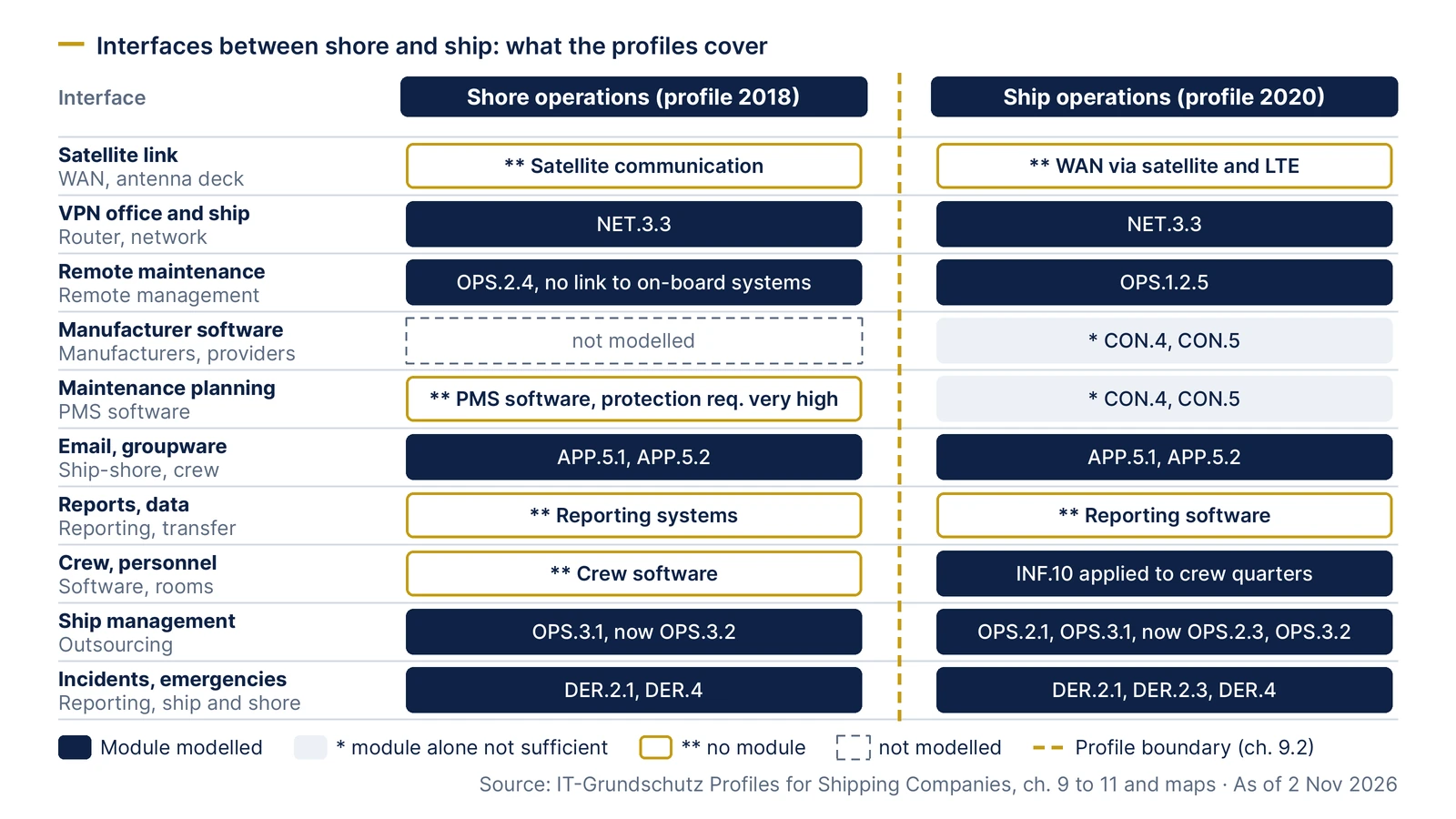
The matrix compares ten interfaces between office and ship: what each profile says about it, which 2023 Compendium identifier fits it and what you should record so that the interface is covered in one of the two security concepts. The last column is our proposal. Stars as in the maps: * module alone is not enough, ** no module.
| Interface | Shore operations (2018) | Ship operations (2020) | Identifier 2023 | What you record (our proposal) |
|---|---|---|---|---|
| Satellite link, WAN | application „Satelliten-Kommunikation“ (satellite communication) in Accounting ** (Annex 1) | „WAN (Sat.-Anlage, LTE)“ (our translation: "WAN (satellite system, LTE)") **, antenna deck ** (Annex 4) | no module; in Grundschutz++ target object category (Zielobjektkategorie) external network connections | provider and contract, encryption of the link, fallback route, who looks after the antenna system |
| VPN between office and ship | NET.3.3 on router, WLAN, network (Annex 1, 2) | NET.3.3 on the on-board network (Annex 1 to 4) | NET.3.3 | endpoints on both sides, who manages configuration and keys |
| Remote maintenance, remote management | OPS.2.4 remote maintenance (R3), without reference to on-board systems (ch. 11.2.4) | sub-processes remote management and remote maintenance (ch. 10.1.1); OPS.1.2.5 (Annex 4) | OPS.1.2.5 | who accesses which on-board systems from shore or from the manufacturer, who approves and observes on board |
| Manufacturers and service providers | profile as the basis for selection, requirements in the contract (ch. 7.3) | manufacturer and service provider software * with CON.4, CON.5 (Annex 1); same recommendation (ch. 7.3) | CON.4, CON.5 withdrawn; according to our proposal APP.6, APP.7 | update routes, contact persons, contract clauses for each manufacturer |
| Maintenance planning (PMS) | „PMS vorbeugende Wartung“ (our translation: "PMS preventive maintenance"), very high protection requirements; PMS software ** (ch. 8.2, Annex 2) | ship management and PMS software * with CON.4, CON.5 (Annex 1) | no module of its own; CON.4, CON.5 withdrawn, according to our proposal APP.6, APP.7 | which instance is authoritative, how ship and shore reconcile, common protection requirements |
| Email and groupware | email (Outlook), high protection requirements; APP.5.1, APP.5.2 (Annex 1) | email and groupware „insbesondere Schiff-Land“ (our translation: "in particular ship-shore"), crew and passengers; APP.5.1, APP.5.2 (Annex 4) | APP.5.2; APP.5.1 withdrawn, according to our proposal APP.5.3 | separate routes for operations and crew, who manages the mailboxes on board |
| Reports and data transfer | sub-process Reporting; reporting systems ** (Annex 1, 2) | reporting software **; file server with automatic data transfer, APP.3.3, APP.3.4 (Annex 3, 4) | APP.3.3, APP.3.4; software without a module | which data are transferred automatically, how the receiving side checks their integrity |
| Crew and personnel | Accounting for the crew; crew software ** (Annex 1) | private communication, crew quarters (INF.10), crew WLAN in the network plan (ch. 10.3) | INF.10; software without a module | separation of private devices from the administration and control networks, who sees personnel data on board |
| Ship management on behalf of others | OPS.3.1 Outsourcing for service providers „bei Ship-Management im Auftrag“ (our translation: "for ship management on behalf of others") (ch. 11.3.1) | OPS.2.1 Outsourcing for customers (R2), OPS.3.1 (R3) (ch. 11.2.4) | OPS.2.3 and OPS.3.2 (successors according to the 2023 Compendium) | who is the shipowner and who the ship manager, and whether you use or offer outsourcing |
| Security incidents, emergencies | DER.2.1 (R2), DER.4 (R3) (ch. 11.2.5) | DER.2.1, DER.2.3 (R2), DER.4 (R3); sub-process emergency management in Nautical Operations (ch. 10.1.1, 11.2.5) | DER.2.1, DER.2.3, DER.4 | reporting route from ship to shore, who decides whether a system on board is disconnected, reachability without the satellite link |
Satellite link, maintenance planning and remote maintenance are the rows where shipping companies are most likely to need follow-up work. The satellite link has no module in either profile, although every other interface runs over it. Ashore, the PMS software is the target object with the highest protection requirements, while on board it carries only one star; define common protection requirements. And for remote maintenance, only ship operations models the on-board side. Contracts with manufacturers of on-board technology, satellite providers and ship managers are dealt with from a Grundschutz++ perspective on the page Practice: procurement and service providers.
Route to Grundschutz++: shore, ship and the satellite link
Both profiles are based on the methodology of BSI Standard 200-2 and an older Compendium edition. For the transition, the State-of-the-Art Library (Stand-der-Technik-Bibliothek) contains a draft mapping from IT-Grundschutz 2023 to Grundschutz++ (status draft, as of 21 July 2026). We have applied it to all modules named in chapter 11 and the maps, insofar as they exist under the same identifier in the 2023 Compendium; for shore operations, INF.6 and INF.10 from the map are included. Target requirements are resolved in the user catalogue (Anwenderkatalog) build 2026-10-29. The figures are a draft based on a draft; they do not show complete coverage.
| Count | Shore operations | Ship operations |
|---|---|---|
| modules named with the same identifier in the 2023 Compendium | 58 | 82 |
| 2023 requirement identifiers in these modules | 1,143, of which 217 marked as withdrawn | 1,556, of which 283 marked as withdrawn |
| identifiers with at least one assignment in the draft mapping | 286 | 377 |
| distinct target requirements in Grundschutz++ that resolve in the catalogue | 269 in 16 practices | 313 in 17 practices |
| target references in the draft that do not resolve in the catalogue | 9, all to the same identifier VRB.1.2 (270 distinct target identifiers in total) | 13, all to VRB.1.2 (314 distinct target identifiers in total) |
| identifiers that no longer exist in 2023 | 10: CON.4, CON.5, OPS.2.4, OPS.3.1, APP.5.1, SYS.1.1.2, SYS.2.2.2, SYS.3.4, INF.3, INF.4 | 9: CON.4, CON.5, OPS.2.1, OPS.3.1, APP.5.1, SYS.2.2.2, SYS.3.4, INF.3, INF.4 |
| target objects without a module (**), in no mapping | e.g. PMS software, crew software, e-banking, satellite communication | e.g. ECDIS PC, radar, GMDSS, voyage data recorder, WAN via satellite |
57 modules are the same in both profiles. Only shore operations models INF.8 Working from Home; only ship operations models 25 more, including the six IND modules with 64 identifiers, of which 9 are withdrawn and 21 assigned. For the withdrawn identifiers, the 2023 Compendium names two successors: OPS.2.3 Use of Outsourcing for OPS.2.1 (24 identifiers, 2 with an assignment) and OPS.3.2 Provision of Outsourcing for OPS.3.1 (21 identifiers, 1 with an assignment); SYS.2.2.2 Clients under Windows 8.1 is withdrawn without replacement. For the others, we propose an equivalent that the 2023 Compendium does not confirm: OPS.1.2.5 Remote Maintenance for OPS.2.4 (in chapter 11.2.4, ship operations lists „OPS.1.2.5 Fernwartung“ (remote maintenance) where shore operations lists „OPS.2.4 Fernwartung“), APP.6 General Software and APP.7 Development of Individual Software for CON.4 and CON.5, APP.5.3 General Email Client and Server for APP.5.1, SYS.4.5 Removable Media for SYS.3.4 and INF.12 Cabling for INF.3 and INF.4. We cannot reliably assign "SYS.1.1.2" to any module; since the Technical Management map assigns SYS.1.2.2 Windows Server 2012 to the Windows server, we suspect transposed digits.
Example 1, ship operations: remote maintenance over the satellite link. Profile reference: sub-processes remote management and remote maintenance in Technical Operations (chapter 10.1.1), application remote maintenance with OPS.1.2.5 in the Communication map (Annex 4). Requirement 2023: OPS.1.2.5.A3 „Absicherung der Schnittstellen zur Fernwartung“ (our translation: "Securing the interfaces for remote maintenance") (basic): restrict access, disconnect connections after access, software only where necessary, encrypt connections over untrusted networks, each with MUSS (MUST). Draft mapping: only the sub-statements UA.4 and UA.5 are assigned, both as a subset of ARCH.6.2 „Verschlüsselung von Weiterverkehrsverbindungen“ (our translation: "Encryption of wide area connections") (SOLLTE (SHOULD), security level normal-SdT); as we read it, these are the two sentences on encryption. Gap: restriction, disconnection and installation have no assignment, and MUSS becomes SOLLTE. In the Compendium, the satellite link has no module; in Grundschutz++ it falls, as an external network connection, under the target object category to which ARCH.6.2 applies. Anything needed beyond that, such as a fallback route, belongs in the package as a requirement of your own after the risk assessment.
Example 2, interface: remote maintenance by manufacturers. Profile reference: the foreword to ship operations names the manufacturers responsible for the technical equipment on board and its security; the Technical Operations map lists manufacturer software with a star (Annex 1). Requirement 2023: OPS.1.2.5.A19 „Fernwartung durch Dritte“ (our translation: "Remote maintenance by third parties") (standard): observe and record the activities of external parties, contractual arrangements with MUSS, and anyone remotely maintaining several customers must not connect their networks. Draft mapping: no assignment. Gap: the entire requirement. In our assessment, DLS.1.1 „Verfahren und Regelungen“ (our translation: "Procedures and rules") (MUSS) and DLS.3.1 „Einhaltung der Sicherheitsvorgaben“ (our translation: "Compliance with the security specifications") (SOLLTE) in the catalogue come into question for the contractual part; observing, recording and separating customer networks are not covered there. This assignment is ours, not from the draft.
Example 3, shore operations: ship management on behalf of others. Profile reference: chapter 11.3.1 names OPS.3.1 Outsourcing for service providers with „bei Ship-Management im Auftrag“ (our translation: "for ship management on behalf of others") in brackets. Requirement 2023: successor OPS.3.2 Provision of Outsourcing, including OPS.3.2.A4 „Erstellung eines Mandantentrennungskonzepts“ (our translation: "Creating a client separation concept") (basic, MUSS) for data of different clients, in our assessment an obvious fit for ship management with ships of several owners. Draft mapping: no assignment for A4; of the 21 identifiers in OPS.3.2, only A14 „Überwachung der Prozesse, Anwendungen und IT-Systeme“ (our translation: "Monitoring of processes, applications and IT systems") is assigned, as an overlap with DET.4.17 „Anwendungsbasiertes Kapazitätsmanagement“ (our translation: "Application-based capacity management") (KANN (MAY), security level elevated (erhöht)). Gap: the obligations of a ship manager as a provider are practically not reflected in the draft; you keep them as requirements of your own.
Two points apply to both profiles. Grundschutz++ specifies two protection requirements categories, normal and high; further categories of your own are permitted, but must be mapped to these two (BSI Standard 300-1, chapter 2.6). The „sehr hoch“ (very high) of the PMS software therefore ends up in "high", even if you keep it internally as a separate level. And for business processes with high protection requirements for at least one protection goal, 300-1 requires an explicit risk assessment (chapter 2.11), as it does for assets that are not adequately covered by the target object categories and the requirements assigned to them. The two stars of the profiles refer to the Compendium, not to Grundschutz++. In Grundschutz++, the satellite link (WAN via satellite and LTE) is an external network connection; Annex 1 of 300-1 gives as examples, among others, „Leitungen zu Partnern/Dienstleistern“ (our translation: "lines to partners/service providers") and „öffentliche Mobilfunk-/5G-Router“ (our translation: "public mobile/5G routers"). In the user catalogue, this target object category is assigned requirements such as ARCH.6.2 „Verschlüsselung von Weiterverkehrsverbindungen“ (SOLLTE) and ARCH.8.2 „Redundante TK-Anbindung“ (our translation: "Redundant telecommunications connection") (KANN, security level elevated (erhöht)); whether that is enough for the link is something you clarify in the risk assessment. For navigation and on-board technology such as the ECDIS PC, radar, GMDSS or voyage data recorder, we found no dedicated target object category in Annex 1; these target objects are candidates for the explicit risk assessment. How to assign such target objects is described on the page Modelling with target object categories, the approach to the risk assessment on the page Risk analysis, and how to check individual assignments of the draft on the page Checking the IT-Grundschutz 2023 mapping.
Rights notice: Quotations and information from the two IT-Grundschutz Profiles for shipping companies: protected by copyright, rights held by the participants of the workshop „IT-Grundschutz-Profil für Reedereien“, publisher Verein Hanseatischer Transportversicherer e. V.; the documents contain no open licence. Sources: BSI page shore operations (German), BSI page ship operations (German), retrieved on 2 November 2026. Quotations from BSI Standard 300-1 © Bundesamt für Sicherheit in der Informationstechnik 2026, source: BSI page on Grundschutz++ (German). Module and requirement titles from the IT-Grundschutz Compendium, 2023 edition, © 2023 Reguvis Fachmedien GmbH and © 2023 Bundesamt für Sicherheit in der Informationstechnik. This content is not licensed under CC BY-SA 4.0; the quotations are unchanged, the summaries are our own. The licence notice at the end of the page applies to the excerpts from catalogue and mapping data.
What this page does not decide
Both profiles justify the obligation to ensure information security with the General Data Protection Regulation and the Federal Data Protection Act (Bundesdatenschutzgesetz) 2018 and, in chapter 8.6, also name „zukünftige Anforderungen der International Maritime Organization (IMO)“ (our translation: "future requirements of the International Maritime Organization (IMO)"); in its foreword, shore operations names an IMO deadline of 1 January 2021 (chapters 1, 2, 8.6, 8.7). That is the situation at the time of writing in 2018 and 2020. Which maritime, flag state or insurance law obligations apply to your shipping company today, and whether a concept prepared according to these profiles fulfils them, is not examined on this page. The same applies to the profiles' statements on data protection, ISO 9001 and ISO 27001 (chapters 1, 8.5).
Both profiles see themselves as a model security concept and template (chapter 2). They do not do the structure analysis and protection requirements determination for your fleet and your office for you, and on their own they are not sufficient as evidence towards authorities, insurers or business partners. The profiles do not show a registration with the BSI, and being linked on the BSI's list of profiles is not a form of recognition.
Support
Blackfort Technology supports you as a team in defining the interfaces between your shore operations and your ships, matching the matrix against contracts and security concepts and transferring the requirements of both profiles, including the target objects without a module, into a requirements package according to Grundschutz++. The packages are on the page Consulting.