

Profile summary
| Original title | „IT-Grundschutz-Profil für Handwerkskammern“ (IT-Grundschutz Profile for chambers of skilled crafts) |
|---|---|
| Publisher and authorship | Publisher Deutscher Handwerkskammertag (DHKT); authorship „Handwerkskammern in Kooperation mit dem Deutschen Handwerkskammertag (DHKT)“ (our translation: "chambers of skilled crafts in cooperation with the Deutscher Handwerkskammertag (DHKT)") (ch. 2). Prompted by a cooperation between ZDH and BSI of October 2017, drawn up in three workshops from March to June 2018 (ch. 1) |
| Version and date | Version 1.0, „Veröffentlicht am 11.07.2018“ (our translation: "Published on 11 Jul 2018"), created on 12 May 2018 (ch. 2). The change history lists all three entries as version 1.0, the first of 16 Apr 2018 with the name „BSI“ and the description „Anlegen des Templates“ (our translation: "creation of the template"). The BSI page on the profile gives the date 18 Jul 2018. |
| Registration number | „HWK/2018/1.0“ according to ch. 2; the document does not say who assigned it |
| Revision cycle | Its currency „soll alle zwei Jahre überprüft werden“ (our translation: "is to be reviewed every two years") (ch. 2). We did not find a newer version on the BSI page on 2 Nov 2026. |
| Compendium edition | not named in the profile; according to our comparison the 2018 edition (see below) |
| Methodology | BSI Standard 200-2, Standard Protection; risk analysis according to BSI Standard 200-3 (ch. 4, 9) |
| Scope of the document | 17 pages (PDF, about 455 KB), 9 chapters, 3 tables |
| Accessibility | freely available via the BSI page on the profile. The profile also announces a confidential version for chambers of skilled crafts only, classified TLP „amber“ (ch. 2). We could not check whether it has been published. |
| Licence and rights | The document contains no licence information. We therefore quote only briefly and with the location, and otherwise reproduce the content in our own words; we do not reproduce the tables and figures of the profile. |
| Type | IT-Grundschutz Profile of a chamber organisation, published by the DHKT and made available on a BSI page (no critical infrastructure (KRITIS) profile, no thesis) |
| Location | BSI page „IT-Grundschutz-Profil für Handwerkskammern“ (German), retrieved on 2 Nov 2026 |
Do not confuse: The BSI list of profiles also lists an IT-Grundschutz Profile for craft businesses by the Zentralverband des Deutschen Handwerks, without a document, and as a working aid a route planner „Cyber-Sicherheit für Handwerksbetriebe“ (cyber security for craft businesses). Both are aimed at businesses and are not part of the profile for chambers of skilled crafts. The link to the route planner returned error 404 when retrieved on 2 November 2026; we could not check its content. How the chamber profile compares with the other profiles in age and Compendium edition is shown on the page Finding and reusing IT-Grundschutz Profiles.
Does the profile fit your chamber?
The profile fits if …
- you want to protect the examination process, i.e. admission, registration and examination up to file inspection, as your first information domain and are looking for a ready-made process structure for it;
- your chamber operates the website, databases, email and network for these processes largely itself or through a service provider under contract, and you are compiling requirements for this contract (chapter 5);
- you need a template for the protection requirements categories with damage scenarios and downtimes from a chamber's point of view (tables 1 to 3);
- you want to agree a common starting point for structure and terms with other chambers.
The profile does not fit, or fits only to a limited extent, if …
- you want to protect the entire chamber, including services for members, support for businesses and representation of interests: the profile considers only the path to master craftsman (chapter 3);
- you are looking for a selection of modules for your chamber: chapter 7 lists the entire 2018 Compendium without assignment to objects; you have to do the modelling yourself;
- you work with the 2023 Compendium: eleven identifiers on the list no longer exist there (see below), and modules for telephone systems, VoIP, fax, cloud usage or terminal servers are missing from the list because they did not yet exist in 2018;
- parts of your processes have elevated protection requirements, for example the preparation of examination tasks before the examination date: the profile refers notes on this to the confidential version (chapter 4);
- workshops with networked machines are part of the examination: the profile does list modules of industrial IT, but does not say what they are to be applied to;
- you start directly with Grundschutz++: then you take over the 18 sub-steps of the examination process and the downtimes from tables 1 to 3; you do not need the module list from chapter 7 for this (see below).
Scope: „Der (digitale) Weg zum Meister“ (the (digital) path to master craftsman)
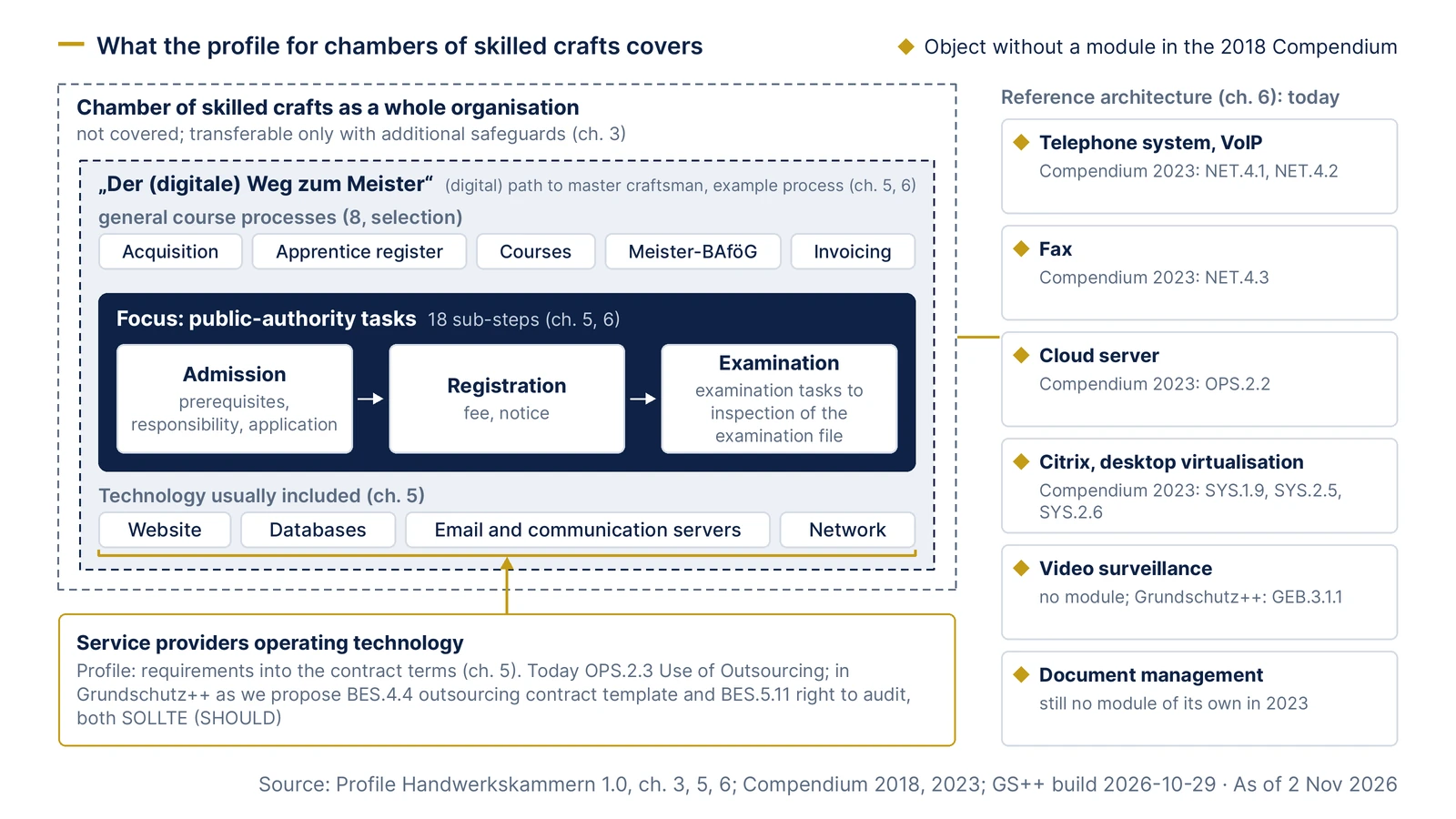
The profile is based on the role of the chambers as corporations under public law. As public-authority tasks it names keeping the apprentice register (Lehrlingsrolle) and the register of craft businesses (Handwerksrolle), regulating vocational training and the examination system in the chamber district (chapter 1). It derives the information domain from a single example process, „Der (digitale) Weg zum Meister“ (our translation: "The (digital) path to master craftsman") (chapter 5). In the open version it considers „in erster Linie die hoheitlichen Aufgaben“ (our translation: "primarily the public-authority tasks") of this path, with the processes admission, registration and examination.
The figure of the business processes in chapter 6 breaks these three processes down into 18 sub-steps, from checking the admission requirements through the examination fee, examination planning and preparation of examination tasks to assessment, certificate, statistics and file inspection. Above it, set off by a dashed line, is a second group of general course processes: acquisition, apprentice register, course planning, course management, registration of participants, Meister-BAföG (state funding for advanced vocational training), course delivery and invoicing.
At the technical level, according to chapter 5, the website, the databases, email and other communication servers, the network infrastructure and other IT systems essential to the process are usually included. The reference architecture in chapter 6 counts 8 infrastructure objects (from the building through the server room, workshops and the examination room for the theory examination to video surveillance), 10 network objects (from firewall and VoIP to the provider leased line) and 19 IT systems (from Citrix applications and document management server through telephone system and fax to cloud server and web server).
The chamber as a whole organisation is expressly not covered. Components are said to be transferable: „Im Bedarfsfall sind hierfür jedoch zusätzliche Schutzmaßnahmen auszuwählen.“ (our translation: "Where required, however, additional safeguards must be selected for this.") (chapter 3) For chambers that have parts of their technology operated by third parties, the profile recommends using it as the basis of the cooperation and including its requirements in the contract terms (chapter 5).
What characterises the profile and where it leaves gaps
It is based on the modernised methodology, no longer on the old IT-Grundschutz Catalogues. The profile refers to BSI Standards 200-2 and 200-3, uses modules and requirement identifiers such as ISMS.1.A4 and contains no safeguard identifiers following the pattern „M 2.1“. It does not name an edition of the Compendium. We therefore compared the module list from chapter 7 with the table of contents of the 2018 edition, the first edition after the modernisation (as of February 2018, 80 modules): the list contains 79 of these 80 modules with their titles at the time, such as „Server unter Unix“ (servers under Unix) or „Betriebs- und Steuerungstechnik“ (operational and control technology). Only DER.3.2, the IS audit for federal authorities, is missing. Modules that appeared later do not occur.
This leads to the most important finding for practice: chapter 7 is not a selection. The profile takes over the entire 2018 Compendium, does not assign the modules to any object of the reference architecture and excludes nothing on stated grounds. The list therefore also contains modules that fit a chamber only in some circumstances, such as iOS and Android side by side, clients under Windows 8.1 and Unix, outsourcing for service providers, information security on trips abroad and five modules of industrial IT down to programmable logic controllers, sensors and actuators. Only ISMS.1 Security Management is broken down to requirement level, and completely, with A1 to A17, including the two requirements in case of elevated protection needs.
Protection requirements: the profile sets a level corresponding to Standard Protection and assumes „grundsätzlich“ (our translation: "as a matter of principle") normal protection requirements for the public-authority tasks; an individual protection requirements determination is „dringend empfohlen“ (our translation: "strongly recommended") (chapters 4, 9). Information on parts with elevated protection requirements is to be given only in the confidential document (chapter 4). As possible damage it names loss or theft of business, apprentice and examination data, loss of reputation, claims for damages and fines under the GDPR (chapter 9). The three protection requirements tables set tolerable downtimes of 24 to 72 hours for normal, one to 24 hours for high and less than one hour for very high (tables 1 to 3).
When adopting it, six points stand out at which the profile is imprecise or contradicts itself: chapter 7 introduces the list with the sentence „Die folgenden obligatorischen Prozess-Bausteine sind anzuwenden.“ (our translation: "The following mandatory process modules are to be applied."), but also lists all system modules, and chapter 4 calls the same requirements „Empfehlungen“ (our translation: "recommendations"). Text and figure assign the processes differently: chapters 1 and 9 count the apprentice register among the public-authority tasks, the figure lists it under the general course processes; chapter 9 names the register of craft businesses first, in the figure it does not occur. The field „Nicht berücksichtigte Objekte“ (our translation: "objects not considered") in chapter 5 names what is considered. Video surveillance appears in the list of rooms (R8), and the management summary speaks of „Standardsicherung“ (our translation: "standard safeguarding"), meaning Standard Protection.
Objects without a module: for several objects of the reference architecture there was no suitable module in 2018, among them telephone system, VoIP and fax, cloud server, Citrix and desktop virtualisation, document management and video surveillance. Chapter 8 names exactly this case as a reason for an additional analysis, but the profile does not carry it out for these objects. The table further down shows what exists for them today.
Working aid: comparison of the reference architecture with the 2023 Compendium and Grundschutz++
The table takes the objects of the reference architecture for which something has changed between 2018 and today or for which the profile had no module. Go through it with your structure analysis: does the object exist in your chamber? If so, the third column shows the module in the 2023 Compendium and the fourth where it ends up in Grundschutz++. The fourth column names target object categories (Zielobjektkategorien) according to BSI Standard 300-1 Annex 1 and individual requirements from the user catalogue (Anwenderkatalog); the assignment is our proposal unless the draft mapping is named.
| Object in the profile (ch. 6, 7) | Status in the 2018 profile | Compendium 2023 | Grundschutz++ (our proposal) |
|---|---|---|---|
| Telephone system (S16), VoIP (N3) | no module; the NET.4 layer did not exist in 2018 | NET.4.1 Telecommunications Systems, NET.4.2 VoIP | Category telecommunications applications (TK-Anwendungen); the connection at the provider as external network connection (Externer Netzanschluss), Annex 1 names the VoIP connection as an example |
| Fax (S17) | no module | NET.4.3 Fax Machines and Fax Servers | Category fax (applications) (Fax(-anwendungen)); in the draft mapping NET.4.3 has not a single entry, you search for the requirements in the catalogue yourself |
| Cloud server (S18) | no module; under operation by third parties only outsourcing and remote maintenance | OPS.2.2 Cloud Usage | Category cloud services (Cloud-Dienste); the question „Welche Cloud-Dienste werden genutzt?“ (our translation: "Which cloud services are used?") belongs to the outsourcing delimitation according to 300-1 ch. 3.1 |
| Citrix applications (S1), client desktop virtualisation (S11) | only SYS.1.5 Virtualisation | additionally SYS.1.9 Terminal Server, SYS.2.5 Client Virtualisation, SYS.2.6 Virtual Desktop Infrastructure, all new in the 2023 edition | Categories virtualisation solutions (Virtualisierungslösungen) and host systems (Hostsysteme) |
| Document management server (S7) | no module of its own | no module of its own; general requirements in APP.6 General Software | Categories applications (Anwendungen) and host systems. Check whether examination files are stored there: then the sub-step file inspection depends on it |
| Video surveillance (R8) | listed as a room, no module | no module of its own | GEB.3.1.1 „Videoüberwachung“ (video surveillance) (security level elevated (erhöht), KANN, i.e. MAY) for access monitoring; record cameras and recorders as IT systems |
| Workshops (R6) | IND.1 and IND.2.1 to IND.2.4 listed, not assigned to any object | the same identifiers, IND.1 is now called „Prozessleit- und Automatisierungstechnik“ (process control and automation technology); IND.2.2 and IND.2.3 without an entry in the draft mapping | Annex 1 names no category of its own for machines and controllers. Among other things, the draft mapping maps IND.2.4.A1 to ARCH.2.2.5 „OT-Systeme“ (OT systems) (normal-SdT, where SdT = Stand der Technik, state of the art; SOLLTE, i.e. SHOULD; restrict connections to other IT systems). If machines are connected to the chamber network, this is a case for risk assessment (300-1 ch. 2.11) |
| Examination room for the theory examination (R7) | INF.10 Meeting, Event and Training Rooms | INF.10, revised in the 2023 edition | Category rooms (Räume); record IT in the room (examination computers, printers) separately |
| Provider leased line (N7), interfaces (N10) | no module of its own | no module of its own | Category external network connections (Externe Netzanschlüsse); document every interface according to 300-1 ch. 3.1 „organisatorisch, technisch sowie infrastrukturell“ (our translation: "organisationally, technically and in terms of infrastructure") |
| Service providers operating technology (ch. 5) | OPS.2.1 Outsourcing for Customers; recommendation to write the profile requirements into the contract | OPS.2.3 Use of Outsourcing (replaces OPS.2.1) | Categories outsourcing or services (Dienstleistungen); contract content see example 3 below |
| Mobile devices (S10) | SYS.3.2.1 to SYS.3.2.4 and MDM, without choice of platform | the same identifiers; SYS.3.2.3 iOS has no entry in the draft mapping | Category mobile devices (Mobile Endgeräte); record only the platforms you actually use |
| Clients (ch. 7) | SYS.2.2.2 Windows 8.1, SYS.2.2.3 Windows 10, SYS.2.3 Unix | SYS.2.2.2 dropped, SYS.2.2.3 is called „Clients unter Windows“ (clients under Windows) and covers Windows 10 and 11 | Category IT systems (IT-Systeme); check your inventory against the versions supported today |
How to form the requirements package from the list of your assets is described on the page Modelling: forming a requirements package from assets; how to delimit the information domain and its interfaces, on the page Delimiting the information domain.
From the 2018 Compendium via 2023 to Grundschutz++
Between the chamber profile and Grundschutz++ there are two steps: the 2018 Compendium, whose module list changed in eleven identifiers up to 2023, and the change of methodology from BSI Standard 200-2 to 300-1. We had not found a Grundschutz++ version of the profile by 2 November 2026. The transfer therefore runs in two stages: first from the 2018 edition to the 2023 edition, because a draft mapping exists only for the latter, then from the 2023 Compendium to Grundschutz++.
The process part of the profile can be reused well. Grundschutz++ determines protection requirements for business processes, for the chamber therefore for the sub-steps of the examination process, and knows only normal and high (300-1 chapter 2.6). For authorities and institutions under public law, 300-1 names the statutory mandates as the source for the business processes (chapter 2.5). The 18 public-authority sub-steps of the profile are a usable first process list; each of them gets its own protection requirements determination. The profile's levels high and very high merge into the category high in Grundschutz++, and a risk assessment is required for these processes (chapter 2.11). You can take over the downtimes from tables 1 to 3 as the justification for your classification.
The module part is the weaker one. Before counting, we checked every identifier from chapter 7 against the 2023 edition. 68 of the 79 modules exist there under the same identifier, some with a new title and revised text. Eleven identifiers no longer exist:
| Module in the profile (2018 edition) | 2023 edition | Evidence |
|---|---|---|
| OPS.2.1 Outsourcing for Customers | OPS.2.3 Use of Outsourcing | Compendium 2023, chapter „Neues“ (what's new) |
| OPS.3.1 Outsourcing for Service Providers | OPS.3.2 Provision of Outsourcing | Compendium 2023, „Neues“ |
| SYS.2.2.2 Clients under Windows 8.1 | dropped, without successor | Compendium 2023, „Neues“ |
| APP.5.1 General Groupware | APP.5.3 General E-Mail Client and Server | Compendium 2021, „Neues“ |
| CON.4 Selection and Use of Standard Software | APP.6 General Software | Compendium 2021, „Neues“ |
| CON.5 Development and Use of General Applications | APP.7 Development of Individual Software | Compendium 2021, „Neues“ |
| INF.3 Electrical Cabling, INF.4 IT Cabling | INF.12 Cabling | Compendium 2021, „Neues“ |
| OPS.1.2.3 Exchange of Information and Data Media | CON.9 Exchange of Information | Compendium 2020: old identifier dropped, new one appears without being counted as a new module (96 = 94 from 2019 + CON.8, INF.5) |
| OPS.2.4 Remote Maintenance | OPS.1.2.5 Remote Maintenance | Compendium 2020: old identifier dropped, new one appears without being counted as a new module (96 = 94 from 2019 + CON.8, INF.5) |
| SYS.3.4 Mobile Data Media | SYS.4.5 Removable Media | Compendium 2020: old identifier dropped, new one appears without being counted as a new module (96 = 94 from 2019 + CON.8, INF.5) |
For the last three rows, no „Neues“ chapter names the successor expressly; the 2020 edition does, however, continue the modules under the new identifiers without counting them as new. For the 68 modules with unchanged identifiers we counted the draft mapping IT-Grundschutz 2023 to Grundschutz++. The file has the status „draft“ (as of 21 July 2026), and we resolved the targets in the user catalogue build 2026-10-29. The result is a draft and not an official assignment.
| Metric | Value |
|---|---|
| Requirement identifiers of the 68 modules in the 2023 Compendium | 1,299, of which 249 marked as dropped, i.e. 1,050 valid |
| Requirements with at least one entry in the draft mapping | 334 (around 32% of the valid ones); none of them is dropped |
| different Grundschutz++ requirements as targets | 303 from 17 practices (Praktiken); most in DET (73), ARCH (62), KONF (45) and TEST (28) |
| Modules without a single entry | 12: ORP.4 Identity and Access Management, OPS.1.2.4 Teleworking, CON.2 Data Protection, CON.3 Data Backup Concept, CON.6 Deletion and Destruction, SYS.1.2.2 Windows Server 2012, SYS.1.3 Linux and Unix Servers, SYS.3.2.3 iOS (for Enterprise), IND.2.2 Programmable Logic Controller (PLC), IND.2.3 Sensors and Actuators, INF.7 Office Workplace, INF.9 Mobile Workplace |
| Target references that cannot be resolved in the catalogue | 11 references, all to the same identifier VRB.1.2; it is not included in the 303 targets |
| for orientation: the 6 documented successors from the first table | 99 requirements, none dropped, 22 with an entry, 27 different targets |
| for orientation: the 3 successors identified via the 2020 edition | 51 requirements, of which 11 dropped, 8 with an entry, 12 different targets |
An entry in the mapping does not mean that the requirement is fully covered; the relationships range from equal to partial overlap. ISMS.1, the only module that the profile details down to requirement level, is found in Grundschutz++ mainly in the methodology practices: of 25 targets of the mapped ISMS.1 requirements, 18 lie in governance and compliance (Governance und Compliance), implementation (Umsetzung), improvement (Verbesserung) and monitoring evaluation (Monitoring-Evaluation). According to 300-1 chapter 3.4.1, these methodology requirements are mandatory for every information domain. We traced three points individually:
| Point in the profile | Requirement in the 2023 Compendium | Target in Grundschutz++ (catalogue build 2026-10-29) | Gap |
|---|---|---|---|
| Ch. 7: ISMS.1.A4 „Benennung eines Informationssicherheitsbeauftragten [Institutionsleitung]“ (appointment of an information security officer [top management]) | ISMS.1.A4 (basic, MUSS, i.e. MUST): appoint an ISB, provide resources, direct reporting line to top management, early involvement in projects | Mapping: sub-requirement 1 equal (equal-to) to GC.9.1.1.1 „Informationssicherheitsbeauftragter“ (information security officer), normal-SdT, MUSS; in the mapping file still under the older identifier GC.8.1.1.1 | No entry for the other sub-requirements. Our own search: GC.9.1.1.1.1 „Ressourcen für den Informationssicherheitsbeauftragten“ (resources for the information security officer) and GC.9.1.1.1.2 „Vorspracherecht“ (right of direct access), both MUSS. New in Grundschutz++: responsibility lies with one person who reports directly to top management |
| Ch. 7: ISMS.1.A17 „Abschließen von Versicherungen (A)“ (taking out insurance (A)), under elevated protection requirements | ISMS.1.A17 (high, SOLLTE): check whether residual risks are insurable, review insurance policies regularly | Mapping: no entry. Our own full-text search of the catalogue for „Versicherung“ (insurance): no hit | There is no requirement of its own. In Grundschutz++ insurance is a case of the risk treatment option risk transfer (300-1 Annex 3, minimum criterion (Mindestkriterium) 23); if you want to keep the check, manage it as a supplementary requirement (ch. 3.4.3) |
| Ch. 5: requirements of the profile „sollten in den Vertragsbedingungen enthalten sein“ (our translation: "should be included in the contract terms"); ch. 7: OPS.2.1 | OPS.2.3.A4 „Grundanforderungen an Verträge mit Anbietenden von Outsourcing“ (basic requirements for contracts with outsourcing providers) (basic, MUSS): information security, consent requirement for further outsourcing, right to inspection, audit and review | Mapping: no entry; of 24 requirements in OPS.2.3 only 2 have one. Our own search: BES.4.4 „Vertragsvorlage für Outsourcing“ (outsourcing contract template) and BES.5.11 „Recht auf Audit“ (right to audit) (both normal-SdT, SOLLTE), BES.5.6.2 „Autorisierung von Unterauftragnehmern“ (authorisation of subcontractors) (elevated (erhöht), KANN) | The assignment is ours. The modal verb drops from MUSS to SOLLTE, and the consent requirement for further outsourcing becomes optional. The profile's recommendation to write your own requirements into the contract is not in any catalogue; record it as a supplementary requirement |
Profile-specific provisions are few in the profile: the structure of the examination process, the protection requirements tables with downtimes, the assumption of normal protection requirements for the public-authority tasks and the recommendation on service provider contracts. The draft mapping links only requirements of the Compendium and therefore does not capture them: you take over the process structure and downtimes into the protection requirements determination, and the contract recommendation as a supplementary requirement. How to look up the assignment of ISMS.1.A4, for example, in the draft yourself is shown on the page Checking the IT-Grundschutz 2023 mapping; the contractual side of service provider management is covered on the page Practice: procurement and service providers.
Rights notice: Short quotations from the IT-Grundschutz-Profil für Handwerkskammern, version 1.0 of 11 Jul 2018, publisher Deutscher Handwerkskammertag (DHKT), authorship Handwerkskammern in Kooperation mit dem DHKT. The document contains no licence or rights notice; we therefore quote it only briefly and with the location. The BSI makes the document available on its website. Source: BSI page on the profile. Short quotations from BSI-Standard 300-1 „Methodik Grundschutz++“, version 1.0 of 20 Oct 2026, © Bundesamt für Sicherheit in der Informationstechnik 2026, source: BSI page on Grundschutz++. Requirement and module titles from the IT-Grundschutz-Kompendium: Edition 2023 © 2023 Reguvis Fachmedien GmbH and © 2023 Bundesamt für Sicherheit in der Informationstechnik; Edition 2021 © 2021 Reguvis Fachmedien GmbH and © 2021 Bundesamt für Sicherheit in der Informationstechnik; Edition 2018 © 2018 Bundesanzeiger Verlag GmbH and © 2018 Bundesamt für Sicherheit in der Informationstechnik; source: BSI pages on the editions 2018, 2021 and 2023. These texts are not covered by CC BY-SA 4.0; the licence notice at the end of the page applies to the excerpts from catalogue and mapping data.
What this page does not decide
We do not interpret which legal provisions govern the tasks of a chamber of skilled crafts and which information security requirements result from them. The same applies to the question of whether the BSI Act (BSIG) in its current version, state law or requirements of a supervisory authority apply to your chamber. The profile itself names as its only legal reference fines under the GDPR (chapter 9); we do not deal with data protection here.
In chapter 4 the profile says that Standard Protection is compatible with ISO 27001. Whether and how a chamber seeks certification is not decided on this page. Implementing the profile is neither proof towards an authority nor a certification. The fact that the BSI makes the profile available and was involved in its creation does not make it a requirement for your chamber.
We have not seen the confidential version of the profile or the profile for craft businesses. We make no statements about their content.
Support with the transfer
If you want to convert a security concept based on the chamber profile to the 2023 Compendium or to Grundschutz++, or extend it to further areas of the chamber, the team at Blackfort Technology supports you with the process list, protection requirements, modelling and requirements package. How converting a chamber concept works with us is described on the page Consulting on IT-Grundschutz and Grundschutz++. The entry for craft businesses and the other profiles with publisher and status are listed in the overview of IT-Grundschutz Profiles.