

Fact sheet for the two profiles
Both profiles were published by the Bundesamt für Sicherheit in der Informationstechnik (BSI), the German Federal Office for Information Security. According to their introduction, they were produced on behalf of the BSI together with experts in 5G campus networks and in IT-Grundschutz Profiles. The selection of modules and the 5G-specific notes on individual requirements are in a separate Excel spreadsheet containing annexes 1 to 4. Without it, most of the working basis is missing.
| Attribute | In-house operation | Third-party operation |
|---|---|---|
| Title on the BSI page | IT-Grundschutz-Profil zur Absicherung von 5G-Campusnetzen im Eigenbetrieb (IT-Grundschutz Profile for securing 5G campus networks in in-house operation) | IT-Grundschutz-Profil zur Absicherung von 5G-Campusnetzen Fremdbetrieb (third-party operation); title page: „Betrieb durch ein externes Dienstleistungsunternehmen“ (our translation: "operation by an external service company") |
| Title in the document (table 1) | IT-Grundschutz-Profil für 5G-Campusnetze (IT-Grundschutz Profile for 5G campus networks) | |
| Publisher | Bundesamt für Sicherheit in der Informationstechnik | |
| Authors, review (table 1) | Authors SoftEd Systems GmbH; review blackned GmbH, GuardStack GmbH | Authors TU Dresden and SoftEd Systems GmbH; review blackned GmbH, TeleTrusT e. V. |
| Version according to document history | 1.0, „Finale Veröffentlichung“ (our translation: "final publication") Feb 2024 (draft 0.1 Aug 2023, community draft Oct 2023) | 2.0 of 24 Nov 2023, „Überarbeitung der Struktur und Netzplan“ (our translation: "revision of the structure and network plan") and update to the 2023 Compendium (1.0 of 25 Oct 2022, community draft of 31 May 2022) |
| Date of the BSI page | Profile 16 Feb 2024, annexes 30 Aug 2024 | Profile 15 Dec 2023, annexes 26 Feb 2025 |
| Compendium edition | 2023 | |
| Revision cycle according to table 1 | annual; we found no newer version on the BSI pages on 2 Nov 2026 | |
| Scope | 35 pages PDF, Excel annexes 1 to 4 | 31 pages PDF, Excel annexes 1 to 4 |
| Availability | freely available via the BSI pages (PDF and Excel); the Excel file also contains a sheet mapping to ISO/IEC 27001:2022, which we have not evaluated | |
| Licence, rights | No licence or copyright notice in the document. The publisher is the BSI, written on behalf of the BSI (authors see above). We quote only briefly, verbatim and with a reference. | |
| Type | IT-Grundschutz Profile published by the BSI, methodology according to BSI Standard 200-2, at least Standard Protection (ch. 3) | |
| Reference | BSI page profile, BSI page annexes | BSI page profile, BSI page annexes |
| Retrieved | 2 Nov 2026 | |
The overview of all published profiles and their route to Grundschutz++ is on the page IT-Grundschutz Profiles.
Scope and reference architecture
Both profiles consider a locally operated, non-public 5G network as a standalone network according to 3GPP Release 15 or later, that is, with a 5G core network. Both profiles describe the network purely as „Insellösungen“ (our translation: "isolated solutions"), without a direct connection to the public mobile network or the internet. All components are on the user's premises (ch. 1). The core components are the Radio Unit, gNodeB and 5G Core. The profiles are limited to one quality of service class without traffic prioritisation and to physical SIM cards. Remote access, for example for maintenance by a service provider, is only intended via the internal corporate network (ch. 5.3).
Both profiles exclude a connection to the public mobile network, use of the end devices in the corporate network as well, connections of the 5G Core over TCP/IP to other networks and WLAN sidelink (ch. 4.2, 5.3). The profile for in-house operation also explicitly excludes running the 5G Core or gNodeB in the cloud, and leaves eSIM and iSIM out of scope (ch. 4.2).
The reference architecture differs in depth. In-house operation models two processes, „5G-Campusnetz nutzen“ (our translation: "use the 5G campus network") and „5G-Campusnetz betreiben“ (our translation: "operate the 5G campus network"), the latter with the sub-processes planning, provisioning, monitoring, service maintenance, SIM card management and decommissioning (table 3). In addition, there are seven applications, including network management, monitoring, SIM card management and the 5G Core functions, ten IT systems with a server for time synchronisation via Precision Time Protocol, a management server and an administration laptop, plus the existing management network of the corporate network, separated by a firewall. Third-party operation has only the process „5G-Campusnetz nutzen“, three applications for sensor data, actuators and analysis, and six IT systems. It treats the core components „als funktionale Einheit“ (our translation: "as a functional unit"), because they are provided by the service provider and „für gewöhnlich nicht verändert werden können“ (our translation: "usually cannot be changed") by the user (third-party operation ch. 5).
Where the responsibility boundary lies
In in-house operation, the „grundlegende Verantwortung für den Betrieb“ (our translation: "fundamental responsibility for operation") lies with the users, even if they assign one or more tasks to a service provider (in-house operation ch. 2.2). According to the profile, delivery, installation, maintenance and applying updates are not outsourcing within the meaning of IT-Grundschutz. The module OPS.2.3 Use of Outsourcing is therefore marked as not relevant, with a reference to the profile for third-party operation in case outsourcing does apply (ch. 4.1, annex 1). Where a service provider performs tasks, the requirements described „müssen“ (our translation: "must") then be implemented by that provider (ch. 1).
In third-party operation, outsourcing applies according to the profile, and „die Dienstleistersteuerung ist zentraler Bestandteil der Sicherheitskonzeption“ (our translation: "managing the service provider is a central component of the security design") (third-party operation ch. 1). The annexes draw the boundary at specific modules: the server modules SYS.1.1 to SYS.1.6 are not relevant for users because they cannot change the 5G Core. System management, time synchronisation and VPN lie with the service provider. OPS.2.3 becomes relevant. For the SIM cards, the applicable parts of the user-defined module according to annex 1 are to be implemented either by the using organisation or by the service company. For end devices, industrial components, firewall, building and cabling, both profiles model the same modules for the users.
In Grundschutz++, this corresponds to the question that BSI Standard 300-1 asks when delimiting the information domain: „Welche organisatorischen, technischen und infrastrukturellen Teile werden lokal betrieben und welche werden an externe Parteien ausgelagert?“ (our translation: "Which organisational, technical and infrastructural parts are operated locally and which are outsourced to external parties?") (ch. 3.1). Annex 1 separates the target object categories (Zielobjektkategorien) services, for example a support service contract, and outsourcing, meaning services of substantial scope within the business processes. A maintenance contract in in-house operation and a fully operated network in third-party operation are therefore likely to fall into different categories. You classify your own contract yourself.
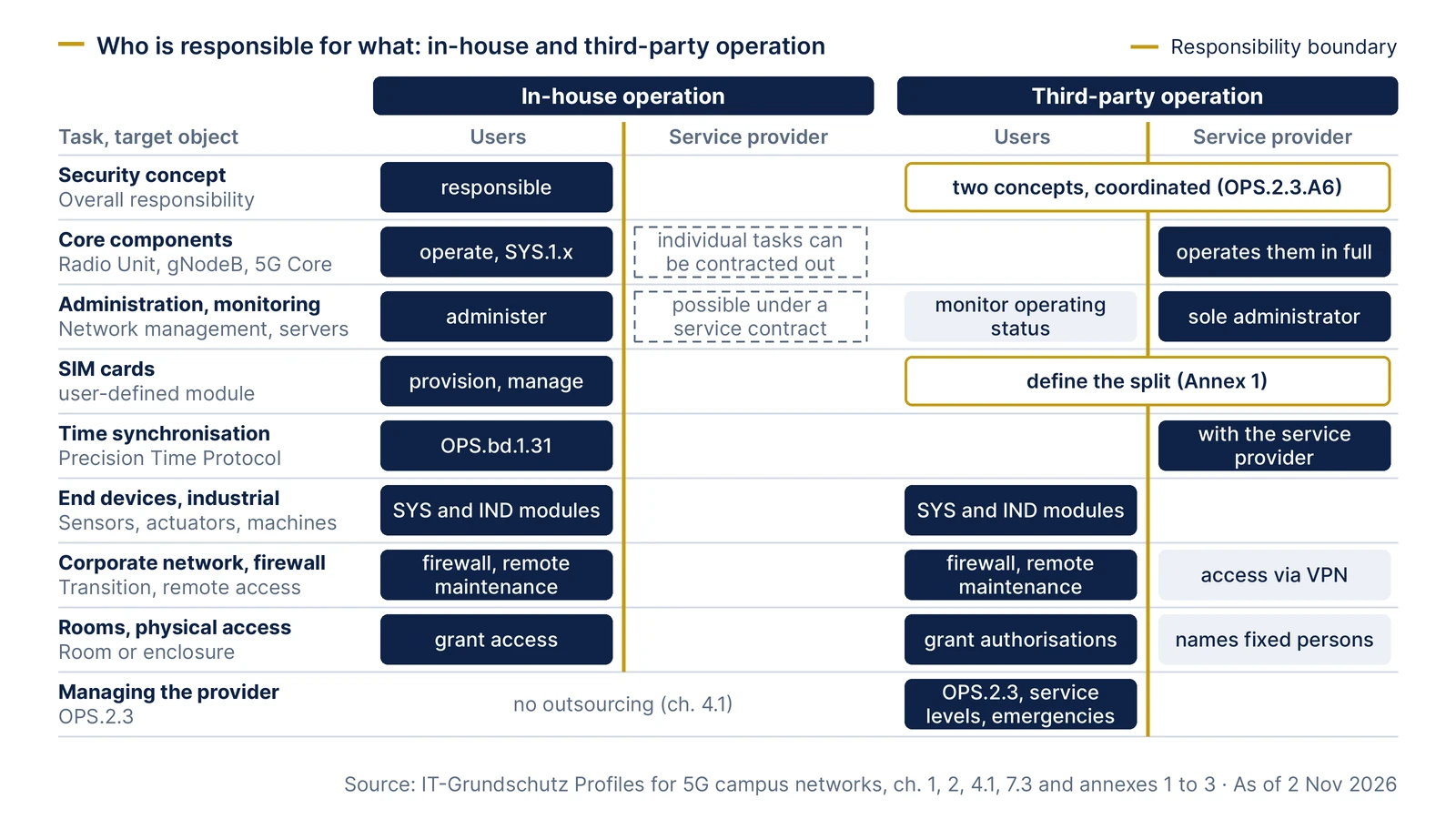
Working aid: responsibility matrix for in-house and third-party operation
For 14 tasks, the matrix compares who is responsible for them under each profile. The column "What you record" is our suggestion for the contract, service specification or security concept. If you run a mixed model, for example your own administration with an outsourced 5G Core, enter for each row which profile applies to you.
| Task, target object | In-house operation | Third-party operation | What you record (our suggestion) | Reference |
|---|---|---|---|---|
| Security concept | Users, even where individual tasks are contracted out | Users document the components and interfaces; implementation for the core components is set out in the service provider's security concept (note on OPS.2.3.A6) | Cross-reference between the two concepts, right to inspect the service provider's part | In-house ch. 2.2; third-party annex 3 |
| Core components Radio Unit, gNodeB, 5G Core | Users; server modules SYS.1.1 et seq. on the 5G Core, PTP and management servers; mobile network module | Service provider; server modules not relevant for users; work on the mobile network module jointly with the service provider | which requirements of the mobile network module the service provider evidences, and in what form | Annex 2; third-party ch. 7.3 |
| Administration, network management | Users; anyone performing specialist tasks in the network must not administer it (note on ORP.4.A4); system management can go to the service provider under a service contract, who then implements OPS.1.1.7 | Service provider exclusively (note on ORP.4.A4); it submits a role and authorisation concept (note on OPS.1.1.1.A2) | Roles, access paths, list of administrators | Annexes 1, 3 |
| Monitoring | Users (sub-process monitoring, application A5) | Service provider monitors operating parameters, the using organisation the operating status (note on OPS.1.1.1.A9) | which notifications reach you, and within what time | In-house tables 3, 4; third-party annex 3 |
| SIM cards | Users, up to their own provisioning via a SIM card management solution | Supply, provisioning and deactivation with the service provider; module partly with the organisation, partly with the service provider | who blocks a lost card, who keeps the register of card to device | In-house table 3; third-party ch. 2.1, annex 1 |
| Time synchronisation (PTP) | Users; user-defined module OPS.bd.1.31 | Service provider | Time source and its protection in the service specification | Annexes 1, 2 |
| End devices, sensors, actuators, machines | Users | Users; the same SYS and IND modules | Compatibility of the devices with the core components | Annexes 2, 4 |
| Transition to the corporate network, firewall | Users; firewalls to the management network and to the outside | Users; service provider has access via VPN through the corporate network (note on OPS.2.3.A15) | permitted connections between 5G Core and corporate network, owners of the rules | Ch. 5.3; annexes 2, 3 |
| Remote maintenance | Users; remote maintenance by external parties to be observed and logged by internal staff (note on OPS.1.2.5.A19); VPN module not relevant according to annex 2, but its requirements are met by the VPN endpoint (administration devices S9, S10) | as in-house operation; annex 2 assigns the VPN module to the service provider, annex 4 requires its requirements to be „vollständig umzusetzen“ (our translation: "implemented in full"): agree in the contract who evidences the implementation | who approves and records sessions | Ch. 5.3; annexes 2, 3 |
| Rooms, enclosure, physical access | Users; service provider only on active request (note on ORP.4.A5) | Users grant the access authorisations; the service provider names fixed persons (notes on ORP.4.A5, A6) | List of authorised persons, management of the keys to the enclosure | Annexes 2, 3 |
| Patch and change management | Users' operational patch management | with the service provider; coordinate the installation and agree it in the contract; information on vulnerabilities to IT operations (note on OPS.1.1.1.A10) | Maintenance windows, reporting of vulnerabilities | Annex 3 |
| Cryptographic concept | Users; the installation company hands over the algorithms at commissioning | Service provider prepares it in coordination with the users | Handover of the list of algorithms, coordination on changes | Annex 3 on CON.1.A10 |
| Security incidents, emergencies | Users; responsibilities with the service provider recorded in the contract (note on DER.2.1.A3) | in addition, an emergency preparedness concept as part of the contract and arrangements for failure of the service provider (notes on OPS.2.3.A20, A7) | Reporting channels, fallback processes if the network fails | Annex 3 |
| Managing the service provider | OPS.2.3 not relevant as long as there is no outsourcing | Users; requirement profiles or BIA, service levels, connection only to the corporate network (notes on OPS.2.3.A1, A14, A15) | whether your contract is outsourcing; key figures and consequences of non-compliance | Ch. 4.1; annexes 1, 3 |
Two rows need particular attention. For the SIM cards, both profiles leave open who takes on what, so you decide that. For the mobile network module, the third-party operation documents contradict each other: chapter 7.3 recommends working on it „gemeinsam mit den Mitarbeitenden des Dienstleistungsunternehmens“ (our translation: "together with the staff of the service company"), while annex 4 lists it with the note that it applies if the organisation operates the network itself. On the reference: in the Excel file for third-party operation, annex 4 is stored as the fourth sheet with the label „Anl.3 Kap.7.3 Anf. System-BS“. How to reflect requirements for service providers in Grundschutz++ is shown on the page Practice: procurement and service providers.
What makes the profiles distinctive
Protection requirements: both profiles assume that 5G campus networks are mainly used where there are elevated requirements for availability and integrity (ch. 6). For almost every module, the annexes therefore list the requirements in case of elevated protection needs that must also be checked. According to the profile, anyone who determines "normal" for all basic values can manage with the basic and standard requirements. The damage examples extend to machine malfunctions causing personal injury (table 10).
Own modules: for target objects without a suitable Compendium module, the profiles refer to user-defined modules: operation of private mobile networks (5G campus), management of SIM cards and mobile enclosure for IT systems, and in in-house operation also Precision Time Protocol. The identifiers are not consistent: the mobile network module is called NET.bd.2.3 in the text and NET.bd.3.2 in the annexes. The SIM module is CON.bd.20 in the text for third-party operation and CON.bd.1 elsewhere. The enclosure is called „Transportable Einhausung für Telekommunikationssysteme“ (our translation: "transportable enclosure for telecommunications systems") in the annexes for third-party operation. We did not find the texts of these modules on the BSI pages of the two profiles. Those pages only contain the PDF and the Excel spreadsheet.
The profiles also differ on whether the Compendium covers the core components. In-house operation states that the 5G Core, gNodeB and Radio Unit can „grundsätzlich“ (our translation: "in principle") be represented with existing modules (ch. 7.3). Third-party operation states: „Für diese Geräte gibt es im IT-Grundschutz-Kompendium keinen Baustein.“ (our translation: "There is no module for these devices in the IT-Grundschutz Compendium.") (ch. 7.3).
Threats: chapter 8 contains a consolidated table of the elementary threats for enclosure, SIM card and network operation, and adds a threat of its own, „eG.1 Blitzschlag und Überspannung“ (our translation: "eG.1 lightning strike and overvoltage"), for outdoor antennas (table 13). As an example of risk treatment, both profiles name an additional firewall at the transition between the 5G campus network and the corporate network (ch. 8, step 4). For these target objects and for all target objects with elevated protection requirements, both profiles require a risk analysis (ch. 7.3, 8).
How to handle target objects without sufficient catalogue coverage in Grundschutz++ is described on the page Risk analysis.
Does the profile fit your network?
It fits if
- your network is a local 5G standalone network without a connection to the public mobile network or the internet, and all core components are on your premises,
- you use physical SIM cards and a single quality of service class without prioritisation,
- service providers only access the campus network via your corporate network,
- for in-house operation: you retain responsibility for operation and service providers take on one or more tasks, such as delivery, maintenance or system management under a service contract, without this being outsourcing within the meaning of OPS.2.3,
- for third-party operation: a service provider supplies and operates the core components in full and you cannot change them.
It does not fit, or only partly, if
- the 5G Core or gNodeB run in a cloud or at a network operator (explicitly excluded for in-house operation, ch. 4.2),
- end devices are also meant to use the public mobile network or the corporate network,
- you use eSIM or iSIM, use WLAN sidelink or prioritise traffic,
- your network runs as a non-standalone network with an LTE core network,
- you administer some parts yourself and outsource others: then you need both profiles and the matrix above, row by row.
For every deviation, both profiles require the additional target objects to be documented in the structure analysis and assigned to suitable modules (ch. 5.5).
Route to Grundschutz++: what the draft mapping covers
Both 5G profiles model according to BSI Standard 200-2 with modules from the 2023 Compendium, and the boundary between in-house and third-party operation lies in exactly this selection of modules. We therefore applied the draft mapping from IT-Grundschutz 2023 to Grundschutz++ from the State-of-the-Art Library (Stand-der-Technik-Bibliothek) (status draft, as of 21 July 2026) separately for each profile to the modules that its annexes 1 and 2 mark as relevant, including the operating system modules that are only conditionally relevant. „SYS.1.2 Windows Server 2012“ from the annexes corresponds to SYS.1.2.2 in the 2023 Compendium. We resolved the target requirements against the user catalogue (Anwenderkatalog) build 2026-10-29. The difference between the two columns shows what the responsibility boundary amounts to in Grundschutz++. None of the figures implies full coverage, because they count assignments in a draft.
| Count | In-house operation | Third-party operation |
|---|---|---|
| Compendium modules (relevance yes or yes*) | 59 | 53 |
| 2023 requirement identifiers in these modules | 1,154, of which 178 marked as withdrawn | 1,021, of which 154 marked as withdrawn |
| Identifiers with at least one assignment in the draft mapping | 313 | 284 |
| distinct target requirements in Grundschutz++, resolved in the catalogue | 259 in 17 practices | 247 in 18 practices |
| Target references that cannot be resolved in the catalogue | 10, all to the identifier VRB.1.2 | 10, all to the identifier VRB.1.2 |
| user-defined modules, in no mapping | Mobile network, SIM cards, enclosure, Precision Time Protocol | SIM cards, enclosure; mobile network recommended according to ch. 7.3 |
52 modules are the same in both profiles. Only in-house operation includes system management OPS.1.1.7 and the server modules SYS.1.1, SYS.1.2.2, SYS.1.2.3, SYS.1.3, SYS.1.5 and SYS.1.6. Only third-party operation includes OPS.2.3 Use of Outsourcing. Notable for the responsibility boundary: for ORP.4 Identity and Access Management, on which the profiles base segregation of duties, physical access and system access between users and service provider, the draft contains no assignment for any of the 24 identifiers. Of the 24 identifiers in OPS.2.3, two are assigned.
Example 1, both profiles: firewall at the transition to the corporate network. Profile reference: annex 2 models NET.3.2 Firewall onto the firewalls of the corporate network, chapter 8 names an additional firewall between the 5G campus network and the intranet as an example of risk treatment. 2023 requirement: NET.3.2.A2 „Festlegen der Firewall-Regeln“ (our translation: "defining the firewall rules") (basic). Draft mapping: the implementation aspects UA.2 to UA.5 are assigned, among them UA.3 as equivalent to ARCH.2.2 „Einschränkung von Verbindungen zwischen Segmenten“ (our translation: "restriction of connections between segments") and as equal to ARCH.5.2 „Blockieren direkter öffentlicher Verbindungen“ (our translation: "blocking direct public connections"), plus subset relationships to ARCH.2.2.1 „Externe Netzanschlüsse“ (our translation: "external network connections") and ARCH.5.1 „Einschränkung und Inspektion von Verbindungen“ (our translation: "restriction and inspection of connections"). Gap: the target requirements are listed with SOLLTE (SHOULD) or KANN (MAY) in the catalogue, while the 2023 requirement is a basic requirement with MUSS (MUST). Assignments exist only for UA.2 to UA.5. NET.3.2.A2 also explicitly requires naming those responsible for designing, implementing and testing the filter rules and clarifying who may change them. The assigned target requirements do not cover this. In third-party operation, this responsibility for the rules between the 5G Core and the corporate network belongs in the matrix above.
Example 2, third-party operation: risk-oriented outsourcing. Profile reference: annex 3 on OPS.2.3 requires a business impact analysis or requirement profiles as process fact sheets for all processes that run over the campus network. 2023 requirement: OPS.2.3.A2 „Verfolgung eines risikoorientierten Ansatzes im Auslagerungsmanagement“ (our translation: "pursuing a risk-oriented approach in outsourcing management") (basic), which builds on these requirement profiles. Draft mapping: UA.4 equivalent to DLS.3.2 „Checkup“, UA.1 overlapping with UMS.2.2 „Priorisierung von Maßnahmen“ (our translation: "prioritisation of safeguards") (still listed in the mapping file under the old identifier UMS.3.2, resolved via the unique identifier). Gap: DLS.3.2 is listed with KANN at the security level elevated (erhöht). The regular and event-driven reassessment that OPS.2.3.A2 requires as MUSS therefore only reappears as a KANN requirement, to the extent that the draft assigns it to DLS.3.2. The requirement profiles themselves (OPS.2.3.A1) have no assignment.
Example 3, third-party operation: split security concept. Profile reference: annex 3 on OPS.2.3.A6, the using organisation's security concept documents the components, the service provider's documents the implementation. 2023 requirement: OPS.2.3.A6 „Festlegung von Sicherheitsanforderungen und Erstellung eines Sicherheitskonzeptes für das Outsourcing-Vorhaben“ (our translation: "defining security requirements and preparing a security concept for the outsourcing project") (basic). Draft mapping: no assignment. Gap: the entire requirement. In our assessment, DLS.1.1 „Verfahren und Regelungen“ (our translation: "procedures and rules") and DLS.3.1 „Einhaltung der Sicherheitsvorgaben“ (our translation: "compliance with the security specifications") in the catalogue are candidates. This assignment is ours and does not come from the draft.
The user-defined modules are missing from every mapping. You adopt their requirements as your own requirements in the requirements package. To do so, check which target object categories you assign the 5G Core, gNodeB, SIM cards and enclosure to (page Modelling with target object categories). How to check individual assignments in the draft is shown on the page Checking the IT-Grundschutz 2023 mapping.
Rights notice: Quotations and information from the two IT-Grundschutz Profiles for securing 5G campus networks and their annexes, publisher Bundesamt für Sicherheit in der Informationstechnik; the documents contain no licence or copyright notice. Sources: BSI page in-house operation, BSI page third-party operation, retrieved on 2 November 2026. Quotation from BSI Standard 300-1 © Bundesamt für Sicherheit in der Informationstechnik 2026. Requirement and module titles from the IT-Grundschutz-Kompendium, Edition 2023, © 2023 Reguvis Fachmedien GmbH and © 2023 Bundesamt für Sicherheit in der Informationstechnik. This content is not licensed under CC BY-SA 4.0. The quotations are unchanged, the summaries are our own. The licence notice at the end of the page applies to the extracts from catalogue and mapping data.
What this page does not decide
Both profiles point out that a 5G campus network may only be operated within the locally assigned area and in the approved frequency bands (ch. 5.4), and the annexes include this as a note on ORP.5. We do not interpret frequency or telecommunications law: who holds the assignment, which conditions apply and what a service provider takes on from them is for you to clarify with your legal department and the competent authority.
Chapter 3 of the profiles (framework conditions) refers to the BSI Act (BSIG) and operators of critical infrastructure (KRITIS). That is the legal position at the time the profiles were written (2022 to 2024). Whether and how your organisation falls under the BSI Act today is not assessed on this page. Both 5G profiles describe a generic isolated solution. Which target objects your campus network actually has only emerges from your own structure analysis (ch. 5.5, 9), and the profile does not serve as evidence towards supervisory authorities or clients. We have not checked the mapping to ISO/IEC 27001:2022 in the Excel annexes.
Support
Blackfort Technology's team supports you in defining the responsibility boundary for your campus network, checking the matrix against your contract and security concept, and transferring the requirements of both profiles into a requirements package under Grundschutz++. The packages are on the page Consulting. For information security in telecommunications in general, see the company website at https://www.blackfort-tec.de/en.