

What BSI Standard 200-1 covers
200-1 is the management standard of the 200 series. It replaces BSI Standard 100-1 (chapter 1.1) and answers questions at top management level: what the success factors are, how the security process is steered and monitored, how security objectives and strategy are developed and how a level once achieved is maintained (chapter 1.4). For how the individual steps work under IT-Grundschutz, 200-1 refers to 200-2. The requirements for implementation are in the IT-Grundschutz Compendium.
200-1 names management principles, resources, staff and the security process with policy, security concept and security organisation as the components of an ISMS (chapter 3.1). The policy documents top management's strategy. The security organisation and the security concept are the tools used to implement it.
One detail is helpful for existing ISMS: 200-1 marks „jede Aktion, die angemessen dokumentiert bzw. aufgezeichnet werden muss“ (our translation: "every action that must be appropriately documented or recorded") with „[DOK]“ (chapter 4.2). This marking is a good starting point for an inventory of documents. Anyone who has worked under 200-1 should have a document for each [DOK] item or know that it is missing. The adoption check below starts exactly there.
Annotated reading path through 200-1
The table takes you through the chapters and says what reading them is still worth today and where to continue in 300-1. The comments are our assessment. The chapter references point to the originals.
| Chapter of 200-1 | Content in brief | What you read it for today | Continue in 300-1 |
|---|---|---|---|
| 1-2 Introduction, norms and standards | Objectives, target groups, overview of ISO standards, BSI publications and other standards. | For context. The overview of standards reflects the state of 2017. The bibliography cites ISO/IEC 27001:2013. | Chapters 2 and 3 map the process steps to the clauses of DIN EN ISO/IEC 27001. |
| 3 ISMS definition, life cycle | Components of an ISMS, PDCA life cycle. | As a terminology framework for your own ISMS description. | Introduction: five process steps in the PDCA cycle. |
| 4 Management principles | Tasks of top management, communication and documentation, monitoring of success, improvement. | For top management responsibility and the formal requirements for documentation (chapter 4.2). | Chapter 2.9 documentation and communication, chapter 2.10 definition and approval, chapter 5.3 management reviews. |
| 5-6 Resources, staff | Resource planning and involvement of employees. | As supporting arguments when dealing with top management. | Chapter 2.10 (approval of resources), chapter 4.4 (responsibilities, competences). Awareness in the user catalogue (Anwenderkatalog) as practice (Praktik) SENS. |
| 7 The security process | Framework conditions, security objectives and policy, scope, security organisation, maintenance, improvement. | For the policy, scope and organisation you want to carry over into a Grundschutz++ ISMS. | Chapters 2.1-2.8, chapter 3.1. |
| 8 Security concept | Risk method, risk classification, risk treatment strategy, selection of safeguards, implementation plan, monitoring of success, management review. | For your existing risk policy and your implementation plan. | Chapter 2.11 and Annex 3 (risk), chapters 4.3-4.5 (implementation planning), chapter 5 (monitoring). |
| 9 Certification of the ISMS | Certification according to ISO/IEC 27001, ISO 27001 certification on the basis of IT-Grundschutz. | As background. The procedure itself is covered on the page Certification. | Milestone plan: applications on the basis of Grundschutz++ from 1 Jan 2027. |
| 10 ISMS on the basis of IT-Grundschutz | Brief outline of the IT-Grundschutz methodology and the integrated risk assessment. | As a bridge to 200-2. For the actual work, read BSI Standard 200-2. | Chapter 2.11 (implicit and explicit risk assessment), Annex 4. |
How 200-1, 200-2, ISO 27001 and 300-1 fit together
In the classic world, 200-2 builds on 200-1 and thus on ISO 27001 (200-2, chapter 1.2). 200-1 itself states that an approach based on IT-Grundschutz is fully compatible with ISO/IEC 27001, meaning the version cited in 2017, ISO/IEC 27001:2013, and refers to 200-2 for the detailed description (200-1, chapters 10.1 and 11.1). For ISO 27001 certification on the basis of IT-Grundschutz, the BSI scheme uses the Compendium and the BSI Standards 200-x as audit catalogues, according to 200-2 chapter 11.
300-1 takes a different route. Instead of referring to a management standard of its own, 300-1 refers directly to the norm: in process step 1 the activities from clauses 4 and 5 of DIN EN ISO/IEC 27001 are carried out, in process step 2 those from clauses 6 and 10 (300-1, chapters 2 and 3). According to chapter 3.4, the requirements of the methodology practices in the user catalogue reflect clauses 4 to 10 of the norm. In our reading, 300-1 itself and the methodology requirements of the catalogue thus take over the role that 200-1 had in classic IT-Grundschutz.
There is no statement on the status of 200-1: 300-1 names neither 200-1 nor 200-2 or 200-3, and the BSI milestone plan only governs the end of certifiability of classic IT-Grundschutz on 30 November 2031. Anyone running an ISMS under 200-1 today therefore does not have to discard it. They should, however, check which documents already cover the requirements of 300-1.
Where 300-1 goes beyond 200-1
The comparison only shows points that stand out when documents are carried over. The full overview of changes between classic IT-Grundschutz and Grundschutz++ is in the comparison of IT-Grundschutz 2023 and Grundschutz++.
| Topic | BSI Standard 200-1 | BSI Standard 300-1 |
|---|---|---|
| Top management responsibility | Overall responsibility remains with top management. The operational task is typically delegated to an information security officer (ISB) (chapters 4.1, 7.2). | As in 200-1, responsibility remains with top management. 300-1 states expressly that it cannot be delegated. 200-1 already provides for decision papers (chapter 3.2.2). What is new is a list of topics on which decision papers are submitted to top management „insbesondere“ (our translation: "in particular"): scope, protection requirements, order of the business processes, resources and policy (chapter 2.10). |
| Policy | Minimum content such as significance, relation to business objectives, security objectives, assurance of enforcement, organisational structure (chapter 7.1). | Commitment of top management, specific and measurable objectives (e.g. SMART), strategy, organisation. Approval by top management, communication to all staff (chapter 2.7). |
| Context and stakeholders | Analysis of the environment with internal and external parties as part of the framework conditions (chapter 7.1). | Separate steps for context (chapter 2.1), compliance management (chapter 2.2) and analysis of interested parties (chapter 2.4). |
| Documentation | [DOK] marking and formal requirements: up to date, stored for use, author and date identifiable (chapter 4.2). | „Ein Verfahren zur Lenkung mindestens aller für das ISMS relevanten Dokumente muss eingerichtet und verankert werden.“ (our translation: "A procedure for controlling at least all documents relevant to the ISMS must be set up and embedded.") (chapter 2.9) |
| Security organisation | At least one person coordinates, typically as ISB. The role should be organised as a staff unit (chapter 7.2). | Roles with qualifications and competences, avoidance of conflicts of interest (head of IT and ISB, DPO and ISB), defined involvement of the ISB in security-relevant projects (chapter 2.8). |
| Risk method | A method must be chosen and documented. Classification, risk treatment strategy, risk appetite (chapter 8.1). | Method freely selectable, provided 35 mandatory minimum criteria (Mindestkriterien) are met. Top management authorises risk appetite and acceptance criteria (chapter 2.11, Annex 3). |
| Implementation plan | Priorities, responsibilities, resources, deadlines and costs (chapter 8.2). | Each safeguard linked to its requirement, date and documenting or reviewing person, evidence assigned, progress tracking without conflict of interest (chapters 4.3-4.5). |
| Review | Internal audits should take place regularly and should not be carried out by those who did the planning (chapter 7.4). Check compliance as well as suitability and effectiveness (chapter 8.3). | Internal audit programme with objectives, risks of the programme and selection of the audit team (chapter 5.2). Validation of the requirements (chapter 5.5). |
| Indicators | Achievement of objectives can be monitored with indicators, for example (chapter 4.1). | Performance evaluation required. Uniform specifications are still pending, organisations are free to design it (chapter 5.1). According to the milestone plan, a concept and indicators will follow in February and March 2027. |
Adoption check for existing management documents
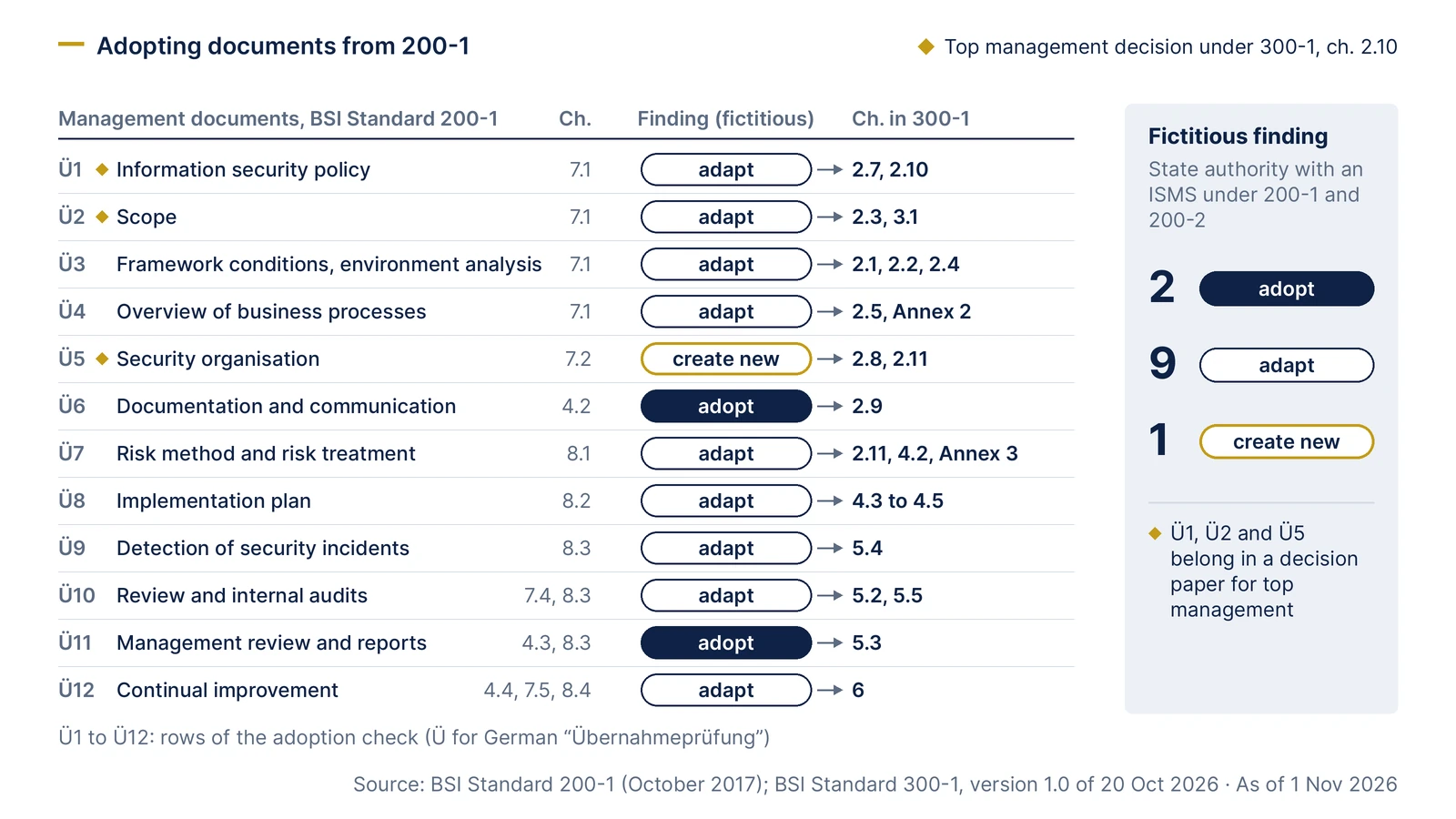
The check goes through the main documents that 200-1 marks with [DOK]. Risk analysis and selection of safeguards (chapter 8.1) are checked together with Ü7, steering and control of implementation (chapter 8.2) together with Ü8. Four documents that 200-1 covers without this marking have been added (Ü3, Ü4, Ü6, Ü12). For each row the check asks whether the document already covers the corresponding part of 300-1. The result per row is one of three decisions: adopt, adapt or create new. The check questions are our working aid. The binding text is that of 300-1 at the place indicated.
The last column shows a fictitious finding for a state authority (Landesamt) with an ISMS under 200-1 and 200-2. It is meant to illustrate the application and does not replace a check of your documents.
| No. | Document (200-1) | Counterpart in 300-1 | Check question for adoption | Fictitious finding and decision |
|---|---|---|---|---|
| Ü1 | Information security policy (chapter 7.1) | Chapters 2.7, 2.10 | Does it contain measurable objectives and a strategy for them? Is top management's commitment explicit? Is approval by top management documented and is communication to all staff evidenced? | Objectives only formulated qualitatively, approval documented in 2021: adapt (make objectives measurable, approve again). |
| Ü2 | Scope (chapter 7.1) | Chapters 2.3, 3.1 | Are the business processes considered fully included? Are organisational units, sites, applications, IT systems, service providers and exclusions named? | Scope cut along organisational units, service providers missing: adapt, see Information domain. |
| Ü3 | Framework conditions and analysis of the environment (chapter 7.1) | Chapters 2.1, 2.2, 2.4 | Are external and internal factors documented? Is there a register of legal requirements and a list of contractual obligations? Are interested parties recorded with requirement and priority, and are the binding obligations agreed with top management? | Analysis of the environment available, no stakeholder list: adapt. |
| Ü4 | Overview of business processes (chapter 7.1 as a topic of the strategy) | Chapter 2.5, Annex 2 | Are the business processes within the scope documented and is their purpose for the organisation's objectives recognisable (chapter 2.5)? If there is no process map: does each process have the minimum information of the simplified analysis under Annex 2 (identifier, name, person, role or organisational unit responsible for the subject matter, short description, main applications)? | Process list without responsible persons: adapt, see Structure analysis and Protection requirements determination. |
| Ü5 | Security organisation (chapter 7.2) | Chapters 2.8, 2.11 | Are roles described with qualifications and competences? Have the conflicts of interest between head of IT and ISB and between DPO and ISB been checked? Is it defined when the ISB is involved in projects? Is there a risk owner role? | ISB is also deputy head of IT, no risk owner: create new (organisational decision by top management). |
| Ü6 | Rules on documentation and communication (chapter 4.2) | Chapter 2.9 | Is there a document control procedure that ensures traceability, currency and completeness across the life cycle? Are internal and external communication governed, including for security-relevant projects? | Document control via quality management in place: adopt, include ISMS documents. |
| Ü7 | Risk method, risk classification, risk treatment strategy (chapter 8.1) | Chapters 2.11, 4.2, Annex 3 | Are risk appetite and acceptance criteria defined separately and authorised by top management? Does the method meet all 35 minimum criteria? | Risk policy under 200-3, risk appetite not defined: adapt, see Checking the risk method. |
| Ü8 | Implementation plan (chapter 8.2) | Chapters 4.3-4.5 | Is each safeguard linked to the requirements it addresses? Are the date and the documenting or reviewing person recorded, evidence assigned, responsibilities and deadlines named? | List of safeguards without reference to requirements: adapt, see Evidence plan. |
| Ü9 | Detection of security incidents (chapter 8.3) | Chapter 5.4 | Are the three procedures embedded: detection of security incidents, handling of vulnerabilities and response to newly emerging threats, the last two with feedback into the risk assessment? | Incident procedure in place, vulnerability procedure without feedback into risk: adapt. |
| Ü10 | Review of compliance, suitability and effectiveness; internal audits (chapters 7.4, 8.3) | Chapters 5.2, 5.5 | Is there an internal audit programme with objectives, assessed programme risks and a justified selection of the audit team? Are the requirements validated regularly? | Annual individual audits without a programme: adapt. |
| Ü11 | Management review and management reports (chapters 4.3, 8.3) | Chapter 5.3 | Does the report take into account audit results, performance evaluation, security incidents, status of risk treatment, changes in the organisation and the threat situation, and the status of earlier decisions? | Report covers everything except performance evaluation: adopt, extend the structure. |
| Ü12 | Documents on continual improvement (chapters 4.4, 7.5, 8.4) | Chapter 6 | Are nonconformities recorded with root cause analysis? Is there a correction and improvement plan with responsibilities and effectiveness review? | Actions from audits without root cause analysis: adapt. |
Evaluation of the fictitious example: two documents can be adopted, nine need to be adapted, one has to be created new. The decisions on Ü1, Ü2 and Ü5 are top management decisions under 300-1 chapter 2.10 and belong in a decision paper. Where a check question touches on statutory or contractual requirements (Ü3), we classify the requirements you name or that are in your documents. Whether they apply legally is checked by your legal department.
200-1 and an ISMS under ISO 27001
If you built your ISMS under ISO 27001 and only used 200-1 for orientation, you can apply the adoption check in the same way. In process steps 1 and 2, 300-1 refers expressly to clauses 4, 5, 6 and 10 of DIN EN ISO/IEC 27001. Whether a certificate under ISO 27001 or under ISO 27001 on the basis of IT-Grundschutz is the right evidence is covered on the certification page.
Blackfort Technology offers consulting on an ISMS under ISO 27001 without reference to Grundschutz on its company website. For existing Grundschutz ISMS, Blackfort Technology supports the assessment of the existing documents and plans with you the order in which they are adapted.
- Evidence and procedure: Certification
- All changes at a glance: Comparison of IT-Grundschutz 2023 and Grundschutz++
- What 300-1 requires as a whole: BSI Standard 300-1
- Transferring an existing ISMS: Migration to Grundschutz++
- Commissioning an assessment of the existing documents: Readiness and migration concept
- ISO 27001 consulting: https://www.blackfort-tec.de/en
Rights notice: Quotations from BSI Standard 300-1 © Bundesamt für Sicherheit in der Informationstechnik 2026, source: BSI, Grundschutz++. Quotations and information from BSI Standard 200-1 and information from BSI Standard 200-2 © Bundesamt für Sicherheit in der Informationstechnik, sources: BSI Standard 200-1, BSI Standard 200-2. They are not licensed under CC BY-SA 4.0.