
What you need to know about OSCAL for the import
OSCAL, the Open Security Controls Assessment Language, is an initiative led by NIST for machine-readable formats in XML, JSON and YAML. The models are arranged in layers: the control layer with catalog, profile and control mapping, the implementation layer with component definition and system security plan, and the assessment layer with assessment plan, assessment results and plan of action and milestones. Each layer uses the information of the layer below, and the same content can be converted between XML, JSON and YAML without loss (NIST, project page and the page "OSCAL Models"). For importing the Grundschutz++ catalogue you need little of this: the catalog model, the profile from which the resolved catalogue is created and, for legacy data, the mapping model.
The library arranges its files in layers accordingly: the control layer holds catalogues, profiles, resolved catalogues and mappings, the implementation layer component definitions; according to the README, the assessment layer is intended for future artefacts relating to assessments. The README also states that resolved catalogues can be „direkt in einer Institution verwendet werden“ (our translation: "used directly in an organisation").
For a clean import, the identifiers matter most. Each level has its own, and not all of them stay the same between two builds:
Which file serves which purpose is described on the page Grundschutz++ user catalogue; this page deals with handling it technically.
| Identifier | Where in the JSON | Value in build 2026-10-29 | Behaviour between builds |
|---|---|---|---|
| Document identifier | catalog.metadata.document-ids[0].identifier | ebe77c16-3ddc-42ce-8d53-eff5b6e23334 | the same in the build of 22 Oct 2026; the BSI schema describes it as stable across versions |
| Catalogue UUID | catalog.uuid | d3fb98e5-14c6-4522-975c-a9a605e46a37 | new for each build (22 Oct 2026: 81573937-…) |
| Version | catalog.metadata.version | timestamp 2026-10-29T08:03:12.736989+00:00 | new for each build; no sequential version number |
| OSCAL version | catalog.metadata.oscal-version | 1.1.3 | the mapping IT-Grundschutz 2023, by contrast, uses 1.2.1 |
| Requirement identifier | controls[].id | e.g. BER.3.11 | can be reassigned (see mapping below) |
| Requirement UUID | controls[].props[name=alt-identifier] | exactly one per requirement, 1,000 distinct | stays the same; the right key for comparisons |
| Title | controls[].title | e.g. „Verfahren und Regelungen“ (our translation: "procedures and rules") | changes and is not unique: 14 titles are shared by 89 requirements |
Step 1: retrieving the catalogue reproducibly
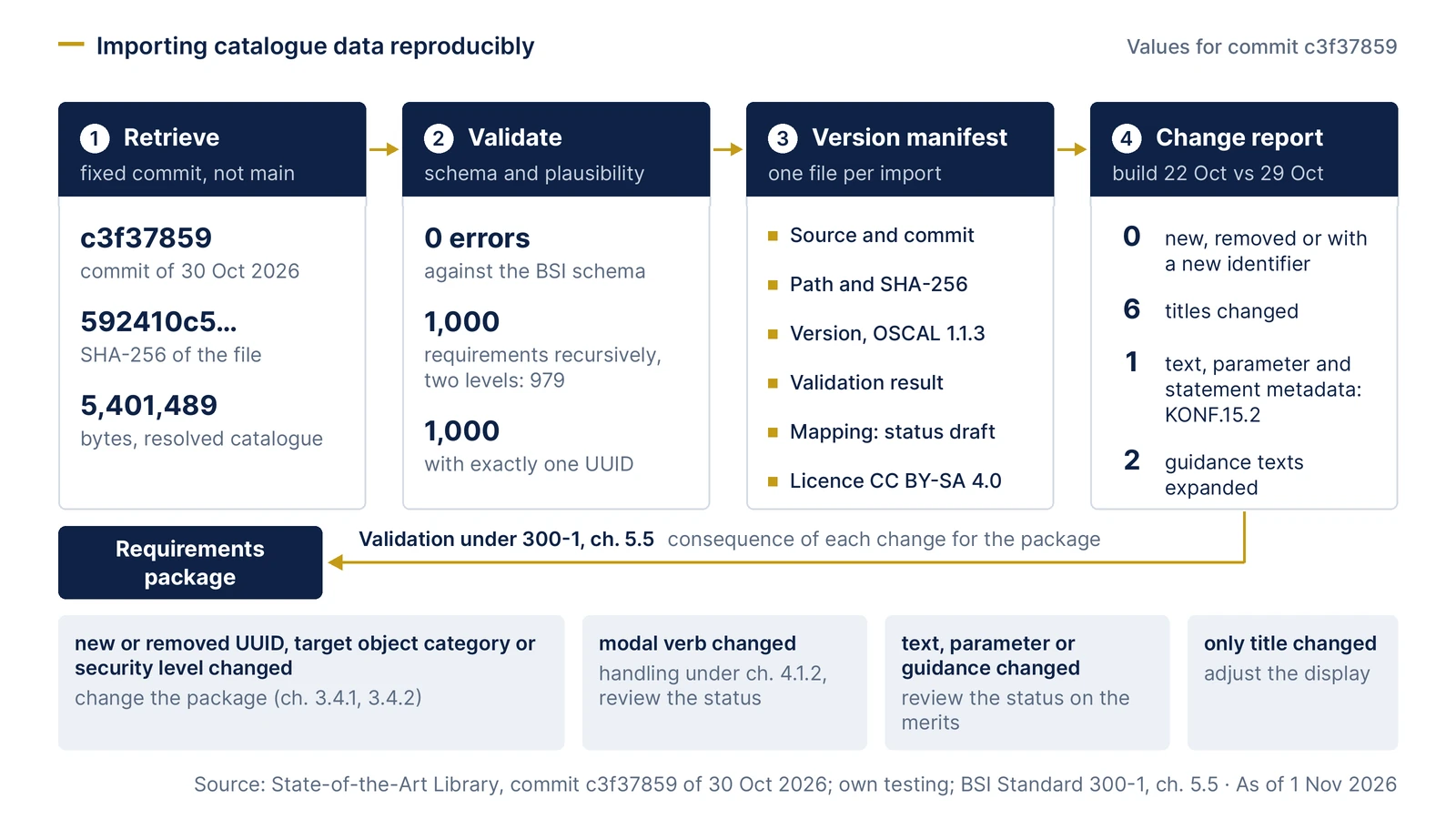
Always download the file from a fixed commit and record the checksum; the state of main changes with every publication. Only then can you show later which text a requirements package, a count or an assessment result refers to.
C=c3f37859fdf302394de39e89252eb3e72a45953c
P='control_layer/Grundschutz++/Grundschutz++-resolved_catalog.json'
curl -fsSL -o catalogue.json "https://raw.githubusercontent.com/BSI-Bund/Stand-der-Technik-Bibliothek/$C/$P"
sha256sum catalogue.json
# 592410c513691c18631402db3982dda6a4530dd6f2960868a6999017d311fa28  catalogue.json
You should know three peculiarities of the library:
- Build date and commit date differ. The build of 29 October 2026 (field
last-modified) reached the repository on 30 October 2026. The BSI publishes the files via pull requests titled "chore: publish rolling artifacts". Record both. - Paths have changed. With the commit "Migrate public library to layer-based structure" of 27 July 2026, the library got its current folder structure. Anyone retrieving older states needs the paths of that time.
- The file is large, but not huge. In state c3f37859 the resolved catalogue has 5,401,489 bytes. That is fine for any script, but too much to compare changes by hand.
Step 2: validating schema and content
Validating means two things here: does the file match the schema, and is its content plausible? For the schema, the BSI publishes the file documentation/datamodel/oscal_satzschablone_schema.json in the repository, described as a JSON schema for BSI OSCAL catalogues "based on OSCAL 1.1.3 with BSI-specific extensions". It checks the structure and only allows the known names for properties, including the BSI's own such as modal_verb, sec_level and threats. It does not check their values, and it does not require a requirement to have these fields; that is what the content checks below are for.
Our test on 1 November 2026: the resolved catalogue from commit c3f37859 passes validation against this schema without errors (Python library jsonschema 4.10.3, validator for JSON Schema Draft 7). One pitfall: the field $id in the schema points to the path "Dokumentation/datamodel/…", under which GitHub delivered nothing on 1 November 2026 (HTTP 404); the file is located under "documentation/datamodel/…". So load the schema from the same commit as the catalogue and not via the $id. In addition, you can validate against the general OSCAL schema of the version stated in the field oscal-version. The NIST page "OSCAL Models" links the XML and JSON schemas for each model; the catalogue is governed by the schema of the catalog model, the mapping by that of the control mapping model.
The schema is followed by content checks. The example counts the requirements recursively across all levels and checks that each has exactly one unique UUID:
import json

cat = json.load(open('catalogue.json', encoding='utf-8'))['catalog']

def requirements(node):
    for group in node.get('groups', []):
        yield from requirements(group)
    for c in node.get('controls', []):
        yield c
        yield from requirements(c)

all_reqs = list(requirements(cat))
uuid_to_id = {}
for c in all_reqs:
    uuids = [p['value'] for p in c.get('props', []) if p['name'] == 'alt-identifier']
    assert len(uuids) == 1, c['id']
    uuid_to_id[uuids[0]] = c['id']
print(len(all_reqs), len(uuid_to_id))   # 1000 1000
We run these checks on every import. The right-hand column shows the result for commit c3f37859.
| Check | Why | Result c3f37859 |
|---|---|---|
| Checksum against manifest | file unchanged since retrieval | identical |
| Schema oscal_satzschablone_schema.json | structure and permitted field names; the schema does not check values | 0 errors |
| Number of requirements, recursive | tools that read only two levels lose requirements | 1,000 (two levels: 979) |
| exactly one UUID per requirement, all distinct | basis for change report and mapping | 1,000 of 1,000 |
| modal verb in the requirement text and in the field modal_verb identical | field and sentence must not contradict each other | fulfilled |
| threat identifiers in the field threats appear in basethreats.csv | no unknown identifiers | fulfilled |
| security level elevated (erhöht) only with KANN (MAY) (300-1, ch. 3.4.2) | make known deviations between catalogue and standard visible | three exceptions: BES.1.4, DET.4.12.1, REA.2.5 |
Step 3: creating a version manifest
The manifest is a small file that sits next to every import. It answers the questions that auditors and you yourself will ask later: Which state? From where? Checked with what? With what result? The values in the example are the real values of 1 November 2026; the structure is our proposal.
{
  "source": "https://github.com/BSI-Bund/Stand-der-Technik-Bibliothek",
  "commit": "c3f37859fdf302394de39e89252eb3e72a45953c",
  "commit_date": "2026-10-30T10:01:58Z",
  "retrieved": "2026-11-01",
  "files": [
    {
      "path": "control_layer/Grundschutz++/Grundschutz++-resolved_catalog.json",
      "sha256": "592410c513691c18631402db3982dda6a4530dd6f2960868a6999017d311fa28",
      "title": "Anwenderkatalog Grundschutz++",
      "last_modified": "2026-10-29T08:03:17.266980922Z",
      "version": "2026-10-29T08:03:12.736989+00:00",
      "oscal_version": "1.1.3",
      "document_id": "ebe77c16-3ddc-42ce-8d53-eff5b6e23334",
      "requirements": 1000
    },
    {
      "path": "control_layer/Mappings/IT-GS2023-zu-GSpp/ITGS-to-GS++-mapping_collection.json",
      "sha256": "df7ea11261ace956a3ebb440f60928851a4815f5545775ac9b24e4d3d22f267f",
      "last_modified": "2026-07-21T07:57:12Z",
      "oscal_version": "1.2.1",
      "status": "draft",
      "mappings": 1185
    }
  ],
  "schema": {
    "path": "documentation/datamodel/oscal_satzschablone_schema.json",
    "sha256": "11f01d7f1525a5a16ec7f3f065a4ccbe045514c75b76ffe975c9a32061f4b1af",
    "result": "0 errors (jsonschema 4.10.3, Draft 7)"
  },
  "licence": "CC BY-SA 4.0"
}
Pay attention to three fields that the catalogue itself does not provide: the status of the mapping (draft), the licence and the tool used for validation. If component definitions from the implementation layer are part of your import, include them with path and checksum. The manifest is also good evidence for the validation of the requirements that 300-1 provides for in chapter 5.5: there, adjustments to the requirements of the State-of-the-Art Library are expressly listed among the aspects the validation should cover.
Step 4: the change report between two builds
A new build has only been adopted once you know what has changed. You produce the report by placing both builds side by side via the UUID of the requirements and comparing, for each UUID, identifier, title, requirement text, parameters, guidance and the metadata of the requirement (such as security level and threats) and of the requirement statement (such as modal verb and target object categories). Comparing via the identifier is not enough, because the BSI reassigns identifiers; comparing via the title does not work at all, because titles occur more than once.
def snapshot(file):
    cat = json.load(open(file, encoding='utf-8'))['catalog']
    res = {}
    for c in requirements(cat):
        u = next(p['value'] for p in c['props'] if p['name'] == 'alt-identifier')
        stmt = next(t for t in c['parts'] if t['name'] == 'statement')
        res[u] = {'id': c['id'], 'title': c['title'], 'text': stmt['prose'],
                  'params': json.dumps(c.get('params', []), sort_keys=True),
                  'guidance': next((t.get('prose') for t in c['parts'] if t['name'] == 'guidance'), None),
                  'props': json.dumps(c.get('props', []), sort_keys=True),
                  'stmt_props': json.dumps(stmt.get('props', []), sort_keys=True)}
    return res

old, new = snapshot('catalogue-2026-10-22.json'), snapshot('catalogue-2026-10-29.json')
print('new:', [new[u]['id'] for u in new.keys() - old.keys()])
print('removed:', [old[u]['id'] for u in old.keys() - new.keys()])
for u in old.keys() & new.keys():
    for field in ('id', 'title', 'text', 'params', 'guidance', 'props', 'stmt_props'):
        if old[u][field] != new[u][field]:
            print(new[u]['id'], field, old[u][field], '|', new[u][field])
Result for the build of 22 October 2026 (commit 9fb19de7 of 23 October 2026) against the build of 29 October 2026 (commit c3f37859): 1,000 requirements in both, none new, none removed, no identifier changed. Six titles changed, one requirement text together with parameter and statement metadata, and two guidance texts. The report with our assessment of the substance:
| Requirement | Change | before | after | Assessment |
|---|---|---|---|---|
| KONF.2.3 | Title | „Änderung von Default-Zugangsdaten“ (our translation: "changing default credentials") | „Default-Zugangsdaten in IT-Systemen“ (our translation: "default credentials in IT systems") | previously the same title as KONF.10.3; text unchanged, no consequence in substance |
| KONF.10.3 | Title | „Änderung von Default-Zugangsdaten“ (our translation: "changing default credentials") | „Default-Zugangsdaten in Anwendungen“ (our translation: "default credentials in applications") | as KONF.2.3 |
| KONF.2.5 | Title | „Überprüfung der Konfiguration“ (our translation: "review of the configuration") | „Überprüfung der Systemkonfiguration“ (our translation: "review of the system configuration") | clarification, no consequence in substance |
| KONF.2.6 | Title | „Automatische Konfigurationsverwaltung“ (our translation: "automatic configuration management") | „Mobile Device Management“ | The unchanged text requires management to be activated through an MDM; the new title matches this. Check whether safeguard and evidence were previously selected according to the old title |
| KONF.9.2 | Title | „Begrenzung der Rechenleistung“ (our translation: "limiting computing power") | „Begrenzung der Hostleistung“ (our translation: "limiting host performance") | previously the same title as KONF.15.2 |
| KONF.15.3 | Title | „Denial of Service“ | „Schutz gegen Denial of Service“ (our translation: "protection against denial of service") | clarification |
| KONF.15.2 | Requirement text, parameter and statement metadata | „… KANN die Rechenleistung einschränken.“ (our translation: "… KANN (MAY) restrict the computing power.") | „… KANN die Rechenleistung pro {{ insert: param, konf.15.2-prm1 }} einschränken.“ (our translation: "… KANN (MAY) restrict the computing power per {{ insert: param, konf.15.2-prm1 }}."), new parameter with the label „Zugangskonto oder Mandant“ (our translation: "user account or tenant"), new field result_specification „pro {{Zugangskonto oder Mandant}}“ (our translation: "per {{user account or tenant}}") | Change in substance: anyone who has KONF.15.2 in their package must specify the new parameter (300-1, ch. 3.5) |
| BES.7.4.7, BES.7.4.12 | Guidance | one short sentence each | detailed guidance | read the guidance; requirement text unchanged |
What belongs in the report is determined by the consequence for your package: new or removed UUIDs and changed target object categories (Zielobjektkategorien) or security levels change the requirements package, because target object category and security level determine which requirements belong in it (300-1, ch. 3.4.1 and 3.4.2). A changed modal verb changes how a requirement that is not fulfilled has to be handled (ch. 4.1.2): KANN (MAY) is optional, with SOLLTE (SHOULD) a justified temporary or a permanent non-fulfilment with risk assessment is possible, with MUSS (MUST) there is no exception; in that case review the status again. Changed texts, parameters and guidance require a review of the status on the merits; for title changes with unchanged text, adjusting the display is enough. Record in the report who made the assessment and when.
Linking the mapping 2023 to Grundschutz++ via the UUID
The value of the UUIDs is most evident in the mapping from the IT-Grundschutz Compendium 2023 to Grundschutz++. The file has the status "draft"; its field last-modified gives 21 July 2026, the field generated-at gives 9 June 2026 as the export date. Its 1,185 target identifiers match the catalogue states from 5 March to 20 April 2026 completely. After that, the BSI reassigned identifiers in five stages, with the builds of 28 May, 24 June, 3 July, 16 July and 26 July 2026; the UUIDs stayed the same (our own resolution against the catalogue states in the repository).
Besides the target identifier in the field id-ref, each mapping carries a UUID in the property oscal_uuid. In the catalogue, the same UUID appears as alt-identifier. We counted against the build of 29 October 2026:
| Result of the comparison | Mappings | What to do |
|---|---|---|
| Identifier and UUID match | 1,039 | review on the merits like any draft mapping |
| Identifier exists but belongs to a different UUID | 90 | determine the current identifier via the UUID; the identifier alone leads to the wrong requirement |
| Identifier no longer exists, UUID is present | 40 | determine the current identifier via the UUID |
| neither identifier nor UUID in the build | 16 | all with target VRB.1.2; mapping open, check against the current BSI state |
An example for the second row: the mapping of APP.3.1.A1-UA.4 points to the identifier BER.3.10. In the build of 29 October 2026, however, the UUID supplied with it belongs to BER.3.11; a different requirement now sits under BER.3.10. The resolution is one line if you have the dictionary uuid_to_id from step 2:
target_today = uuid_to_id.get(target_uuid) # None if the UUID is missing from the buildThe mappings themselves remain a draft. How to review them on the merits is shown on the page Mapping IT-Grundschutz 2023.
What a clean import does not replace
A valid, documented import proves that you have taken over the file correctly. It does not prove that its content matches the standard. In the build of 29 October 2026, catalogue and BSI Standard 300-1 differ in three places: in the implementation status, in the requirements without a target object category and in the three SOLLTE requirements with level elevated (erhöht); the details are on the page Grundschutz++ user catalogue.
The library is published under the licence CC BY-SA 4.0. Among other things, it requires attribution and the sharing of adaptations under the same terms; what this means for your tool or your exports is a matter for review by your legal department. If you want to attach technical test results from your own operations to requirements as evidence, you will find the approach on the page Automated evidence.
Read on: Grundschutz++ user catalogue, Automated evidence. Blackfort Technology supports the comparison of legacy data with the current catalogue state as part of the readiness analysis and the migration; the services are listed on the page Consulting.
Rights notice: Quotations from BSI Standard 300-1 are taken from the BSI page on Grundschutz++ and are © Bundesamt für Sicherheit in der Informationstechnik; they are not licensed under CC BY-SA 4.0. The code examples are Blackfort Technology's own examples.